The Ultimate ISP Billing System DRC Guide for 2026
Discover the essential ISP billing system DRC features for 2026. Learn to manage MikroTik, integrate mobile money, and automate payments for growth in Congo.
If you’re running an Internet Service Provider in the Democratic Republic of Congo, you know the market is booming. But if you're still using spreadsheets and manual invoicing, you're trying to manage a bustling Kinshasa market with a pen and paper. It’s chaotic, prone to errors, and a surefire way to lose money.
An automated ISP billing system for the DRC isn't just a nice-to-have anymore. It's a fundamental tool you need to keep up, stay profitable, and grow.
Why Manual Billing Is Holding Back DRC ISPs

The internet market in the DRC is growing faster than anyone could have predicted. While this growth is exciting, it puts an incredible strain on any ISP relying on old-school, manual methods. What worked for a hundred subscribers quickly falls apart when you hit a thousand.
Think about the daily reality. Your team is buried in spreadsheets, trying to track who has paid. They're manually checking bank deposit slips and mobile money statements, then hunting down customers whose service needs to be disconnected for non-payment. This isn't just inefficient—it’s a direct path to revenue leaks and frustrated customers.
Every hour your team spends on these tedious administrative jobs is an hour they aren't spending on improving your network, finding new customers, or providing better support.
The Hidden Costs of Sticking to the Old Ways
The problems with manual billing pile up fast. A simple human error can lead to a wrong invoice, sparking a dispute with a customer and damaging the trust you’ve worked so hard to build. Chasing down late payments becomes a full-time job, pulling your best people away from tasks that actually grow the business.
This operational mess has real financial consequences. In a market like the DRC, we see ISPs losing an estimated 10-15% of their revenue simply because their manual systems can't keep up with collections. With data demand exploding, you can't afford to leave that money on the table.
Adopting a system that automates recurring invoices and intelligently handles reminders for late payments (a process called dunning) is the only way to scale. You can learn more about how automation directly boosts ISP collections and fuels growth.
The real issue here isn't just about saving a bit of time. Manual billing puts a hard ceiling on your growth. You reach a point where your operations physically cannot handle another new customer without something breaking.
This is where an automated ISP billing system changes the game. It becomes the central command centre for your entire operation, handling everything from creating invoices and processing payments to automatically suspending and reactivating services. For details on these capabilities, you can always refer to https://docs.centipidbilling.com.
The table below paints a clear picture of just how different these two approaches are.
Manual Billing vs Automated ISP Billing System
This table shows the stark contrast between outdated manual processes and a modern ISP billing system designed for the challenges faced by ISPs in the DRC.
Feature | Manual Process (The Old Way) | Automated System (The Centipid Way) |
|---|---|---|
Invoicing | Manually created in Excel/Word; prone to errors. | Invoices are generated and sent automatically on a schedule. |
Payment Tracking | Staff must manually check bank/mobile money statements. | Payments are automatically reconciled with customer accounts. |
Late Payments | Staff must call or message customers one by one. | System sends automated reminders and late fee notices. |
Service Suspension | A technician must manually disconnect non-paying users. | Automatically suspends service after a grace period. |
Customer Onboarding | A slow, multi-step manual process. | New customers can sign up and get activated instantly. |
Reporting | Time-consuming to compile; often inaccurate. | Real-time dashboards on revenue, subscribers, and growth. |
Moving to an automated system isn't just about efficiency; it's about fundamentally changing how you operate.
From Survival Mode to Scalable Growth
By letting software handle these critical but repetitive tasks, you gain some serious advantages:
Stop Revenue Leaks: An automated system ensures every single subscriber is billed accurately and on time. Smart follow-ups automatically chase overdue payments so you don't have to.
Happier Customers: Customers get their own portal to manage their accounts, check their data usage, and pay their bills whenever they want. This cuts down on support calls and builds loyalty.
Focus on What Matters: With the administrative headache gone, your team can finally concentrate on expanding the network, providing excellent support, and executing your growth strategy.
Ultimately, switching to an automated ISP billing system in the DRC is about shifting your mindset. You move from constantly putting out fires just to survive, to proactively building a business that can scale. A platform like Centipid, built with the specific needs of markets like the DRC in mind, gives you the tools to not just survive, but to truly thrive. You can explore the full range of features at centipidbilling.com.
Core Features Every DRC ISP Billing System Needs
When choosing an ISP billing system in the DRC, it's easy to get lost in long feature lists. The real goal isn't just to find a platform with the most functions, but to find one with the right functions that solve the specific challenges we face on the ground. Your billing system should be the brain of your operation, not just a glorified invoicing tool.
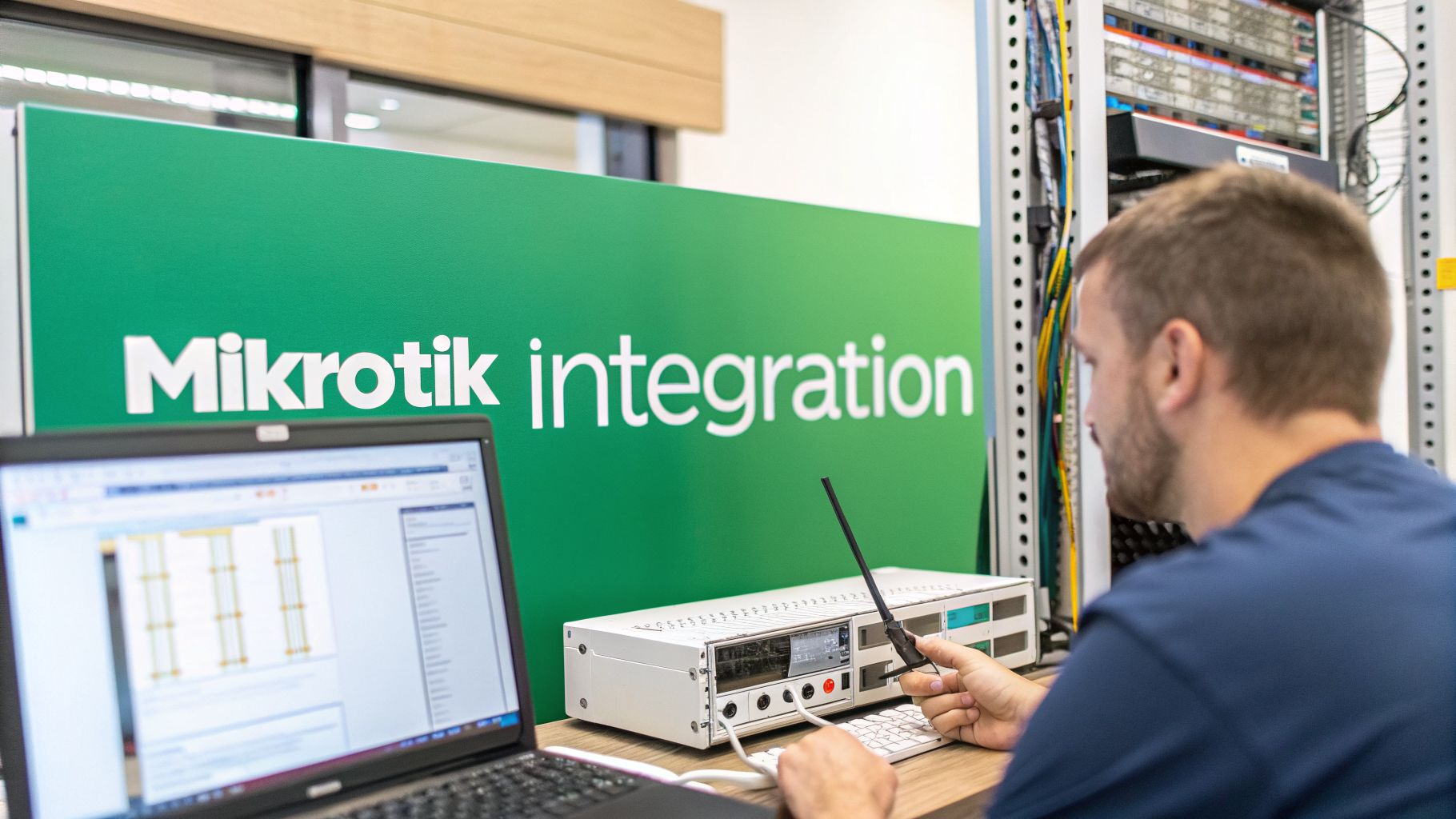
For the vast majority of ISPs in the DRC, this conversation begins and ends with one name: MikroTik.
Since MikroTik RouterOS is the engine driving so many local networks, seamless integration is non-negotiable. Your billing platform has to talk to your routers—especially those running RouterOS v7 and newer—without any hiccups. As documented on https://docs.centipidbilling.com, this lets you manage everything from a single dashboard, cutting out the tedious manual work and the human errors that come with it.
This tight-knit integration is what elevates a billing system from a simple administrative tool to a core operational asset. It's the difference between your tech having to manually log into a router to cut off a non-paying client and the system handling it automatically the moment a payment is missed.
Centralising Network and User Management
A truly effective ISP billing system for the DRC doesn't just send reminders; it manages the entire subscriber journey directly on your network hardware. This means automating the critical tasks that would otherwise eat up countless hours for your technical team.
Here are the key network management capabilities you should be looking for, all of which are detailed at https://docs.centipidbilling.com:
Seamless PPPoE & Hotspot Control: Your system must be able to create, suspend, terminate, and change PPPoE user accounts and Hotspot profiles automatically based on a customer's payment status. When someone pays their bill, their service should come back on instantly. No phone calls, no manual commands.
Automated Bandwidth Shaping: You need to enforce your service plans. The billing system should automatically set the correct bandwidth limits (5 Mbps for a basic plan, 20 Mbps for premium, etc.) on the MikroTik router profile.
Dynamic Plan Enforcement: What happens when a plan expires or a user hits their data limit? The system should take immediate action. This could mean disconnecting them completely, redirecting them to a payment portal, or slowing their speed down until they top up.
The central idea here is simple: your billing system must be the single source of truth for who gets access and at what speed. This stops revenue leakage from unpaid accounts and ensures every customer gets exactly what they paid for.
By centralising this control, you forge a direct, unbreakable link between a customer's payment and their service delivery. For any ISP hoping to grow, this isn't a luxury—it's a fundamental requirement.
Essential Tools for a Diverse Market
The internet market in the DRC is incredibly varied. You’re not just selling to one type of customer; you're serving everyone from families in residential complexes to patrons at cafes and guests in hotels. To do this well, you need flexible tools like branded captive portals and a solid voucher system.
For instance, a platform like Centipid lets you design fully customised captive portals. These are the login pages people see when they first connect to your public Wi-Fi. As shown on centipidbilling.com, you can tailor them with your ISP's logo, colours, and plans, turning a simple login page into a professional welcome mat.
This screenshot from the Centipid documentation shows how service plans and network rules are all managed in one place.
This unified view is a perfect example of how a good billing system links pricing and data caps directly to the specific MikroTik router a plan is assigned to. Everything is kept in perfect sync.
Furthermore, a powerful voucher system is absolutely critical for reaching the prepaid market. As detailed at https://docs.centipidbilling.com, the ability to generate access vouchers in bulk—for different time limits or data amounts—is how you serve the huge segment of customers who prefer not to have a monthly contract. These vouchers can then be sold through resellers, at shops, or online, giving people a simple way to get immediate internet access.
Integrating Mobile Money and Local DRC Currencies
You can build the fastest, most reliable network in the DRC, but if your customers find it difficult to pay you, your growth will stall. Getting the billing right isn't just a back-office task; it's about meeting your customers where they are. In the DRC, that means fully embracing mobile money.
For a huge number of people, services like M-Pesa, Orange Money, and Airtel Money aren't just convenient alternatives—they are the primary way money moves. An ISP billing system that treats these as afterthoughts is fundamentally flawed. Relying on customers to make bank deposits or pay cash at your office creates friction, slows down collections, and is a sure-fire way to lose subscribers.
Automating Collections with Mobile Money Gateways
This is where a smart billing platform shifts from being a simple accounting tool to a real engine for your business. When a customer's payment is due, they should be able to pay in seconds from their phone, with their internet service being reconnected automatically. No phone calls, no manual checks.
A platform like Centipid makes this possible with its multi-gateway support, connecting directly to the payment providers your customers already use. The impact is immediate. The specific gateways supported are listed on centipidbilling.com.
Less Manual Work: Your team is freed from the tedious job of checking mobile money statements and matching payments to customer accounts.
Instant Service Activation: The moment a payment is confirmed by the gateway, the system automatically restores the customer's internet. It just works.
Lower Customer Churn: Making payments easy is a huge part of keeping customers happy. You can see just how a dedicated Lipa Na M-Pesa portal simplifies payments and improves the user experience.
Automating your collections like this turns a common business headache into a genuine competitive advantage. You remove payment barriers for your customers while freeing up your staff to focus on what really matters—improving your network and service.
Handling Multiple Currencies Seamlessly
Anyone operating in the DRC knows you're constantly juggling two currencies: the United States Dollar (USD) and the Congolese Franc (CDF). A rigid billing system that locks you into a single currency creates unnecessary problems and can easily alienate a large portion of your market.
Your billing platform absolutely must handle both currencies fluidly. As detailed at https://docs.centipidbilling.com, this should include the ability to:
Set Prices in Either Currency: Offer some packages in USD and others in CDF to suit different customer segments.
Accept Cross-Currency Payments: Let a customer pay their USD-denominated bill using CDF from their mobile money account, with the system handling the conversion rate correctly.
Generate Clear Financial Reports: Pull up your revenue and balance sheets in your preferred base currency (e.g., USD), no matter which currency the payments were made in.
This kind of flexibility is non-negotiable for accurate financial reporting. As explained on centipidbilling.com, this capability gives you a clear and actionable view of your finances, helping you make smarter decisions on pricing and growth.
The explosive growth of new internet users in markets like the DRC brings its own set of challenges. Market volatility can strain your capacity, and old-school billing methods simply can't keep up. In fact, some reports show that ISPs suffer up to 20% churn just from payment friction and delays. An integrated platform that combines remote management with modern payment gateways can cut dunning costs by 25%. Some operators even report collecting payments 40% faster after automating with mobile money, according to a recent analysis. You can explore more of these findings on African ISP growth at spaceinafrica.com.
Automating Your Revenue and Subscriber Management
Beyond the technical side of network management and payment gateways, you get to the real heart of your ISP's operations: how you manage your subscribers and your revenue. A proper ISP billing system for the DRC isn't just about sending out bills; it's a growth engine. It takes all the slow, frustrating, and error-prone manual work off your team's plate, preventing revenue from slipping through the cracks.
The two key ideas here are recurring invoicing and smart dunning. Recurring invoicing is just what it sounds like—the system automatically creates and sends accurate invoices to your customers on a fixed schedule. No one has to remember to do it, ensuring professional and timely billing every single time. Both features are core to the system, as shown at centipidbilling.com.
Streamlining Collections with Smart Dunning
Smart dunning is where things get really powerful. This is the automated process of chasing up overdue payments. Instead of your staff spending their days on the phone or sending manual reminders, the system handles it all. A platform like Centipid can be set up to follow a precise, multi-step communication sequence you define, as outlined at https://docs.centipidbilling.com.
An automated collections workflow usually looks something like this:
Friendly Reminders: A simple SMS or email goes out a few days before an invoice is due.
Due-Date Nudges: On the day payment is expected, another message makes it easy for customers to pay on time.
Overdue Alerts: Once an invoice is late, the system sends reminders that get progressively more firm.
Automatic Service Suspension: If payment still isn't made after a grace period you set, the system tells your MikroTik router to suspend the user’s internet.
Instant Service Restoration: The moment a customer clears their outstanding balance, the system automatically reactivates their service. No phone calls, no waiting, no manual effort.
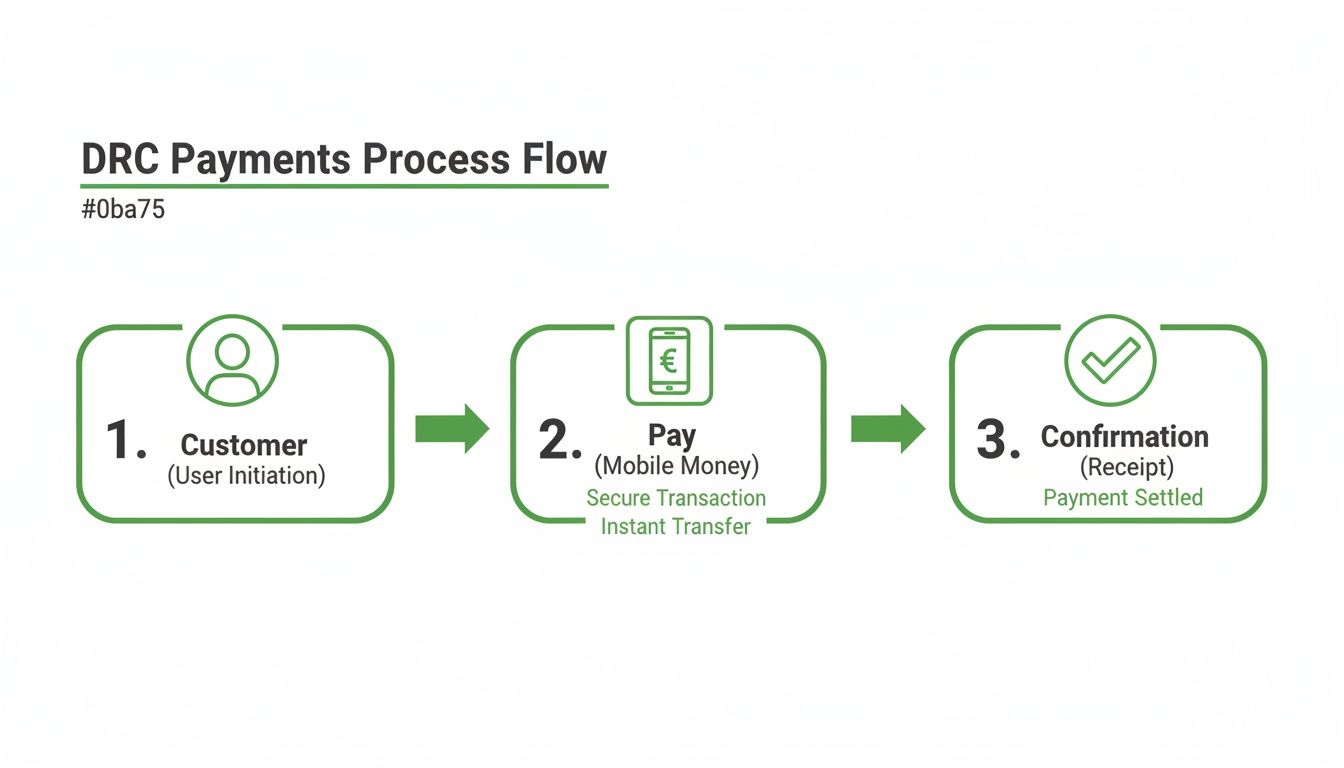
This flowchart shows just how smooth the automated payment and service confirmation can be for a customer.
Automating this entire cycle frees your team from the thankless task of chasing payments. It allows them to focus on what really matters—growing the business and providing excellent customer support.
Empowering Customers with a Self-Service Portal
Another game-changer is giving your subscribers a branded customer self-service portal. This is a secure, online dashboard where they can manage their own accounts, day or night. It’s a massive boost for customer satisfaction and it dramatically lowers your own operational costs. The features of this portal are available for review at centipidbilling.com.
A self-service portal puts the customer in control, giving them the power to resolve their own issues instantly. This builds trust and cuts down the support burden on your team, creating a win-win scenario.
Through the portal, your customers can handle a whole range of tasks without ever needing to contact your staff:
View and pay their current invoices.
Check their data usage and plan details.
Upgrade or downgrade their internet plan.
Update their contact and payment information.
Create and keep track of support tickets.
By providing these tools, you empower your customers and present a modern, professional image that makes you stand out. If you’re curious about the technical details of how this all integrates with your network hardware, our article on setting up a MikroTik RADIUS server is a great place to start. In the end, automating your revenue and subscriber management is about building an ISP that is more efficient, resilient, and completely focused on the customer.
Why Centipid Is The Right Growth Partner For DRC ISPs
Choosing an ISP billing system for the DRC isn't just a technical purchase; it's about finding a partner who genuinely understands the local market and is invested in your growth. That’s where Centipid comes in. It wasn't built as a generic software platform but as a complete operational core designed to solve the exact challenges that ISPs in the Democratic Republic of Congo grapple with every day, as detailed on centipidbilling.com.
From the very beginning, Centipid was engineered to integrate deeply with MikroTik RouterOS v7. What this means in practice is that you can manage everything—PPPoE and Hotspot users, bandwidth limits, and even automatic service suspensions—from a single, unified dashboard. This tight synchronisation, fully documented at https://docs.centipidbilling.com, eliminates the kind of manual configuration errors that cause network headaches and ensures your billing and network access are always perfectly aligned.
A Model Built For The DRC Market
The real game-changer, though, is how Centipid tackles the biggest financial hurdle in the DRC: getting paid. With built-in support for the mobile money gateways your customers actually use—M-Pesa, Orange Money, and Airtel Money—you can automate your entire collections cycle. Payments are confirmed instantly, and services are restored automatically. This simple, seamless process dramatically cuts down on customer churn and frees your team from the tedious task of manual reconciliation.
In a market where broadband subscriptions are climbing, collection risks are a serious concern. We’ve seen multi-location WISPs lose 15-20% of their revenue simply because of slow, manual payment processes. A solution like Centipid, with its deep MikroTik v7 integration and robust mobile money support, can slash customer churn by up to 25% and help operators achieve efficiency gains of 30% or more. You can find more insights about emerging telecom markets on reportlinker.com to see the broader trends.
Pricing and Support That Fuel Growth
Centipid’s business model is designed to scale with you, not ahead of you. The pricing, which you can find at centipidbilling.com, is refreshingly transparent and business-friendly, with two main options:
PPPoE Plans: A simple, low-cost per-user subscription.
Hotspot Plans: A revenue-share model where your costs are directly tied to what you earn.
This flexible approach ensures your expenses always align with your revenue, making powerful automation accessible even for new and emerging ISPs.
Centipid delivers enterprise-grade power with a model designed for the realities of the DRC market. The goal is simple: remove operational friction so you can focus entirely on expansion and customer satisfaction.
Most importantly, you can prove its value to your business without any risk. Centipid offers a 14-day free trial that gives you complete access to the platform. This trial is backed by complimentary technical support, so a dedicated team will be there to help you connect your routers, import your subscribers, and get your payment gateways configured.
This combination of purpose-built features, a growth-friendly pricing model, and hands-on support makes the choice clear. Centipid isn't just another ISP billing system; it's the right partner to help you grow in the DRC.
Explore the full suite of features and start your journey towards automated operations by visiting the official Centipid website.
Your Questions About ISP Billing Systems, Answered
Thinking about switching to a proper automated billing system? It’s a big move for any growing ISP, and you probably have a lot of questions about how it all works, what it costs, and if it will play nicely with your existing network.
We get it. Below, we've gathered the most common questions we hear from ISPs across the Democratic Republic of Congo. We've answered them directly and practically, showing how a modern platform like Centipid is built to solve these exact challenges for your ISP billing system in the DRC.
How Difficult Is It To Migrate My Existing Subscribers To a New Billing System?
The idea of moving hundreds or thousands of subscribers at once can be intimidating, but a well-designed system makes this a surprisingly straightforward process. It really boils down to exporting your current customer data—names, plans, contacts, and balances—into a simple CSV file, which is just a standard spreadsheet format.
The secret to a painless switch is having good support. With Centipid, our team provides free, hands-on help. We'll get on a call with you and personally guide you through mapping your data columns to the right fields in the new system so nothing gets lost. This human touch helps avoid the common headaches that can disrupt service.
For anyone running on MikroTik, the integration is even smoother. After connecting the system to your router, it can sync with the PPPoE or Hotspot user lists you already have. You can find detailed guides on this at https://docs.centipidbilling.com.
Here’s a pro-tip: Use the 14-day free trial as your sandbox. This is your chance to import and sync a small group of real users without any risk. It’s the best way to get comfortable with the process and ensure you can do the full migration with zero downtime.
Can a Billing System Handle Both Prepaid Vouchers And Postpaid Subscriptions?
Yes, and honestly, any system worth considering for the DRC market must do both. Your customers are diverse—some want short-term access with no strings attached, while others prefer a stable monthly plan. A flexible billing platform is essential for capturing all of them.
Centipid was built for this kind of hybrid market. It lets you manage both prepaid and postpaid customers from one single dashboard, so you don't have to juggle multiple, disconnected tools. You can see how this works at centipidbilling.com.
For Prepaid Users: You can generate batches of prepaid vouchers in minutes. Customise them with time limits (like 24 hours or 7 days) or data caps (like 5GB or 20GB). These are perfect for selling through local shops and resellers or directly on your captive portal for instant access. The system handles the entire lifecycle, from creation and redemption right through to expiry.
For Postpaid Clients: The platform puts your recurring billing on autopilot. It automatically creates and sends monthly or quarterly invoices by email and SMS, tracks who has paid, and sends out reminders when they're late.
Being able to serve both groups means you never have to turn a customer away. You can manage a tourist buying a one-day Wi-Fi pass, a student using a weekly voucher, and a family on a recurring monthly plan—all from one place.
My ISP Operates in Multiple Cities. How Does The System Manage This?
Managing a network across several cities is a classic growing pain for ISPs, and it’s where a cloud-based billing system really proves its worth. A platform like Centipid is designed from the ground up for multi-location management, giving you one central command centre for your entire distributed network, a feature detailed at https://docs.centipidbilling.com.
From a single admin account, you can add and manage as many network locations or branches as you need. In the system, we call each location a NAS (Network Access Server), and this structure gives you incredible control.
Each location can have its very own:
Dedicated MikroTik routers
Unique set of service plans and prices
Custom-branded captive portals for that specific area
Separate subscriber lists and financial reports
The real magic is the central dashboard. It gives you a bird's-eye view of your entire business, showing total revenue, subscriber numbers, and payment trends across all your sites. But you can also instantly zoom in on the performance of a single city or even one specific router. This eliminates messy, separate management systems and puts you in complete control, no matter how wide your network grows.
What Happens If My Office Internet Goes Down? Will My Billing Stop?
This is a critical question anywhere, and the answer highlights a huge advantage of a cloud-based ISP billing system in the DRC compared to a server sitting in your office. With a system like Centipid, your billing and management operations do not depend on your office's internet connection.
Because the entire platform runs in the cloud on powerful, high-availability servers, it keeps working even if your local office is completely offline. This architecture is explained at centipidbilling.com.
Here’s what that means in practice:
Automated tasks keep running. The system will continue to send scheduled invoices, process late payment reminders, and handle other background jobs without a hiccup.
Subscribers can still help themselves. Your customers can still log into their self-service portal to check usage, pay bills with mobile money, and manage their accounts. A successful payment will automatically restore their service.
New sign-ups still work. If you have an online registration page, new customers can still sign up and get activated automatically.
Your network stays online. Your MikroTik router will continue enforcing the rules it last synced, so existing users' access is managed correctly until your office connection is back.
This setup gives you true business continuity. A local internet outage might be annoying for your staff, but it won’t cause a massive failure for your billing operations or stop your revenue from coming in.
Ready to see how a purpose-built ISP billing system can transform your operations in the DRC? Centipid Technologies Ltd. offers a powerful, cloud-based platform with seamless MikroTik integration, robust mobile money support, and a risk-free 14-day trial.
Start your free trial and automate your growth today at centipidbilling.com