Finding the Best Billing System for Wireless ISPs in 2026
Discover the best billing system for wireless ISPs in our 2026 comparison. We evaluate WISP software for MikroTik automation, growth, and profitability.
When we talk about the best billing system for wireless ISPs, we're not talking about just any invoicing software. We're talking about a specialised platform built to automate how you collect revenue and integrate directly with your network hardware, like MikroTik. Unlike generic accounting tools, a purpose-built WISP system ties everything together—from recurring invoices and payment reconciliation to subscriber access—plugging the revenue leaks and operational drag that stop you from growing.
Why Generic Billing Fails Modern WISPs

For any growing WISP, trying to manage operations with generic accounting software or spreadsheets is a recipe for failure. It’s like trying to direct motorway traffic with a pen and paper. While these tools can track basic income and expenses, they're completely blind to the most critical part of your business: the network itself.
This fundamental disconnect creates massive operational headaches and financial blind spots.
A WISP’s profitability lives and dies by its ability to link payments directly to service access. It's a simple contract: when a customer pays, their internet works. When they don't, it shouldn't. Generic systems just can't enforce this rule automatically.
The Widening Gap Between Accounting and Network Management
At its core, the failure of generic systems is their inability to speak the same language as your network hardware. An accounting tool can send an invoice, but it can’t actually do anything to enforce payment. This is where the manual, time-sucking work begins.
This forces WISP operators into a painful, inefficient cycle:
Constant Manual Intervention: Your technicians have to manually log into routers to suspend non-paying clients. Then, once a payment comes through, they have to log back in to reactivate the service. This isn't just a waste of skilled time; it's a process loaded with the risk of human error, like accidentally disconnecting a loyal, paying customer.
Chaotic Revenue Collection: Without automated dunning—the process of chasing late payments—collecting what you're owed becomes a messy and inconsistent chore. This leads to serious revenue leakage. In fact, some industry estimates suggest that inefficient billing can cost a provider up to 15-20% in uncollected payments.
Zero Real-Time Subscriber Control: Generic software can't manage PPPoE sessions or control hotspot user access. This means it can’t automatically enforce bandwidth policies, apply fair usage caps, or manage voucher-based access for your public Wi-Fi hotspots. You can get a better sense of how this works in our guide on deep MikroTik integration.
For a WISP, billing isn't a separate function—it's completely intertwined with network management. A system that can't handle both creates an operational bottleneck that makes sustainable growth feel almost impossible. It keeps you stuck in a reactive, manual loop when the industry demands automation.
The difference in capability is night and day.
Operational Need | Generic Accounting Software | Specialised ISP System (e.g., Centipid) |
|---|---|---|
Network Integration | None. It's completely walled off from your routers. | Direct API integration with MikroTik for full automation. |
Access Control | Manual, error-prone suspensions and reconnections. | Fully automated service suspension based on payment status. |
Recurring Billing | Basic subscription features, if any at all. | Advanced recurring invoicing with smart, automated dunning. |
Scalability | Poor. The manual work multiplies with every new subscriber. | High. Built from the ground up to manage thousands of users. |
In the end, generic solutions treat a WISP like any other small business, completely missing the high-stakes connection between a payment and a live connection. This isn't just an inconvenience; it’s a strategic flaw that cripples your ability to scale, drains your resources, and leaves a significant amount of money on the table.
Core Features of a WISP-Specific Billing Platform
So, what’s the real difference between a basic invoicing tool and a platform that can actually grow your WISP? While any generic software can spit out an invoice, a billing system built for wireless ISPs is engineered to automate the entire subscriber journey, tying payments directly to network access. These aren't just "nice-to-have" features; they're the absolute essentials for running a modern WISP.
A purpose-built platform understands the unique operational DNA of an internet provider. It gets that billing and network management are two sides of the same coin. This deep-seated connection is what stops revenue leakage, slashes manual admin, and gives your business the foundation it needs to scale.
Deep MikroTik RouterOS Integration
For any WISP, the single most critical feature is a deep, two-way integration with your network hardware, especially MikroTik RouterOS. Your billing system can't just be about sending bills; it has to understand and control the underlying advanced network infrastructure management. This isn’t a simple on/off switch—it’s about complete automation.
A proper integration gives the billing system the power to:
Automate PPPoE & Hotspot Management: When a new subscriber signs up and pays, their PPPoE account or hotspot access is created on the router instantly. No manual setup needed.
Enforce Service Plans: Bandwidth limits, data caps, and fair usage policies are automatically applied and updated based on the customer's package.
Control Access Dynamically: If a payment is missed, the system automatically suspends the service. The moment payment comes through, access is restored. This alone ends countless late-night support calls.
A billing platform that doesn't talk directly to your routers is little more than an accounting tool. True WISP billing software acts as the central brain of your operation, making real-time network decisions based on financial data.
Automated Recurring Invoicing and Smart Dunning
Chasing down late payments is a massive drain on your time and a major source of lost revenue. A top-tier system completely automates this, turning collections into a predictable, hands-off workflow. The magic behind this is a process called smart dunning.
This is a sequence of automated actions designed to get you paid without you lifting a finger. It starts with sending scheduled recurring invoices, then follows up with polite but firm reminders via SMS or email if a payment is overdue. If the bill still isn't paid after a set grace period, the system triggers the MikroTik integration to suspend the service until the account is settled.
Localised Payment Gateway Support
In a market like Kenya, you absolutely have to let customers pay the way they want to. Any system built for the region must have native support for mobile money gateways. This is more than just a simple connection; it means full support for features like STK Push, which sends a payment request directly to a customer's phone for easy approval.
This is a critical point. With the goal of deploying 25,000 public Wi-Fi hotspots in Kenya by 2025, the demand for specialised billing systems has exploded. Many smaller operators get bogged down by voucher management and multi-currency invoicing, where manual errors lead to 12-18% churn rates. A purpose-built system like Centipid solves this by integrating with RouterOS for hotspot and PPPoE, allowing for remote device management, bandwidth throttling, and automated payments via mobile money—a must-have feature with over 18 million users now relying on digital payments.
This screenshot from Centipid's documentation shows exactly how service plans can be configured to link directly to network rules. You can clearly see the fields for download/upload speeds and pricing, showing how the platform translates a commercial offer into a technical command for the router.
Branded Self-Service Subscriber Portal
Giving your customers control is one of the best ways to lighten your support load. A branded self-service portal lets subscribers manage their own accounts, which does wonders for customer satisfaction. From their portal, users should be able to:
View and download their current and past invoices.
Pay their bills instantly through integrated gateways.
Upgrade or downgrade their service plan.
Check their data usage in real-time.
By offering these tools, you drastically cut down on routine support tickets. This frees up your team to focus on more complex network issues and actually growing the business. For a deeper dive into streamlining your operations, you might find our guide on ISP billing software useful.
Comparing WISP Billing Solutions Head-to-Head
Choosing the right billing system for your WISP isn't just an IT decision—it directly shapes your cash flow, customer satisfaction, and ability to grow. To make a smart choice, you need to look past the sales pitches and compare the common approaches: manual spreadsheets, generic subscription software, and a purpose-built ISP billing platform.
Each of these has its place, but only one is truly designed for the unique grind of running a WISP. Let's put them side-by-side and see how they stack up against the challenges you face every day, from network integration to automated collections.
This flowchart maps out the essential logic. As you’ll see, the need for deep network automation and integrated payments always points toward a specialised solution.
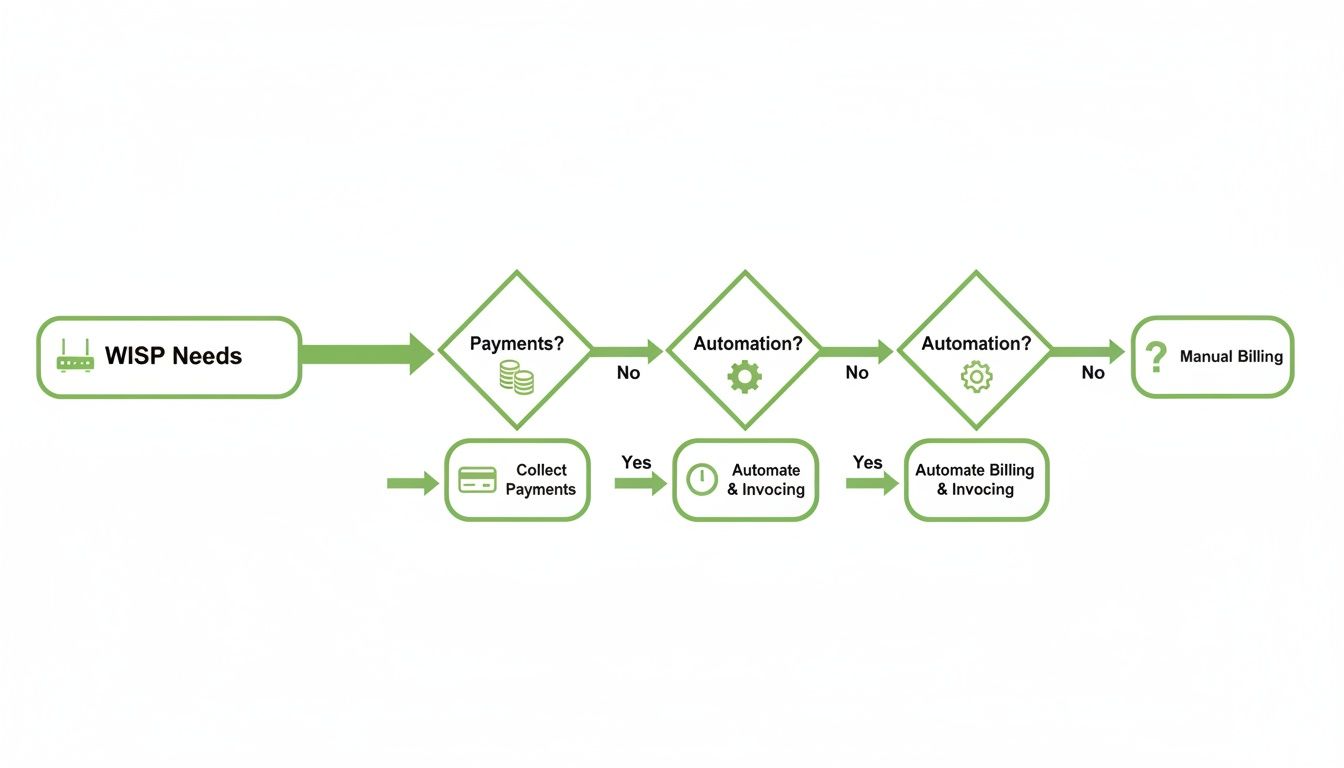
The bottom line is clear: when your billing and network don't talk to each other, you're leaving money on the table.
The Manual Spreadsheet Method
When you're just starting out with a handful of customers, using a spreadsheet to track payments feels simple and free. It's basically a digital ledger showing who has paid and who is late.
This method, however, crumbles under the slightest pressure of growth. There is zero automation. Every single invoice, payment reminder, and service change has to be done by hand. Worse, your spreadsheet is completely disconnected from your network gear. This means a technician has to manually log into your MikroTik router to suspend or reconnect a customer—a tedious process that’s a recipe for human error and revenue leaks.
Generic Subscription Software
Moving up from spreadsheets, you'll find generic subscription software. These platforms are great at one thing: automated recurring invoicing. They're built for all sorts of businesses, from software companies to online magazines, and handle monthly billing cycles well.
The problem is, they are still fundamentally disconnected from your network. They can track that a customer's subscription is active, but they can't enforce it. The system can send a bill, but it has no power to cut off internet access for someone who doesn't pay. You're still stuck with the manual, soul-crushing task of managing network access yourself, which defeats the whole point of automation for a WISP.
Specialised ISP Billing Systems
This is where platforms built specifically for ISPs, like Centipid, change the game. A specialised system is engineered from the ground up to manage the entire lifecycle of a WISP subscriber, from billing to service delivery. Its superpower is the deep, two-way integration with network hardware like MikroTik routers.
This integration isn't just another feature; it's the central nervous system of your entire operation. When a payment comes in, the billing system tells the router to grant access. When a customer misses a payment, it automatically suspends their service. This direct link between billing and your network eliminates manual work, seals up revenue leaks, and guarantees that only paying customers are using your bandwidth.
The fundamental difference is this: a specialised system doesn't just manage subscriptions; it manages subscribers. It connects an account's financial status directly to the delivery of the service—something neither spreadsheets nor generic tools can ever do.
The explosive growth in markets like Kenya shows why this automation is so critical. Kenya’s fixed broadband market recently saw subscriber numbers jump by 147,150 in just three months. A manual billing process simply can't keep up, leading to massive revenue leakage—some estimates show inefficient systems cause up to 15-20% in uncollected payments. A platform like the Centipid ISP Billing System is designed to fix this. By automating recurring invoices and using smart dunning, it can help recover up to 25% more revenue. You can read more about this market growth on Tuko.co.ke.
When weighing your options, don't forget to look at the overall associated costs, including things like managing payment disputes. A system that automates collections and keeps accurate records can save you a fortune in these secondary expenses.
WISP Billing Solutions A Feature-by-Feature Comparison
Let's break down how each approach handles the core operational needs of a modern WISP. The table below cuts through the noise and shows you exactly what you get—and what you don't.
Core Feature | Manual Spreadsheet Method | Generic Subscription Software | Specialised ISP System (e.g., Centipid) |
|---|---|---|---|
MikroTik Integration | None. Requires 100% manual router configuration for every subscriber action. | None. Cannot communicate with network hardware to control access. | Deep & Automated. Directly controls PPPoE and hotspot users via API for real-time access management. |
Automated Dunning | Non-existent. All payment chasing is a manual, inconsistent process. | Basic. Can send automated payment reminders but cannot enforce them. | Smart & Effective. Sends reminders and automatically suspends service for non-payment. |
Subscriber Self-Service | Impossible. Customers must call or message for every query or payment. | Limited. May offer a portal for billing but lacks service management features. | Fully-Featured. Provides a branded portal for payments, plan changes, and usage monitoring. |
Scalability | Extremely Low. The workload multiplies with each new subscriber, creating a growth bottleneck. | Moderate. Scales for billing but the manual network tasks become unmanageable. | High. Built to automate operations for thousands of subscribers with minimal staff. |
Localised Payments | Manual Reconciliation. Requires checking M-Pesa statements or texts one by one. | Often Limited. May require costly custom development for mobile money gateways. | Native Support. Built-in integration for mobile money like M-Pesa with STK Push. |
In the end, spreadsheets and generic software might look cheaper upfront, but they introduce massive hidden costs through lost revenue, wasted staff time, and frustrated customers. For any serious WISP focused on building a scalable, profitable business, the return on investment from a specialised system is undeniable.
Real-World Scenarios Where Specialised Systems Win
A feature list is one thing, but solving the messy, day-to-day problems of running a WISP is another entirely. This is where the true value of a purpose-built billing system comes into sharp focus. Generic software just can't keep up with the operational demands modern WISPs face.
Let's step away from simple feature comparisons for a moment. Instead, we'll walk through three common situations where a specialised system like Centipid doesn't just help—it completely changes the game. These are real-world examples of turning operational headaches into genuine opportunities for growth.
Scenario 1: The Expanding Multi-Location WISP
Picture this: your WISP has successfully captured its home market and is ready to expand into three nearby towns. Suddenly, the operational complexity explodes. Each town has its own competitors and customer expectations, demanding different service plans and pricing structures.
If you’re using generic software, you’re likely stuck juggling separate spreadsheets or even different software accounts for each location. It’s a reporting nightmare. Getting a single, clear view of your entire business is impossible, and your technicians are left to manually manage multiple, disconnected MikroTik routers.
How a Specialised System Wins
A platform like Centipid was designed from the ground up for multi-location management. From one central dashboard, you can:
Set up location-specific service plans: Easily offer a KES 2,500 plan in one town and a KES 3,000 plan in another, all managed from a single account.
Assign routers to specific branches: Your technical team can manage network devices for each town without any confusion, ensuring the right policies are applied to the right customers.
Generate unified reports: As the owner, you get a clean, consolidated view of revenue, subscribers, and collections across every location, empowering you to make smarter strategic moves.
This kind of centralised control transforms a logistical mess into a smooth, scalable operation. It’s a huge time-saver, a fact that many of our 1,000+ ISP partners in Uganda can attest to.
Scenario 2: The Busy Urban Hotspot Operator
Now, think about an operator managing Wi-Fi hotspots in high-traffic places like cafes, bus stations, or student hostels. The customer base is transient, needing flexible, short-term internet access. Trying to manually create and track hundreds of unique login codes isn't just inefficient—it's practically impossible to do well.
On top of that, you need a professional, branded login experience and a simple way for users to pay for access right then and there. A generic subscription tool is useless here; it has no concept of voucher generation, captive portals, or on-the-spot payments.
The core challenge for a hotspot operator is automating the entire transient user journey, from discovery and payment to access and expiration. A specialised system is designed to manage this specific workflow effortlessly.
How a Specialised System Wins
This is exactly where a purpose-built hotspot billing system shines. With a platform like Centipid, the operator can:
Automate voucher generation: Create batches of hundreds or thousands of unique vouchers for different durations (e.g., 1 hour, 1 day, 1 week) in just a few clicks.
Deploy a branded captive portal: Greet users with a professional login page that shows off your brand, runs promotions, and gives clear instructions for getting online.
Integrate on-demand payments: Let users buy access directly through the portal with mobile money, turning every single hotspot into a self-service revenue machine.
This level of automation takes a chaotic, manual process and transforms it into a smooth, professional, and far more profitable business model.
Scenario 3: The Growing Community Network
Finally, imagine a community-focused WISP in a region where mobile money is king. Their mission is to provide affordable, reliable internet, but collecting payments is a constant struggle. Manually checking M-Pesa SMS notifications to reconcile payments is painfully slow, full of errors, and creates delays in getting customers online.
As the WISP grows, this manual reconciliation becomes a massive bottleneck, directly hurting cash flow and customer satisfaction. The Kenyan telecom market, set to be worth USD 3.79 billion by 2025, is booming thanks to massive data demand. Yet, many smaller WISPs are held back by payment friction—some reports estimate that billing inefficiencies cost them 10-15% of their monthly revenue. Centipid tackles this head-on with deep MikroTik integration and automated payment gateways, helping operators capture their full revenue potential in a market with 18 million active mobile money users. You can explore the full report on Kenya's telecom industry here.
How a Specialised System Wins
The best billing system for a WISP in this situation is one that understands and automates local payment habits. With a system that has native mobile money integration, the WISP can:
Automate M-Pesa reconciliation: When a customer pays via STK Push or PayBill, the system automatically detects it, matches the payment to the correct subscriber account, and logs it. No manual work needed.
Enable instant service activation: The moment a payment is confirmed, the system talks directly to the MikroTik router to instantly activate or restore the customer's internet connection.
This seamless link between payment and service delivery completely removes the collections bottleneck, boosts cash flow, and gives customers the professional, instant experience they expect.
Your Step-by-Step Implementation and Migration Guide
Moving to a new billing system can feel like a huge, risky project. But with a clear plan, you can take the stress out of the process and avoid disrupting your service. The real goal here is a smooth switch that not only protects your revenue but actually improves how you run your business.
This isn't about flipping a switch and hoping for the best. It's a careful, phased approach designed to remove the risk. By following these steps, you can confidently upgrade to a more powerful, automated platform and turn a potential headache into a genuine asset for your WISP.
Phase 1: Pre-Migration Preparation
Before you touch a single customer account, solid preparation is key. This whole stage is about getting your existing data in order and getting to know the new system's environment. Honestly, taking the time to get this right sidesteps the vast majority of migration problems down the road.
First, consolidate and clean your subscriber data. Get your customer lists out of whatever spreadsheets or old system you're using and export them into a clean CSV file. Make sure every bit of critical info—names, contacts, current plans, and any outstanding balances—is there and formatted correctly. This clean data is the bedrock of a smooth migration.
Next, get your hands dirty with a trial.
A free trial is your migration sandbox. Centipid offers a 14-day free trial, which is the perfect chance to run through the whole process with a few test accounts. This lets you familiarise yourself with the dashboard and sort out any kinks before it affects paying subscribers.
Finally, get your network hardware ready. Check that your MikroTik routers are running a compatible version of RouterOS and have your API credentials handy. It's crucial to understand how the new system will talk to your network. If you want a deeper look at this connection, our article on setting up a MikroTik RADIUS server is an excellent resource.
Phase 2: System Configuration and Data Import
With your data prepped and clean, it's time to set up the new platform so it reflects how your business actually works. This means building out the core components that make your WISP tick.
Configure Service Plans: Start by re-creating all your internet packages in the new system. You'll need to define the names, prices, and—most importantly—the specific bandwidth limits (upload/download speeds) that will be enforced on your MikroTik routers.
Set Up Payment Gateways: Connect your payment processors. This is especially important for local mobile money services like M-Pesa. Getting this right ensures that when a subscriber pays, the system can automatically log the payment and update their account without you lifting a finger.
Import Subscriber Data: Now, upload that clean CSV file you prepared earlier. A good platform will help you map the columns from your file to the right fields in its database, making the transfer of customer information painless. It's always a good idea to spot-check a few imported accounts just to confirm everything landed in the right place.
Phase 3: Phased Rollout and Go-Live
The final piece of the puzzle is the transition itself, and the key here is to do it gradually. A "big bang" cutover where everyone is switched at once is a recipe for chaos. A phased rollout is always the smarter move.
Start small. Migrate a handful of friendly customers—or even just your own internal staff accounts—onto the new system first. Let them run on it for a few days. This is your chance to watch the automated billing cycles, verify payments are processed correctly, and see that the MikroTik integration is handling suspensions and reconnections just as you expect.
Once you’re confident that everything is running perfectly, you can start moving the rest of your subscribers over in manageable batches. This controlled method means that if any unexpected issue pops up, it only affects a small group and can be fixed quickly. With solid technical support backing you up, you have a partner to guide you through each step, making sure your move to the best billing system for wireless ISPs is a complete success.
Frequently Asked Questions About WISP Billing Systems
Picking the right billing system for your wireless ISP is a big decision, and it’s normal to have a lot of questions. Getting straight answers is the only way to choose a platform that will actually support your operations, improve cash flow, and help you grow.
This section tackles the most common queries we hear from WISP operators. We'll cover everything from the nuts and bolts of technical integrations and security to the practical side of migrating customers and managing payments.
How Does a Specialised Billing System Integrate with MikroTik?
A purpose-built system like Centipid talks directly to your routers using the MikroTik RouterOS API. Think of it as a real-time, two-way conversation that lets the billing platform manage network access based on who has paid.
When a customer pays their bill, their PPPoE account or hotspot access is instantly activated on the router. If they miss a payment, the system can automatically suspend their service or apply a slower speed policy without anyone on your team having to lift a finger. You can find detailed guides on this setup over at https://docs.centipidbilling.com.
This deep integration is what separates a true WISP platform from generic accounting software. It automates the entire subscriber journey and, most importantly, ensures only paying customers are using your network.
Can I Migrate Existing Subscribers Without Service Interruption?
Yes, absolutely. A smooth migration with zero downtime is achievable if you take a careful, phased approach instead of trying to move everyone over in one go.
The process usually starts by exporting your subscriber data into a clean, simple format. Platforms like Centipid have tools and support staff ready to help you import this information correctly. From there, you can run the new system alongside your old one for a short period to double-check that everything—from data to billing cycles—is spot on.
The best way to guarantee a seamless switch is to use a free trial period to run a full test. Move a small, controlled group of customers first. This lets you work out any kinks in the process before migrating your entire base, ensuring no one loses their connection.
The final step is pointing your MikroTik routers to the new billing system’s RADIUS server for authentication. This can easily be scheduled during a late-night maintenance window when network traffic is at its lowest.
What Is Smart Dunning and Why Is It Critical for a WISP?
Smart dunning is just an automated way of chasing late payments. Instead of your team spending hours making phone calls, the system automatically sends a series of reminders via SMS or email when a bill is overdue.
If a customer still doesn't pay after the reminders, the system takes the next step by enforcing your network rules. This could mean redirecting them to a payment portal, slowing their internet speed down, or temporarily suspending their account until the balance is settled.
For any WISP, this isn't a "nice-to-have"—it's essential for cutting revenue loss and creating predictable cash flow. It makes the collections process professional and consistent, freeing up your team to focus on growing the business, not chasing debt.
How Secure Is a Cloud-Based Billing System?
A reputable cloud-based platform is almost always more secure than an on-premise server a small WISP could manage themselves. These systems are built with multiple layers of security, including end-to-end data encryption, strict access controls for your staff, and regular independent security audits.
Specialised cloud providers have entire teams dedicated to platform security, compliance, and preventing threats. This focus ensures your business and customer data is safe from hardware failure, data breaches, and other local risks.
Furthermore, solutions like Centipid include automated backups and have disaster recovery plans already in place. This protects your operational data and ensures you can keep running your business even if your local office has a major technical issue. Always ask a potential provider to be transparent about their security and compliance standards.
Ready to transform your WISP operations with a system built for growth? With deep MikroTik integration, automated M-Pesa payments, and powerful subscriber management tools, Centipid Technologies Ltd. gives you the control you need to scale profitably. Start your free 14-day trial and see the difference automation can make.
Explore the platform and begin your migration today at https://centipidbilling.com.