A Guide to ISP Billing System Ghana for 2026
Discover the best ISP billing system Ghana offers. This 2026 guide shows ISPs how to automate MikroTik, integrate mobile money, and boost efficiency.

An effective ISP billing system in Ghana is so much more than a replacement for spreadsheets. Think of it as the central nervous system of your operation—a platform that automates payments, manages your subscribers, and controls network access without you lifting a finger. It’s not just another business expense; it’s a strategic investment that plugs directly into your network hardware (like MikroTik) and integrates with essential local payment methods like Mobile Money to finally stabilise your cash flow and pave the way for real growth.
Why Your ISP Needs to Ditch Spreadsheets for Good
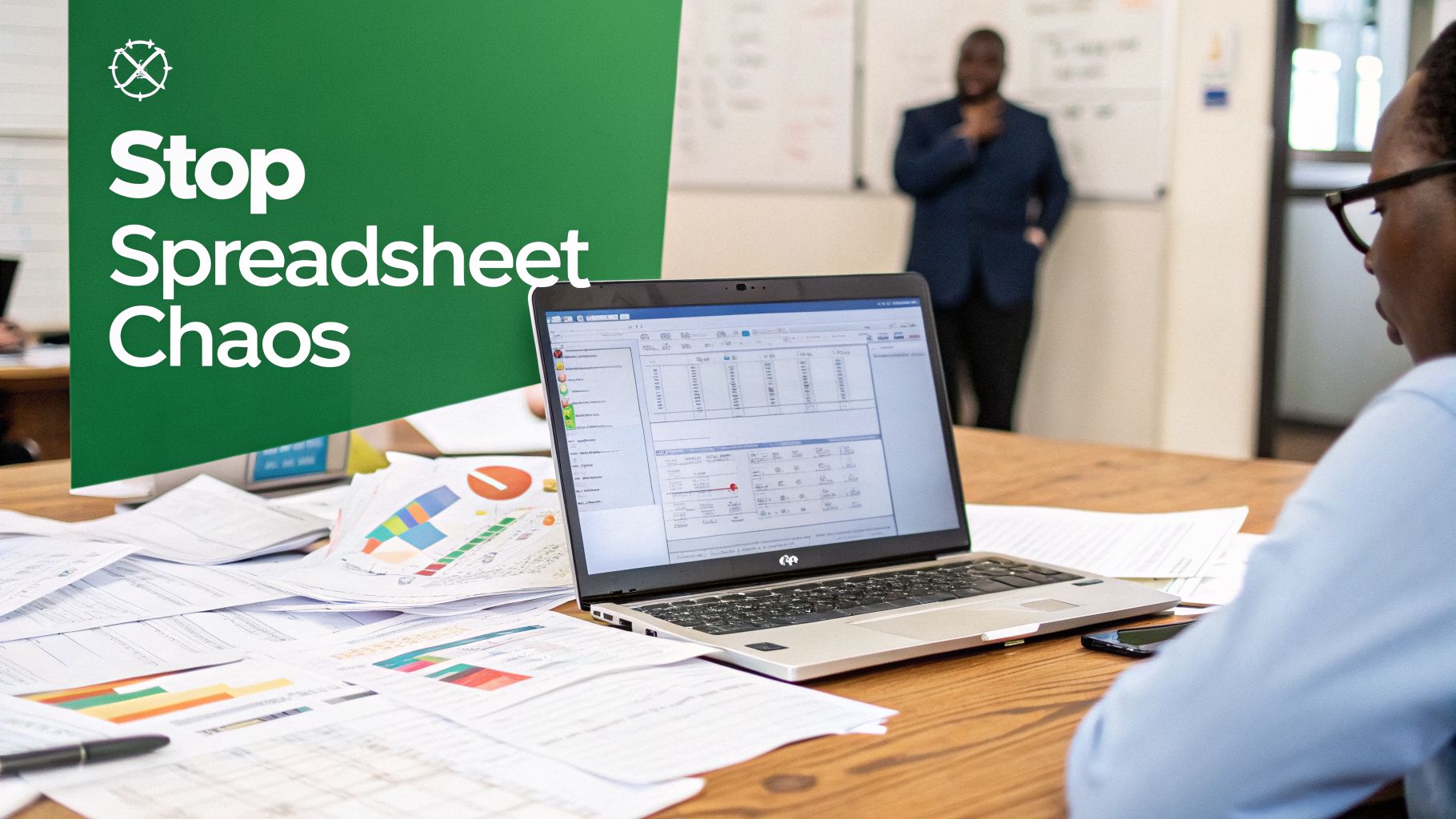
Let's be honest. When you first started, tracking a handful of customers in an Excel sheet probably worked just fine. But Ghana's internet market is growing fast. As your subscriber list balloons from tens to hundreds (and beyond), those manual methods that got you here will start to break. Badly.
Trying to manage a growing ISP with spreadsheets and manual invoicing is a recipe for chaos. You end up chasing late payments, spending countless hours trying to match bank statements to customer names, and manually logging into your router at all hours to cut off or reconnect users. Every minute you burn on these repetitive chores is a minute you're not spending on expanding your network or talking to your customers.
The Real Cost of Sticking with Manual Methods
The hidden costs of running your ISP manually are staggering. Revenue leakage is a huge one—it's almost guaranteed that some unpaid accounts will slip through the cracks each month. Then there's the sheer administrative weight of it all. It slows down how quickly you can get new customers online, creating a frustrating first impression and putting a cap on your growth.
A dedicated ISP billing system is a strategic investment in efficiency and stability. It transforms your operations from a reactive, manual process into a proactive, automated engine for growth, directly impacting your cash flow and customer satisfaction.
Seeing this shift in mindset is critical. Stop viewing a billing platform as a cost. Start seeing it as the core infrastructure that lets your business scale without falling apart. It’s the difference between constantly fighting fires and building a solid foundation for the future.
From Chaos to Control with Automation
This is exactly where an automated platform like Centipid Billing comes in. It ties everything together—your network, your customers, and your finances—into a single, cohesive system.
To see what a difference this makes, let's compare the old way with the new.
Manual vs Automated ISP Billing Comparison
The table below highlights the stark differences between relying on manual processes versus adopting a modern ISP billing system like Centipid.
Feature | Manual Process (Spreadsheets/Invoices) | Automated System (Centipid Billing) |
|---|---|---|
Invoicing | Manually creating and sending individual invoices. Highly time-consuming and prone to human error. | Invoices are generated and sent automatically on a set schedule. No manual effort is needed. |
Payment Collection | Chasing customers for payments via phone/email. Reconciling bank and Mobile Money statements by hand. | Customers pay via an integrated self-service portal. Payments are automatically recorded and reconciled. |
Network Access | Manually logging into MikroTik routers to suspend non-paying users and reactivate paid ones. | The system automatically suspends, reactivates, or changes a user’s plan based on their payment status. |
Customer Onboarding | A slow, manual process of creating user accounts, configuring router settings, and sending login details. | New customers can sign up and get online in minutes through a self-service portal. Account creation is instant and automated. |
Reporting | Compiling data from multiple spreadsheets. Difficult to get a clear, real-time view of business health. | Real-time dashboards show revenue, active subscribers, overdue payments, and network usage at a glance. |
Customer Support | Staff spend most of their time on billing queries, password resets, and payment confirmations. | Customers manage their own accounts, view usage, and pay bills online, freeing up support staff for more complex issues. |
The contrast is clear. Automation isn't just about saving time; it's about building a more resilient, professional, and profitable business from the ground up.
Ghana’s internet sector is absolutely booming. The user base has grown to over 24 million users as of January 2024, and that number keeps climbing. With mobile internet revenue showing a compound annual growth rate of around 37% between 2014 and 2023, you need a system that can handle that explosive growth.
Beyond just ditching spreadsheets, it’s also worth looking into how AI is changing the game for ISPs by taking automation even further. By adopting a modern ISP billing system in Ghana, you’re not just catching up; you’re gaining a serious competitive advantage and turning operational headaches into a well-oiled machine.
Choosing the Right Billing System for the Ghanaian Market
Picking an ISP billing system in Ghana isn't just about software—it's about finding a tool that actually understands how business gets done here. A generic, one-size-fits-all platform is going to cause you headaches. You need a system built for the realities of our market, from the network gear we prefer to how our customers actually pay their bills.
If you get this choice wrong, you're signing up for constant manual workarounds, unhappy subscribers, and money left on the table. The goal is to find a platform that solves the problems you're already facing. A modern system like the one from centipidbilling.com is a great example of what a truly Ghana-ready platform looks like in practice.
The Non-Negotiable Feature Checklist
When you're shopping for an ISP billing system in Ghana, some features are non-negotiable. They are the absolute baseline for running a smooth, profitable operation.
Here’s what you should be looking for:
Deep MikroTik RouterOS Integration: Let's be honest, most of us run on MikroTik. Your billing system must talk to RouterOS (specifically v7 and newer) to manage your PPPoE and Hotspot users. This is what enables automatic suspension for non-payment and instant reactivation the moment a customer pays—no more logging into routers at odd hours.
Seamless Mobile Money Support: This is the big one. The majority of your customers will pay you via Mobile Money. The system must integrate directly with MTN Mobile Money, Vodafone Cash, and AirtelTigo Money to automate the entire process, from generating the payment prompt to reconciling the account.
A Robust Cloud-Based Platform: Our local infrastructure can be a challenge. A cloud-based system means your billing engine stays online, secure, and accessible from anywhere, even when your office internet or power goes out.
A User-Friendly Self-Service Portal: Giving customers control is the fastest way to lighten your support load. A good portal lets subscribers check their invoices, see their data usage, and top up their accounts without needing to call you.
This focus on what works in Ghana is what separates a great system from a frustrating one. You’ll find these same principles hold true in other African markets, as you can see in our guide on selecting an ISP billing system in Kenya.
Why Cloud-Based Is Critical in Ghana
Trying to run your billing on an on-premise server in Ghana is a very risky bet. The daily infrastructure challenges we face are exactly what a cloud solution is designed to handle.
Let's look at the facts on the ground. Research points to significant hurdles, with some reports citing 68.2% network reliability issues and only 50% reliable access. Now, add the 5,600 fibre cuts reported in 2024 alone, and it becomes clear why tying your entire operation to a server in your office is a bad idea. You can read more about these local infrastructure challenges at 6wresearch.com.
A professional cloud platform like Centipid Billing avoids these risks. It hosts your critical system in a secure, professionally managed data centre with redundant power and internet. This means even if your office goes dark, your payment automations keep running and your customer data is safe.
The screenshot below, taken from the Centipid documentation, gives you a feel for how a well-designed system simplifies complex management tasks.
It shows that powerful features—like adding a new router or checking on your payment gateways—can be made simple and accessible, even if you aren't a network engineer.
Scalability and Integration Are Key
Lastly, the right ISP billing system in Ghana has to be able to grow with you. It shouldn't matter if you have 50 subscribers or 5,000. The platform needs to handle the load without slowing down or forcing you into a crazy expensive enterprise plan. It should be just as capable of running a small hotel hotspot as it is a large, multi-branch residential ISP.
What makes this scalability work is deep integration. The system can't just be a glorified spreadsheet for tracking payments; it needs to act on them. When a payment from MTN Mobile Money comes through, the platform must instantly tell your MikroTik router to bring that customer's connection back online.
That seamless, end-to-end automation is what will finally free you from the grind of manual tasks and deliver the professional experience your subscribers expect.
Automating Network Control with MikroTik Integration
For just about every ISP in Ghana, MikroTik is the heart of the network. It’s powerful, it’s reliable, and the price is right. But if you're managing it by hand, you're leaving a ton of efficiency and money on the table. The real magic happens when you pair it with a smart ISP billing system Ghana providers can rely on. Your router stops being just a gatekeeper and becomes an automated engine for your business.
This isn’t just a nice-to-have feature; it’s a game-changer for your daily operations. A modern billing platform, like Centipid, talks directly to your MikroTik RouterOS (we’re talking version 7 and newer) using its API. This gives the billing system the keys to manage your network based on rules you set, pulling you out of the command line for good.
From Payment to Connection in Seconds
Think about what happens when a customer's monthly plan expires. Manually, you'd have to spot the missed payment, log into the router, find their account, and then cut them off. It's tedious and prone to error. With an integrated system, the entire process runs on autopilot.
The moment a payment is missed, the billing system knows. It instantly tells your MikroTik to suspend that user’s PPPoE account or hotspot access. Then, as soon as that customer pays—whether it's with Mobile Money or a bank deposit—the system verifies the payment and immediately tells the router to switch their internet back on. This all happens in a matter of seconds, without you lifting a finger.
The real beauty of API integration is that it turns your MikroTik router into an employee that never sleeps. It enforces your payment rules, manages subscriber access, and adjusts service plans 24/7, keeping your operations smooth and your cash flow steady.
This kind of automation completely transforms your workday. You get to spend your time growing the business, not chasing down payments and fiddling with user accounts.
Real-World Scenarios for Ghanaian ISPs
Let’s get practical. How does this actually look for an ISP or hotspot operator here in Ghana? The deep link between a billing platform and MikroTik opens up some really clever, automated services.
Setting Up a Hotel or Café Hotspot: You can create a captive portal where guests have to buy access. The billing system can generate prepaid vouchers—say, for 1-hour or 24-hour sessions—that the front desk can sell. A guest punches in their voucher code, Centipid confirms it with MikroTik to grant access, and automatically disconnects them when their time runs out.
Tiered Residential Internet Plans: If you're a residential ISP, you can easily offer different plans with different speeds. A "Basic" plan could be capped at 5 Mbps, while your "Premium" plan delivers 20 Mbps. The billing system handles it all, automatically applying the correct speed limits (rate-limits) on your MikroTik router based on what the customer chose and paid for.
Data-Capped Packages: Many customers prefer plans with a set amount of data, like 50GB a month. The system keeps an eye on their usage via the router. When the cap is hit, their service can be automatically slowed down or paused until they buy a top-up through their self-service portal.
This diagram shows you exactly how all the pieces fit together to make this happen without any manual work.
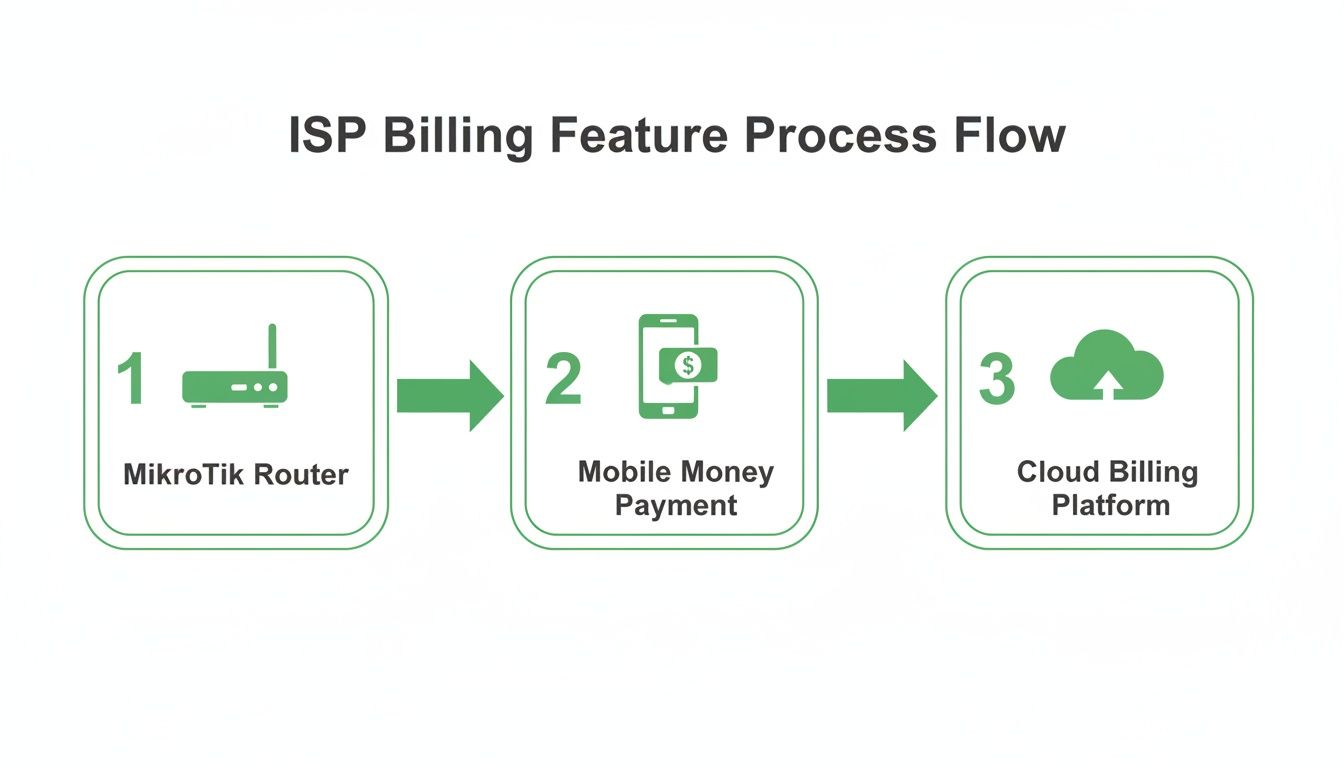
The flow is simple: the MikroTik router controls the network, the customer pays through mobile money, and the cloud billing platform processes it all. It’s a completely hands-off cycle.
Having this level of automated control is absolutely essential for building a business that can scale. If you want to dive deeper into the technical side, check out our guide to Centipid and MikroTik automation.
To take your efficiency even further, many growing ISPs are also adopting IT process automation software to handle workflows beyond billing. By combining these tools, you build a much stronger, more efficient operation that can expand without overwhelming your team.
Mastering Payments with Mobile Money Automation
Let's be honest, steady cash flow is what keeps your ISP running. In Ghana, this means making it incredibly easy for your customers to pay with Mobile Money. A smart ISP billing system in Ghana isn't just for sending bills; it's your best tool for getting paid on time, every single time.
The real challenge isn't just accepting a payment. It's automating the entire process, from the moment an invoice is created to when the money is in your account and the customer's internet is on. A purpose-built platform like Centipid is designed for this. It automatically generates and sends invoices through both email and SMS, giving customers a clear bill and a simple payment link.
No more asking customers to remember account numbers or hunt for a paybill code. They just click a link, enter their details, and pay. It’s that simple.
The Power of Real-Time Payment Reconciliation
Here’s where it gets really powerful. As soon as a customer completes a payment with MTN Mobile Money, Vodafone Cash, or AirtelTigo Money, the billing system gets an instant notification. It immediately knows who paid and which invoice to mark as cleared.
This real-time reconciliation is the key. The system automatically tells your MikroTik router to activate a new subscription or extend an existing one. The entire process—from payment to restored internet service—happens in seconds. No one on your team has to lift a finger. This means your customers never experience frustrating delays after paying, which is a huge factor in keeping them happy and loyal.
The ultimate aim should be a "zero-touch" collections process. By fully automating your mobile money integration, you stop chasing payments and build a reliable revenue stream that allows you to focus on growing your network.
This level of automation also cleans up your finances. You get a perfect, real-time view of who has paid, who is late, and exactly what your monthly recurring revenue is. If you want to dive deeper into what your customers see, understanding the mechanics of a payment portal is essential.
Reducing Churn with Smart Dunning
But what about customers who genuinely forget to pay? Manually calling and chasing late payments is a massive drain on your time and resources. This is where a smart dunning process comes in. Dunning is just a formal name for the automated communication you send to customers about their overdue bills.
Instead of your team making awkward phone calls, the system sends polite, persistent reminders automatically.
A typical automated dunning workflow in a system like Centipid looks like this:
Friendly Reminder: A few days before the due date, an SMS and email go out as a gentle heads-up.
Due Date Notice: If the bill is still unpaid, another reminder is sent on the day payment is expected.
Suspension & Final Notice: Once the invoice is overdue, the system sends a final notice, automatically suspends the account on your MikroTik, and lets the customer know their service is paused until payment is received.
Instant Reactivation: The second they pay through their portal, the system instantly brings their service back online.
This structured communication does more than just get you paid; it drastically cuts down on churn and frees up your staff to work on customer support and network growth. It professionalises your operations and is a vital feature for any modern ISP billing system Ghana operators need to succeed.
Designing Service Plans and Handling Tax Compliance
The internet plans you offer are much more than a simple menu of options. They are a direct reflection of your market strategy and have a massive impact on your bottom line. A flexible and capable ISP billing system in Ghana is easily the best tool you have for crafting service packages that not only attract the right customers but also fuel sustainable growth. Without one, you’re often stuck with rigid plans that are a nightmare to update.
The real goal here is to get past the old one-size-fits-all model. You need a diverse portfolio of plans that speaks to the different needs of subscribers across Ghana. With a modern platform like Centipid Billing, you can finally design, test, and manage a whole range of service packages, all from one central dashboard.
Creating Flexible Internet Packages
Your customers aren't all the same, so why should your plans be? A student might just need affordable access for a few hours at a local cafe. A family, on the other hand, likely wants unlimited data for non-stop streaming. Then you have small businesses that absolutely depend on a stable, high-speed connection. Your billing system has to make it simple to serve all of them.
You can configure several types of plans to capture every part of the market:
Time-Based Hotspot Access: This is perfect for places like cafes, hotels, or public Wi-Fi zones. You can easily set up plans for 1 hour, 24 hours, or even a full week, all managed through vouchers or a self-service login page.
Data-Capped Monthly Plans: These are ideal for budget-conscious users. Offer packages with a specific data limit, like 50GB or 100GB a month. When integrated with your MikroTik router, the system automatically tracks usage. Once the limit is hit, it can either slow the connection down or prompt the user to buy a top-up. It's all automated.
Speed-Tiered Unlimited Packages: This is how you attract high-value residential and business customers. Offer unlimited data plans, but differentiate them by speed. For example, you could have a 10 Mbps plan for basic browsing and a more premium 50 Mbps plan for heavy users. The system takes care of enforcing the correct bandwidth limits.
The ability to quickly create, tweak, and see how your service plans are performing is absolutely vital. A good billing system gives you the agility to react to competitor pricing and market shifts without having to mess around with complex router configurations.
This kind of flexibility allows you to experiment with different pricing strategies until you find what works best. For a deeper dive into setting these up, you can find detailed guides in the Centipid documentation.
Sample ISP Service Plan Structure in Centipid
To give you a clearer picture, here’s an example of how you could structure your service offerings within a billing platform to appeal to different customer segments in Ghana.
Plan Name | Type | Speed (Upload/Download) | Data Cap | Target Customer |
|---|---|---|---|---|
Hotspot Express | Time-Based | 5 Mbps / 5 Mbps | N/A | Cafe visitors, hotel guests |
Home Starter | Data-Capped | 10 Mbps / 10 Mbps | 50GB | Light users, students |
Home Unlimited | Speed-Tiered | 20 Mbps / 20 Mbps | Unlimited | Families, streamers |
Business Pro | Speed-Tiered | 50 Mbps / 50 Mbps | Unlimited | Small businesses, remote workers |
This table shows just how granular you can get, ensuring there’s a perfect plan for everyone from the casual browser to the demanding business client.
Navigating Ghanaian Tax Compliance
Designing great plans is only one part of the equation. The other, and frankly more complicated, part is ensuring every single invoice you send out is fully compliant with Ghanaian tax law. For many ISPs, this is a major source of stress, as simple mistakes can lead to serious financial penalties.
Let’s be honest, Ghana's internet pricing environment is tough. You're juggling factors like the average cost of 1GB, which can be around $1.50, high infrastructure costs, and a telecom tax burden that's close to 39 percent. In this climate, getting your billing right isn't just important—it's essential for survival, especially with the National Communications Authority (NCA) keeping a close eye on service quality. You can get a sense of the pricing pressures in the Ghanaian market here.
A solid billing system like Centipid takes this entire burden off your shoulders by automating tax calculations. The platform is built from the ground up to correctly calculate and apply both the Communication Service Tax (CST) and Value Added Tax (VAT) to every invoice.
When you create a service plan, you just set the base price. That's it. The system automatically adds the correct tax amounts based on the latest regulations, guaranteeing your invoices are always accurate and compliant. This feature alone can save you countless hours of manual work and give you the peace of mind that comes from knowing your financial records are clean and defensible. It effectively turns a huge operational headache into a simple, automated process.
Common Questions We Hear from Ghanaian ISPs
If you're thinking about switching to a proper ISP billing system in Ghana, you're bound to have questions. Moving on from spreadsheets is a big leap, but it’s the only way to scale your operations without the headaches. Let's get into some of the most common concerns we hear from hotspot operators and ISPs across the country.
"Can I Move My Existing Customers from Spreadsheets?"
Yes, you absolutely can, and this is usually the very first thing we help new clients with. Any serious billing platform is built to handle this. For instance, a system like Centipid lets you do a bulk import using a simple CSV file—that’s the format you get when you save an Excel or Google Sheet.
You’re not just importing names. You can bring over all the crucial details: contact info, their current data plan, and even any outstanding balance they owe you. We’ve found that the best providers, including Centipid, offer free hands-on support to help you clean up your spreadsheet and map the data correctly. The whole point is to get everything into one centralised system so the automation can kick in from day one.
"How Do We Handle Hotspot Voucher Generation?"
For anyone running public Wi-Fi—think cafes, hotels, student hostels, or community centres—vouchers are your bread and butter. An integrated billing system turns this from a manual chore into a simple, automated process.
Because the billing platform talks directly to your MikroTik router, a system like Centipid lets you generate thousands of prepaid access vouchers straight from one dashboard.
You set the rules for every batch you create:
Duration: Decide if a voucher is for 1 hour, 24 hours, or even a full week.
Data Caps: You can also limit how much data someone can use, which is great for managing bandwidth.
Price: Set a price for each voucher type, making sales easy to track.
Once you’ve generated them, you just print them out to sell. When a customer enters the code on your hotspot’s login page, the system validates it instantly, starts their session, and automatically cuts them off when their time or data is used up. It’s a clean and professional way to monetise your network.
"What Kind of Support Can I Expect as a Ghanaian ISP?"
This is a big one. When your billing system is the heart of your business, you can't afford to be left hanging. You need to know that expert help is there when you need it.
Good technical support isn’t a nice-to-have; it’s a core part of the service. You should expect free help with the entire setup, from connecting your router to configuring your payment gateways.
Platforms that are actually focused on the African market, like Centipid, understand our unique challenges and typically provide this support at no extra charge. This usually includes:
Connecting your MikroTik router to the billing software.
Setting up Mobile Money and other local payment gateways.
Walking you through the customer migration process.
Support is often available through practical channels like email, live chat, or scheduled calls, so you can talk to someone who understands both the software and your specific network environment here in Ghana.
"Is a Cloud System Really Reliable with Our Internet Issues?"
That’s a fair and very important question. With potential "dumsor" and unpredictable internet, how can you rely on a cloud-based platform? The reality is that a professional cloud system is far more dependable than a server sitting in your office.
These platforms are hosted in world-class data centres with multiple backups for power and internet. This means the core billing engine—the brain that processes payments and sends automated commands—is always on.
While you need an internet connection to log into the dashboard, the automation rules are pushed directly to your MikroTik router. For example, if a customer's plan expires, the command to suspend their service is already on your router. That suspension will happen automatically, even if your office loses internet and power completely. You can get a deeper look at how this works in the Centipid documentation.
Ready to stop chasing payments and finally start growing your ISP? Centipid Technologies Ltd. offers a billing system built specifically to automate your revenue cycle, from invoicing and Mobile Money payments to network control.
Start your 14-day free trial today and see how Centipid can transform your business.