While the promise of an all-in-one platform is tempting, many ISPs quickly discover a greater strategic advantage in decoupling their technology stack. You need billing, CRM, and NMS as separate systems, not bundled, the moment your operations demand specialised tools that a single platform just can't deliver. This best-of-breed approach gives you far superior flexibility and scalability, letting you pick the right tool for the right job.
The All-in-One Myth vs. Best-of-Breed Reality
The pitch for an all-in-one platform is always compelling: one vendor, one interface, and supposedly simpler management. In reality, this convenience often comes at a steep price, especially for Internet Service Providers (ISPs) in dynamic markets like Kenya. The "one-size-fits-all" model starts to show its cracks almost immediately.
The need to separate your billing, CRM, and NMS usually arises when each part of your business has outgrown a generic module. Your network might have evolved to include multi-vendor hardware, demanding a sophisticated Network Management System (NMS) to keep things running smoothly. Or, your sales team might need a dedicated Customer Relationship Management (CRM) with advanced marketing features. In these real-world situations, a bundled system doesn't just fall short, it becomes a bottleneck.
A best-of-breed strategy, on the other hand, is about building a tech ecosystem that actually fits your business. By selecting specialised tools for each function, you gain deeper functionality and genuine operational control. It treats each system as a powerful, distinct component that does its job exceptionally well.
For a growing ISP, flexibility isn't a luxury; it's a core requirement for survival and growth. Decoupling your systems allows you to adapt to market changes, adopt new technologies, and scale individual operations without being held back by a monolithic platform.
Comparing Architectural Choices
Deciding between a unified suite and separate, specialised systems is one of the most critical choices you'll make. Each path has very different implications for your budget, operational agility, and long-term growth potential. Let's break down the real trade-offs.
| Feature | All-in-One Platform | Best-of-Breed (Separate Systems) |
|---|---|---|
| Flexibility | Limited to the vendor's ecosystem and feature roadmap. | High; you choose the absolute best tool for each specific job. |
| Functionality | Often generic; a "jack-of-all-trades, master of none." | Deep and specialised features for billing, CRM, and NMS. |
| Initial Setup | Generally faster since it's a single deployment. | More complex, as it requires integrating different platforms. |
| Scalability | Can become restrictive as your specialised needs grow. | Excellent; you can upgrade or swap out individual parts as needed. |
| Vendor Lock-in | High risk. Moving away is often costly and painful. | Low risk. Systems can be replaced without a full-stack overhaul. |
For many MikroTik-based ISPs, the financial heart of this custom architecture is a purpose-built billing system. A platform like Centipid, engineered specifically for ISPs, is built to handle complex recurring revenue, integrate with local payment gateways, and automate access control on MikroTik routers, as detailed on centipidbilling.com. As we explore in our guide on the best billing system for wireless ISPs, this kind of specialised system serves as the definitive source of financial truth.
From that solid foundation, it can seamlessly feed data into a powerful, separate CRM and receive alerts from a dedicated NMS. This creates a powerful, customised ecosystem that actively supports your growth instead of restricting it.
Evaluating the Trade-Offs Between Integrated and Separate Systems
Picking your core software stack, whether to go with a single, all-in-one platform or hand-pick separate, best-of-breed systems, is one of the most critical decisions an ISP will make. It’s a choice that directly impacts your daily operations, your budget, and how easily you can grow. An integrated system might get you up and running fast, but that speed often comes at the cost of long-term flexibility.
On the other hand, a best-of-breed setup, where you need billing, CRM, and NMS separately, not in one platform, takes more work to get going. But that initial effort pays off by giving you powerful, specialised tools and the freedom to change your tech stack as your business needs shift. It's the classic trade-off: short-term convenience versus long-term control.
Deployment Speed Versus Long-Term Agility
The main draw of an all-in-one platform is how quickly you can launch. You have one vendor and one pre-built system, which means you can have your operational backbone in place much faster than if you were trying to connect three different platforms. For a new ISP that needs to start signing up subscribers yesterday, this is a huge plus.
The problem is, that initial speed can paint you into a corner. As your business matures, your needs get more specific. Maybe you need advanced marketing automation that your platform’s basic CRM module just doesn't have. At that point, you’re stuck waiting on your vendor’s development schedule, not your own. Your ability to adapt is tied directly to their priorities.
A separate systems approach completely changes that dynamic. Yes, the initial setup means getting your hands dirty with API integrations, but it also means you get to choose the absolute best tool for each job. For instance, a Wireless ISP (WISP) covering rural areas might need an NMS with sophisticated RF planning tools, something you’ll almost never find in a generic, bundled suite.
This model shows how specialised systems for billing, CRM, and NMS can all plug into a central operational core, allowing each to function independently while staying connected.
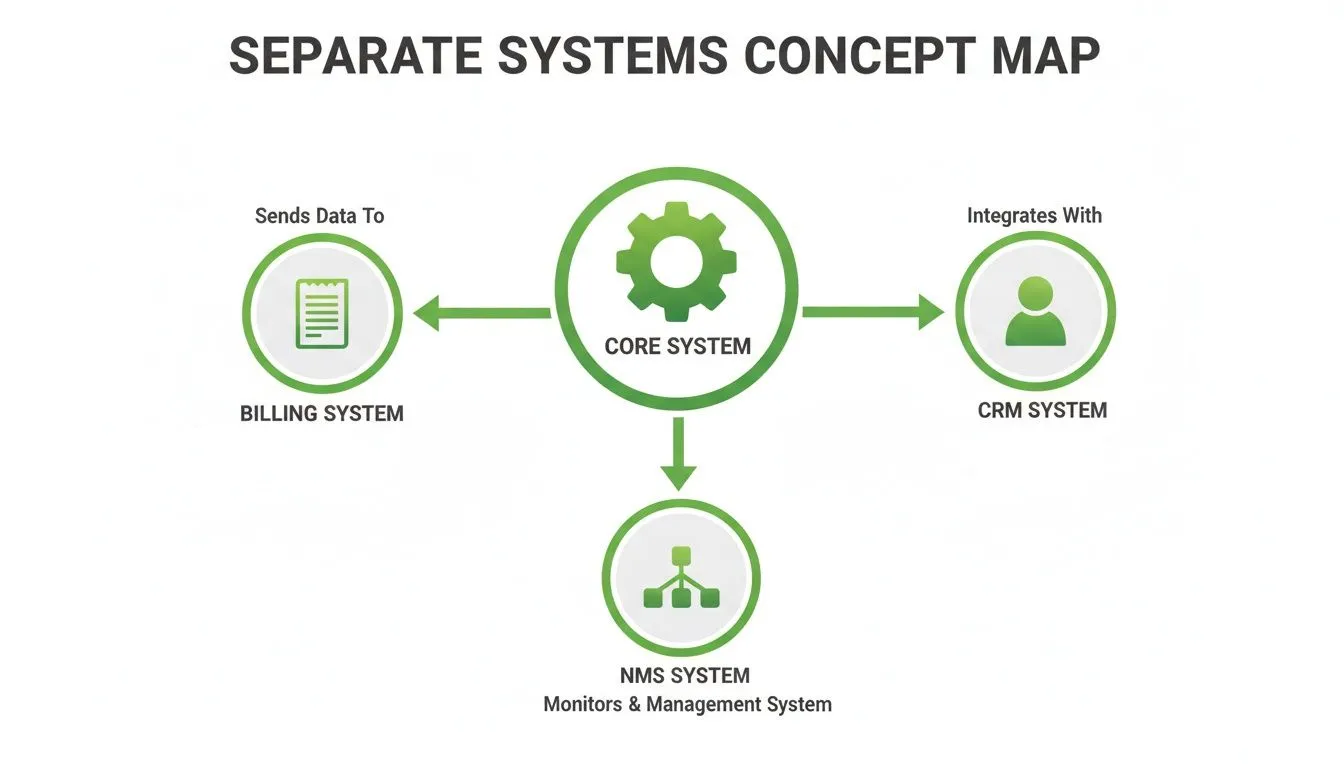
This architecture lets you build a tech stack where every single component excels at its specific job.
Customisation Potential and Staff Skills
All-in-one platforms are built for the "average" ISP. They offer a standard feature set that works for a broad market, which makes them fairly easy for generalist staff to pick up since there's only one interface to learn.
But that simplicity is also their biggest weakness. Deep customisation is rarely on the table. Think of a fibre operator going after enterprise clients. They’d need a CRM with a proper sales pipeline and B2B lead management. The basic ticketing-focused CRM bundled into most all-in-one platforms would be completely inadequate for the job.
A best-of-breed architecture empowers you to build a system that precisely matches your business model. You can pair a robust billing engine like Centipid, which excels at complex invoicing and payment automation, with a world-class CRM and a granular NMS, creating a powerful, tailored ecosystem.
This approach does mean your team will need more specialised skills or at least be willing to learn multiple systems. The upside is that it allows them to become true experts in their domains. Your network engineers can master a powerful NMS, while your sales team can squeeze every last drop of value out of a dedicated CRM, making each department more effective.
Total Cost of Ownership and Scalability
Looking at the initial licence fee alone doesn’t tell you the whole story. An all-in-one platform might look cheaper on paper, but its total cost of ownership (TCO) often creeps up as you run into its limits. The cost of clunky workarounds, missed business opportunities because a feature is missing, and the eventual, painful migration to a better system can easily wipe out any initial savings.
With a separate-systems architecture, the costs are more predictable and scale more logically. You can put your money where it matters most, like a rock-solid billing system, while choosing more budget-friendly options for other functions. As your business grows, you can upgrade or replace each piece independently without having to rip everything out.
To help you weigh these factors, here is a summary of the key differences between the two architectures.
All-in-One vs Best-of-Breed System Architecture Comparison for ISPs
This table breaks down the strategic differences you'll face when deciding between a unified platform and an integrated stack of specialised tools.
| Decision Criterion | All-in-One Platform (e.g., UBO, Splynx) | Best-of-Breed Architecture (e.g., Centipid + separate CRM/NMS) |
|---|---|---|
| Speed of Deployment | Fast. A single, pre-integrated system means a quicker launch. | Slower. Requires careful planning and API integration between systems. |
| Customisation | Low. You are limited to the features and modules the vendor provides. | High. You can select specialised tools with deep functionality for each need. |
| Staff Skill Requirements | Lower. Teams only need to learn one unified interface. | Higher. Requires expertise across multiple, distinct platforms. |
| Total Cost of Ownership | Can be deceptively low initially, but hidden costs arise from workarounds and limitations. | Higher upfront integration costs but better long-term value and no vendor lock-in. |
| Scalability | Limited. Can become a bottleneck as operational complexity grows. | Excellent. You can scale, upgrade, or replace individual components as needed. |
Ultimately, choosing a best-of-breed architecture is a strategic play. When you realise you need billing, CRM, and NMS separately, not in one platform, you’re choosing long-term flexibility and capability over the immediate ease of a single solution. It’s an approach that sets your ISP up for sustainable growth, giving you the agility to adapt and win in a competitive market.
When a Separate NMS Becomes a Strategic Necessity
While a bundled Network Management System (NMS) might look good on a feature list, it often falls short where it matters most: deep, granular control over your network. The moment your stability and performance depend on more than just basic uptime alerts is the exact point you need to consider separating your billing, CRM, and NMS. A generic NMS module simply can’t compete with a specialised tool built for serious network engineering.
When your entire business is built on uptime and performance, a dedicated NMS isn't a luxury, it's how you follow essential network monitoring best practices and stay ahead of problems. This is especially true if you’re running a multi-vendor network. An all-in-one platform might be great with MikroTik routers but often struggles to give you meaningful insights into hardware from other manufacturers, leaving you with critical blind spots.
A specialised NMS delivers the real-time visibility and advanced tools that are non-negotiable for specific, high-stakes scenarios.
- Advanced Radio Frequency (RF) Planning: For Wireless ISPs (WISPs), a dedicated NMS with RF planning and spectral analysis is crucial. It helps you optimise tower placements and cut through the noise of crowded airwaves.
- Deep Packet Inspection (DPI): If you offer enterprise-grade services, you absolutely need DPI. It’s the only way to enforce complex Quality of Service (QoS) policies and guarantee bandwidth for your clients' most critical applications.
- Multi-Vendor Hardware Management: A purpose-built NMS is designed to manage a diverse ecosystem of routers, switches, and access points. It pulls everything together into a single, unified view of your entire network’s health.
Overcoming Technical Limitations
The core issue with most bundled NMS tools is that they’re built for simplicity, not depth. They offer a surface-level overview that works fine for small, homogenous networks but quickly becomes a liability as your ISP scales. A separate NMS, on the other hand, is engineered for the kind of granular control your network engineers need to diagnose and fix complex issues fast.

Think about it this way: while a billing platform like Centipid knows a tower exists and who is connected to it, a true NMS gives you the live signal strength, packet loss, and latency data. That’s the information that makes the difference between a stable network and a constant stream of support tickets. The trade-off is clear: integrated platforms may promise streamlined operations, but this can come at a significant cost to your network's integrity.
Achieving the Best of Both Worlds
Here’s the good news: choosing a separate NMS doesn’t mean you have to give up on automation. The smartest strategy is to integrate a powerful, specialised NMS with a purpose-built billing platform like Centipid. This "best-of-breed" architecture lets you achieve superior network performance without losing automated financial control.
Through robust API integrations, your NMS can send critical alerts and usage data directly to your billing system. For example, Centipid can automatically provision services, enforce bandwidth limits, or suspend non-paying accounts based on triggers it receives from the NMS. As our documentation at https://docs.centipidbilling.com shows, Centipid’s API allows for deep integration with network hardware for access control, a key function often managed from an NMS. For a practical example, see our guide on using Winbox for router management.
This approach lets each system excel at its core function: your NMS focuses on network stability, while Centipid ensures every service is accurately and automatically billed.
Why a Dedicated CRM Isn't Just a Luxury, It's a Necessity
When you’re just starting out as an ISP, a bundled Customer Relationship Management (CRM) module often feels like enough. It handles the basics, like ticketing and storing subscriber details, all in one place. But as your business grows, you'll start to feel the pinch. Those generic tools quickly go from being convenient to being a serious bottleneck, preventing you from properly managing your customers and building real, lasting relationships.
This is usually the moment of realisation for many ISPs: you need separate, specialised systems for billing, CRM, and your Network Management System (NMS). A CRM that’s just a small part of an all-in-one platform is rarely built for what really drives growth, smart sales, targeted marketing, and getting a complete picture of your customer. It’s a compromise that leaves your customer-facing teams working with one hand tied behind their backs.
Moving from Basic Ticketing to True Customer Lifecycle Management
A dedicated CRM platform fundamentally changes how you engage with customers. It's not just about reacting to problems anymore; it's about proactively adding value, keeping customers happy, and spotting new ways to grow revenue. The CRM in an all-in-one system is often just an afterthought, designed almost exclusively for putting out fires via support tickets.
A proper, standalone CRM, on the other hand, is built for scenarios that bundled tools just can't touch:
- Complex B2B Sales Pipelines: Selling to corporate clients means juggling leads, sending proposals, and tracking intricate sales stages. A dedicated CRM gives your sales team the tools they need to build and monitor these pipelines effectively, a capability you just won’t find in most integrated platforms.
- Targeted Marketing Automation: Want to send a special upgrade offer to subscribers on your bronze-tier plan? A real CRM allows you to segment your customer base and run automated campaigns that drive upgrades and boost your average revenue per user (ARPU).
- A Genuine 360-Degree Customer View: Picture this: one screen showing a customer’s entire journey with you. Every support ticket, every payment, their live data usage, and all marketing messages they've received. This complete view empowers your team to deliver smarter, more personal service every single time.
Get the Power of Integration Without the Vendor Lock-In
Opting for a separate CRM doesn't mean you have to give up on having a single, unified source of truth. Actually, when done right, a "best-of-breed" strategy gives you the best of both worlds. A specialised billing platform like Centipid, for instance, is built to be the financial engine of your operation, feeding crucial, real-time data into your chosen CRM.
A decoupled architecture lets you equip your teams with top-tier tools for their specific jobs while keeping all your data perfectly in sync. Your billing system handles the money, and your CRM uses that financial data to create exceptional customer experiences.
As you can see in our documentation at https://docs.centipidbilling.com, Centipid's API is designed to push vital subscription and billing information to third-party platforms. This ensures your sales, marketing, and support teams are always working with accurate, up-to-the-minute information, all without being trapped in a single vendor's restrictive ecosystem. Of course, for any ISP, keeping the network running smoothly is critical, which is why investing in one of the best network monitoring software solutions is just as important as having a great CRM.
Ultimately, a dedicated CRM helps you shift from simply managing subscribers to truly understanding them. It gives you the tools not only to reduce churn but to actively accelerate revenue growth by building a customer experience that is simply better.
Why Your Billing System Is the Non-Negotiable Financial Core
When you start assembling your ISP's technology stack, it’s easy to get bogged down in feature comparisons for network monitoring or customer support. But if you’re opting for separate, specialised systems, a best-of-breed approach, one component stands out as absolutely non-negotiable: your billing platform. It’s more than just a tool; it's the financial engine of your entire operation.
You can often make do with a generic CRM for managing customer tickets or a dedicated NMS for your network hardware. Your billing system, however, must be purpose-built for the unique and often complex world of telecommunications. The financial lifeblood of your ISP depends on it handling challenges that standard accounting software simply wasn't designed for.
The Specialised Demands of ISP Billing
A proper ISP billing system does far more than just churn out invoices. Think of it as the central nervous system that translates every service you deliver into predictable, tangible revenue. This requires a deep, native understanding of industry-specific financial models that you just won't find off the shelf.
For instance, any billing platform worth its salt in the ISP space must flawlessly manage:
- Recurring Subscriptions: Automatically generating and dispatching invoices for monthly, quarterly, or annual plans without anyone needing to lift a finger.
- Prorating Services: Accurately calculating charges when a customer joins, upgrades, or downgrades mid-cycle. This isn't just about fairness; it's about stopping money from leaking out of your business.
- Usage-Based Charges: For things like data top-ups, the system has to track consumption and bill for any overages automatically.
- Automated Dunning: Intelligently managing overdue accounts by sending reminders, applying late fees, and, when necessary, restricting service for non-payment.
A platform like Centipid is engineered from the ground up to master these functions, as you can see on centipidbilling.com. It’s built to give you the financial control needed to make sure every shilling is captured and accounted for correctly. It becomes the definitive source of truth for your ISP’s financial health.

This level of granular control over service plans and automated invoicing is precisely what separates a specialised system from a generic, all-in-one platform. It's the key to effective revenue management.
Integrating the Financial Core with Operations
In a best-of-breed setup, a powerful billing system doesn't just sit on its own, it becomes the operational anchor. Its real power is revealed when it integrates deeply with both your network hardware and your payment infrastructure, creating a seamless link between service delivery and revenue collection.
For example, Centipid’s deep integration with network hardware like MikroTik RouterOS allows it to automate access control right from the billing platform. When a customer pays their invoice, the system can instantly grant or restore their internet access without a technician ever getting involved. On the flip side, if a payment is missed, that same system can automatically enforce service restrictions. This core functionality is detailed at https://docs.centipidbilling.com.
Your billing system isn’t just tracking money; it’s actively enforcing the commercial rules of your network. It connects the financial status of an account to the technical delivery of the service, automating what would otherwise be a constant source of manual work and human error.
This is especially critical in markets like Kenya, where supporting a variety of payment methods is non-negotiable. A specialised billing platform must integrate with local payment gateways, particularly mobile money services like M-PESA. Our guide on integrating the Lipa Na M-PESA portal shows just how this simplifies payments for subscribers and streamlines reconciliation for your business.
Ultimately, your CRM and NMS are vital for service quality and network stability, but your billing platform is what guarantees you get paid for it. It provides the critical revenue analytics you need to run the business, telling you which plans are most profitable, where churn is highest, and how your revenue is trending. It’s the engine that ensures every bit of data you deliver is accurately billed, collected, and optimised.
Building Your Best-of-Breed ISP Technology Stack
Deciding to unbundle your core systems is a big move. Now comes the real work: mapping out how you’ll actually build a best-of-breed stack with separate billing, CRM, and NMS tools. If you just dive in without a plan, you're asking for chaos.
Success depends on a phased, deliberate rollout that keeps your operations stable and your data clean. The starting point is always your financial core. A dedicated ISP billing system isn’t just another tool; it’s the engine that drives every single revenue-generating action in your business.
A Phased Implementation Strategy
A logical rollout gives your team the space to master each new tool without disrupting service. This approach ensures your most critical functions are rock-solid before you start adding more layers.
Phase 1: Solidify Your Billing Core
Start with a powerful, purpose-built billing platform like Centipid. This system becomes your single source of truth for all things financial, handling everything from recurring invoices and prorating to automated dunning. As we've covered on the main features of Centipid, things like automated payment collection and tight integration with network hardware for access control are non-negotiable foundations.
Phase 2: Integrate Your Specialised NMS
Once your billing is running smoothly, it's time to connect your chosen Network Management System (NMS). Using a modern, API-first approach, you can create a direct link where the NMS monitors network health and performance. This isn't just about viewing data; it's about enabling automated actions. For example, as detailed at https://docs.centipidbilling.com, the NMS can get a trigger from Centipid to automatically suspend an account for non-payment.
Phase 3: Connect Your Dedicated CRM
The final piece is integrating your Customer Relationship Management (CRM) platform. Your billing system will feed it with accurate, real-time customer data, including payment status, package details, and service history. This gives your support and sales teams a complete, 360-degree view of every customer, allowing them to provide much better service.
"Think of it as building a house. You pour the financial foundation first (Billing), then you frame the operational structure (NMS), and finally, you finish the interior where you interact with people (CRM). The data has to flow in that order to keep everything standing."
Your Best-of-Breed Decision Checklist
As you weigh your options, run through this checklist. It will help you honestly assess your ISP’s needs and confirm if separating your core systems is the right path for you.
- Future Scalability: Do your growth plans involve new services or territories that a one-size-fits-all platform simply can't handle?
- Specialised Features: Do you need advanced NMS capabilities, like multi-vendor device support, or sophisticated CRM functions, like marketing automation, that bundled tools just don't offer?
- Integration Skills: Does your team have the technical chops to manage API integrations, or do your chosen platforms offer the robust connections needed to build a stable ecosystem?
- Vendor Independence: Is avoiding vendor lock-in a key business priority? This freedom allows you to adapt and choose the right components for the job, like figuring out how a MikroTik RADIUS server fits into your specific architecture.
- True Cost of Ownership: Have you calculated the long-term costs of clunky workarounds and missed opportunities that come with an all-in-one system? Compare that to the one-time integration costs of a best-of-breed stack.
For most ISPs that prioritise flexibility, deep functionality, and long-term growth, the choice becomes pretty clear. A thoughtfully constructed best-of-breed architecture, with a robust billing engine like Centipid at its centre, is the most reliable strategy for building a sustainable business.
Frequently Asked Questions
When you start thinking about splitting your core ISP software, a lot of practical questions come to mind. We've gathered the most common ones here to give you straightforward answers, helping you decide with more confidence when to separate your billing, CRM, and NMS.
How Can We Manage Integration Costs For Separate Systems?
Managing the cost of integrating a "best-of-breed" stack is all about smart planning, not just throwing developers at the problem. The first step is to map out precisely what you need the systems to do. For example, which specific alerts from your NMS should automatically create a ticket or suspend a service in your billing platform? Be specific.
Your best bet is to adopt an API-first approach. Look for platforms with clear, well-documented APIs. A system like Centipid, for instance, is built specifically to connect with other tools for critical tasks like service provisioning. You should also think about a phased rollout. You could connect your NMS to your billing system first to get your core automation running, and then bring your CRM into the mix later. This approach spreads the cost and workload out over time.
How Do We Ensure Data Consistency Across Platforms?
To keep your data consistent, you have to establish a single source of truth for each type of information. Your billing system, for example, must be the absolute authority for all things financial, plans, pricing, invoices, and payment status. A specialised platform like Centipid is designed to be this financial core, feeding accurate data to your other systems as outlined at https://docs.centipidbilling.com.
Likewise, your NMS is the master record for network performance and subscriber usage data. The trick is to create one-way data synchronisations wherever you can. For instance, the billing system should push a customer's account status (active, suspended) to the CRM, but the CRM shouldn't be able to push billing changes back. This simple rule prevents data conflicts and ensures everyone is working from the same correct information.
The most reliable way to maintain data integrity is to assign one system as the master record for each core function. Your billing platform owns financial data, your NMS owns network data, and your CRM owns customer interaction data. This stops data conflicts before they start and ensures every team is on the same page.
What Is The Best Way To Train Staff On Multiple Systems?
The key to training staff on several specialised platforms is to focus on their roles. Your network operations centre (NOC) team doesn't need to be CRM experts, and your sales team definitely doesn't need to know the ins and outs of the NMS. You need to create training that’s tailored to what each person actually does.
Start by training each team thoroughly on the system they'll spend most of their day in. Network engineers get deep-dive training on the NMS, while your customer support team focuses on the CRM and the specific parts of the billing system they need to handle customer queries. The next step is to document the handful of critical workflows that cross between systems, like how a support ticket in the CRM gets escalated to the network team with all the relevant data from the NMS. This ensures everyone understands how their work connects, without having to master every single tool.
Ready to build a more flexible and scalable technology stack for your ISP? It all starts with a solid financial core. Centipid Technologies Ltd. offers a purpose-built billing system that integrates smoothly with your preferred NMS and CRM, giving you complete control.
Find out how Centipid can become the anchor for your operations at https://centipidbilling.com.