
Billing Systems in Kenya: An ISP's Guide for 2026
Discover the best billing systems in Kenya for ISPs and Wi-Fi operators. Our guide covers M-Pesa integration, MikroTik features, selection, and migration.

If you're running an ISP in Kenya, you probably know the monthly pattern. Customers say they paid, the M-Pesa statement is long, staff are forwarding screenshots on WhatsApp, and someone still has to decide who gets reconnected now and who waits until morning. The problem looks like billing, but most of the pain sits in collections, reconciliation, and access control.
That's why good billing systems in Kenya have to do more than send invoices. They need to connect payments, customer status, and network enforcement into one working process. If those pieces stay separate, manual work grows faster than your subscriber base.
The Real Problem with ISP Billing in Kenya
Many operators think the billing issue is simple: generate invoices faster and send more reminders. That helps, but it doesn't fix the part that hurts cash flow. Often, the bottleneck in Kenyan billing systems is payment reconciliation and customer lifecycle control, not invoicing alone, as noted in this Kenya billing FAQ discussion.
A manual setup usually breaks at the same points. Failed STK pushes aren't tracked properly. Partial payments sit in limbo. A customer pays, but service stays blocked because the payment record and subscriber account don't match. That's where support queues pile up and revenue leaks unnoticed.
Practical rule: If payment, suspension, and reconnection are handled by different people or tools, your billing process is still manual.
The shift that matters is operational. You want one system that records the charge, follows up on non-payment, updates account status, and triggers service rules without waiting for staff to intervene. That's the difference between surviving each billing cycle and controlling it. For a deeper operational view, see this guide on how to manage ISP customers and billing.
Essential Features for Kenyan Network Operators
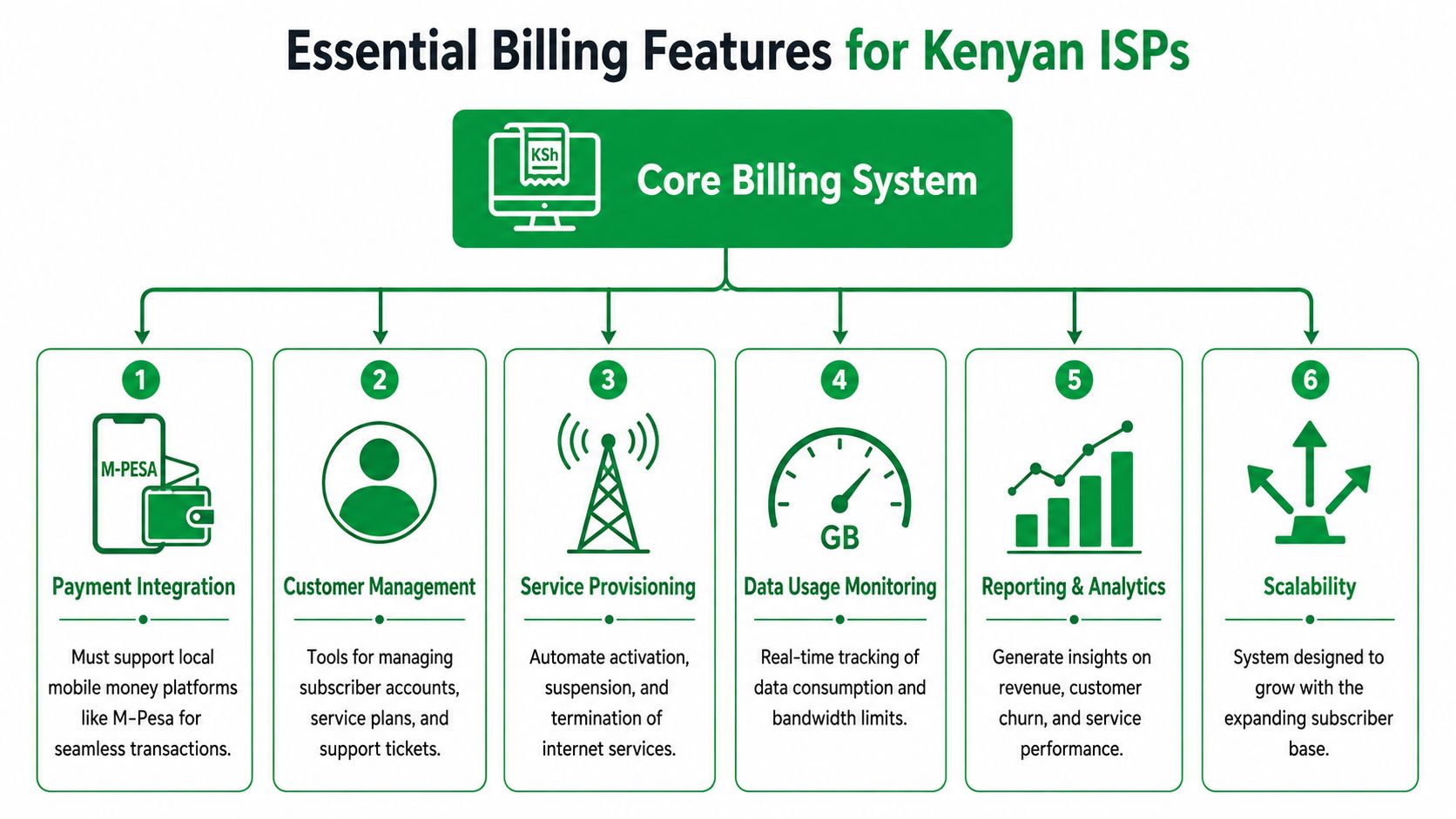
A billing platform for a Kenyan ISP has to work like part of the network, not like a separate finance app. If it can't control access, track service state, and reflect what happened on the router, it will create admin work instead of removing it.
Network enforcement first
Kenya-focused ISP deployments that use MikroTik RouterOS commonly follow a four-layer path of device → router → RADIUS → billing hub, so authentication and policy enforcement happen at session start, not after usage, according to this MikroTik ISP billing workflow reference. That matters because a paid customer expects access immediately, and an unpaid customer shouldn't remain online because someone forgot to update a spreadsheet.
In practical terms, the billing system should support:
PPPoE control: For fixed wireless or home internet subscribers who need authenticated sessions and plan-based speed control.
Hotspot management: For campuses, estates, hostels, cafés, and public Wi-Fi operators selling timed or account-based access.
RADIUS integration: To authenticate users and apply bandwidth policy in real time.
Router synchronisation: So account state in billing matches the actual network state on MikroTik devices.
Customer operations that reduce tickets
Technical control alone isn't enough. Operators also need tools that reduce routine support work.
A strong setup should include:
Self-service access: Customers should be able to see bills, check account status, and make payments without calling your office.
Automated provisioning: New accounts, renewals, suspensions, and reactivations should follow rules instead of manual approval.
Captive portals and plan changes: Especially useful for hotspot environments and mixed-service networks.
Remote multi-site management: Important when you run several towers, branches, or estates and can't log into each device manually.
When the router and billing engine disagree, customers notice before staff do.
The best-performing setups are boring in the right way. Payment comes in, policy updates immediately, and no one needs to “check first”.
Solving Collections with Smart M-Pesa Integration
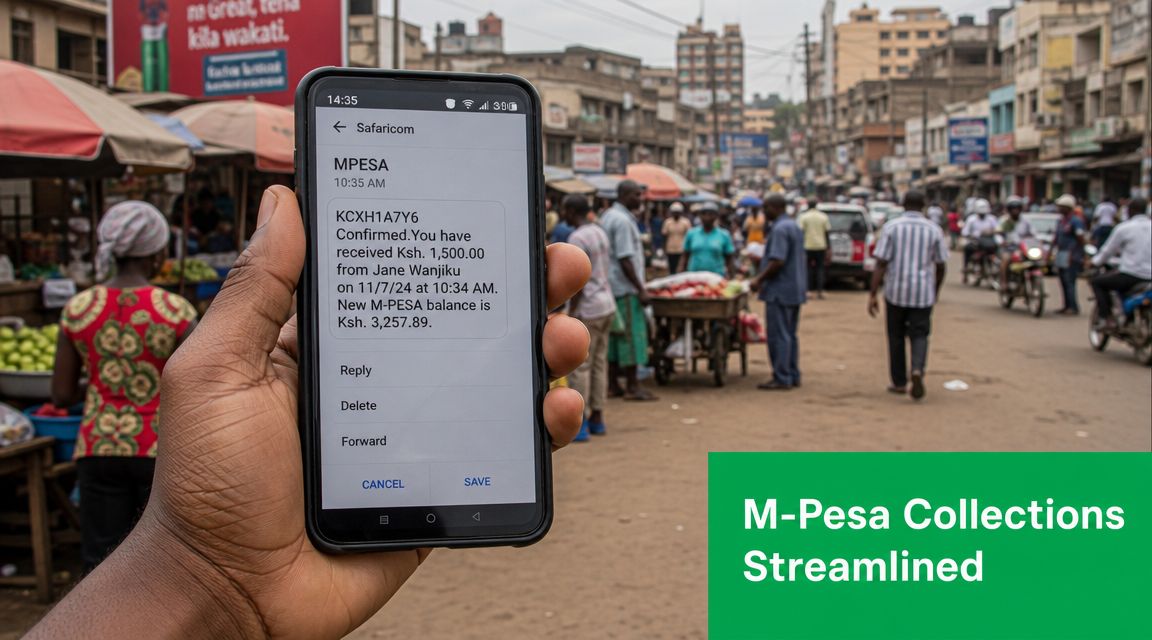
For Kenyan ISPs, M-Pesa integration isn't a feature badge. It's the centre of collections. Bankable and FSD Kenya reporting summarised by LipaNet shows that M-Pesa had about 30 million active customers, about 83% of adult Kenyans were using mobile money, and over 90% of person-to-person transfers moved through mobile money, which is why STK Push, Paybill or Till reconciliation, and near-real-time posting belong in the core workflow for a Kenya billing setup, as described in this M-Pesa billing integration overview.
What manual collection looks like
A small ISP in Ruiru with about 200 subscribers can easily spend several days in each cycle texting customers manually, checking statements, and confirming who has paid. In that setup, money may arrive, but service restoration still depends on someone reading the statement correctly, matching the receipt, and updating the account.
That's slow, and customers feel it immediately.
What an automated flow looks like
The better workflow is straightforward:
Initiate the payment request
Receive the transaction callback
Match the receipt code to the subscriber account
Auto-provision or re-enable service
Reconcile the ledger against the mobile-money statement
That process is what turns mobile money into an operations tool instead of a payment inbox. The main failure point is the mismatch between gateway callbacks and local accounting records. When that happens, you get delayed reconnects, duplicate crediting, or unposted partial payments.
A useful parallel from finance teams is how they automate invoice reminders so follow-up doesn't depend on memory or staff availability. The same thinking works for ISPs. Prompt the customer to pay, record the result automatically, and enforce account rules consistently. If you want to see how a subscriber-facing payment flow fits into that model, this Lipa na M-Pesa portal example is a practical reference.
Fast collections come from reducing payment friction, not from sending harsher reminders.
The Top Three Billing Mistakes Kenyan ISPs Make
Most billing mistakes aren't technical. They're process mistakes that stay hidden until the network grows and the admin team can't keep up.
Manual payment confirmation
This is still common. A customer pays, then sends a screenshot or message, and staff manually confirm the transaction before reactivating the account. The immediate cost is delay. The bigger cost is inconsistency, because different staff will treat the same situation differently.
An automated billing platform fixes this by linking payment confirmation directly to account status and service activation. Once the payment is verified, the system updates the account and applies the correct service state without waiting for a human checkpoint.
Weak follow-up on unpaid accounts
Many ISPs are polite for too long. They know who hasn't paid, but reminders go out late, or not at all, and suspension happens inconsistently. That trains customers to pay only after personal follow-up.
A better pattern is scheduled dunning. Reminders go out before expiry, again when payment is overdue, and service rules apply automatically after the grace window you define. One system that supports this kind of workflow is Centipid Billing System, which handles automated reminders, payment confirmation, reporting, and access control for ISP operations.
Unpaid accounts should follow a rule, not depend on who is on shift.
Flying blind on reporting
Some operators can tell you which customers owe money, but not which plans are worth keeping, which locations collect poorly, or which package changes are overdue. That's not a reporting problem alone. It becomes a pricing problem.
Real-time reporting helps an ISP spot plans that attract demand, plans that underperform, and accounts that need closer collections attention. When you can see revenue and subscriber behaviour as it happens, pricing stops being guesswork and starts becoming management.
Your Checklist for Choosing the Right Billing System
A software demo can sound impressive and still leave your collection problems untouched. The easiest way to assess billing systems in Kenya is to check whether the platform solves daily operational failures, not whether it has a long feature list.
For comparison, it can also help to understand ARPHost's billing approach and see how another provider frames billing rules, customer responsibility, and service control. That won't map directly to an ISP workflow, but it sharpens the questions you should ask in a demo.
ISP billing system selection checklist
Feature/Capability | Why It's Critical for Kenyan ISPs |
|---|---|
Automated M-Pesa STK Push and reconciliation | Reduces manual matching, shortens collection cycles, and lowers “paid but still blocked” disputes |
MikroTik PPPoE and hotspot integration | Connects billing to actual service delivery so access rules are enforced automatically |
Automated dunning and suspension rules | Keeps collections consistent and removes the need for manual chasing |
Real-time financial reporting | Helps staff monitor payments, overdue accounts, active services, and plan performance |
Subscriber self-service portal | Cuts routine calls by letting customers view bills, pay, and manage their accounts |
Scalable pricing model | Matters when you're growing from a small subscriber base to multiple sites or mixed services |
Multi-site device management | Useful for operators serving estates, towns, campuses, or branch networks |
Audit trail for payments and account actions | Makes disputes easier to resolve and improves internal accountability |
If a system can't explain how it handles failed payments, partial payments, and reconnections, keep looking.
How to Migrate from Spreadsheets to an Automated System
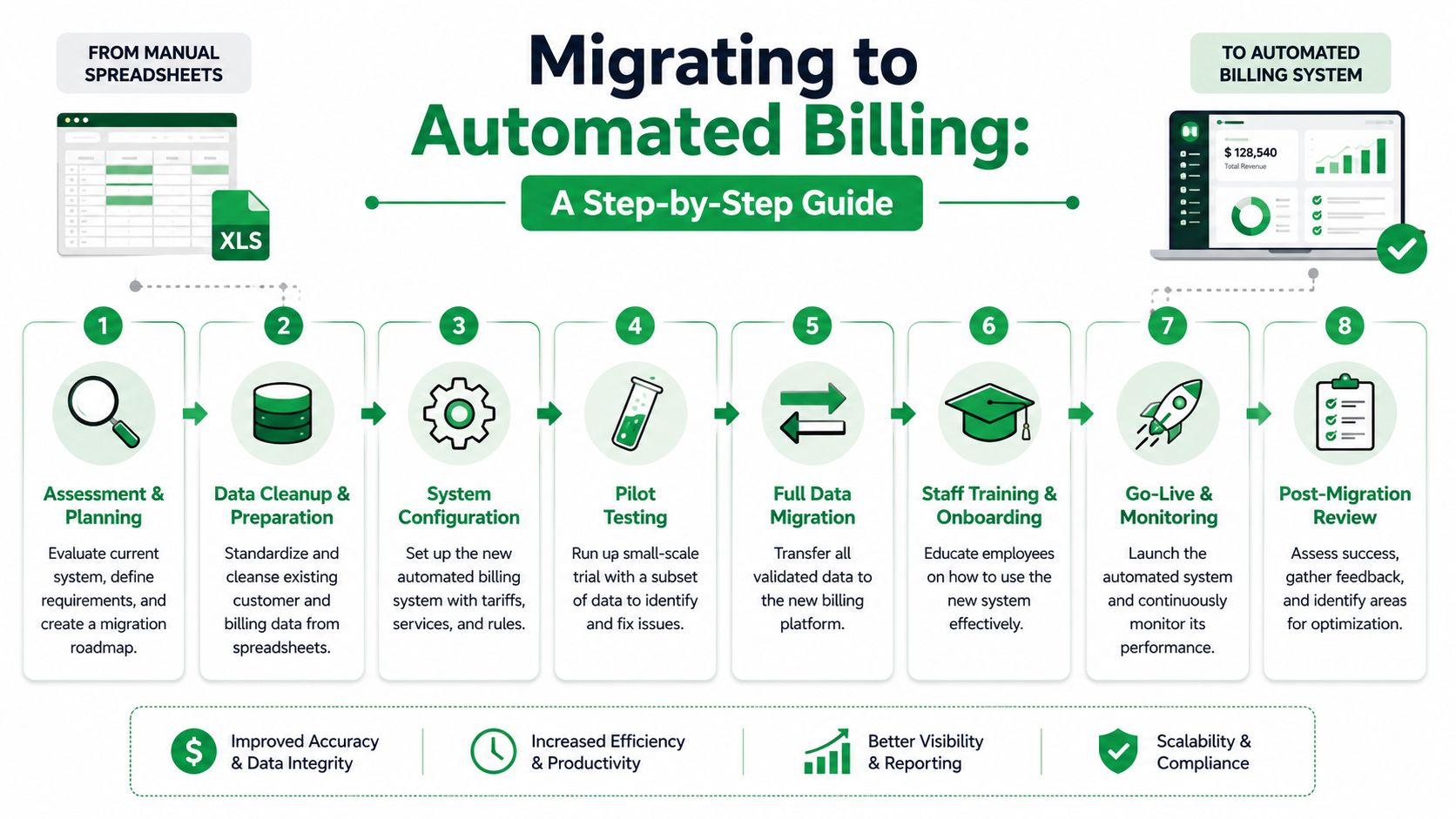
Migration feels difficult when the current setup is undocumented. In practice, most moves succeed when the operator cleans data first and tests service rules before going live.
The migration path that works
A typical move from spreadsheets follows this order:
Assess the current setup
Review customer records, package names, balances, routers in use, and how billing cycles are currently handled.Clean the data
Remove duplicates, fix inconsistent plan names, and separate customer details from payment history.Configure the system
Set pricing plans, bandwidth rules, billing cycles, and payment methods.Import customers and balances
This step needs care because bad opening balances create distrust immediately.Connect the routers
Set up MikroTik integration for PPPoE or hotspot access control.Test real scenarios
Create a user, process a payment, suspend a late account, then reconnect it.Go live
Once the tests match expected behaviour, stop using spreadsheets for daily operations.Train the team
Staff should know how to add clients, verify payments, read reports, and handle exceptions.
How long it usually takes
The timeline depends mostly on data quality and testing discipline.
Small ISP: Up to about 300 to 500 clients often takes 2 to 5 days
Medium ISP: About 500 to 3000 clients often takes 5 to 10 days
Large ISP: Above 3000 clients often takes 1 to 3 weeks
Most of the time is spent on cleanup and testing, not installation. Operators who rush those two stages usually recreate their spreadsheet problems inside the new platform. This guide to an ISP subscriber management system is useful if you're mapping customer records and service states before migration.
Clean data beats fast deployment. If names, balances, and plans are inconsistent, automation will expose the mess rather than fix it.
Future-Proofing Your ISP's Operations
An automated billing setup gives you more than cleaner admin. It gives you a controllable business. Collections become predictable, reconnections happen on time, and staff stop spending their best hours on repetitive tasks. If you want a wider operational lens, this short guide on automating repetitive tasks is a useful reminder that the biggest wins often come from removing manual handoffs.
There's also a forward-looking issue worth watching. Public discussion has noted a bill proposing meter billing systems for telecommunications companies and ISPs in Kenya, but the practical side is still underexplained, including calibration, dispute handling, and how metered usage would fit with existing M-Pesa-based workflows, as highlighted in this recent Kenya metered billing discussion. Small ISPs should pay attention now, because policy language arrives before implementation guidance.
A flexible operating model matters more than ever. Some providers will need billing, CRM, and network management in one place. Others will need separate systems connected carefully. This guide to when you need billing, CRM, and NMS separately is a practical way to think about that decision before growth forces it on you.
If your ISP is still relying on spreadsheets, manual M-Pesa checks, and inconsistent suspension rules, Centipid Technologies Ltd. is worth evaluating as part of your shortlist. Their platform is built for ISP billing operations, including MikroTik integration, customer management, payment workflows, and revenue reporting, which makes it relevant for Kenyan operators trying to move from manual chaos to a controlled billing process.