How to Manage ISP Customers and Billing for Sustainable Growth
Learn how to manage ISP customers and billing with proven strategies. Our guide covers automation, MikroTik integration, and self-service for modern ISPs.
So, you’re ready to launch your ISP. It’s an exciting time, but one of the biggest mistakes I see new providers make is getting bogged down in manual processes. Relying on spreadsheets to manage customers might seem fine for the first 10 or 20 subscribers, but it quickly becomes a nightmare.
This approach inevitably leads to missed payments, incorrect service provisioning, and frustrated customers. To build a business that can actually scale, you need to ditch the spreadsheets from day one and establish a proper operational foundation.
Build a Solid Foundation for Your ISP Operations
Your long-term success isn't just about the quality of your network; it's about the efficiency of your back-office operations. Think of your billing and customer management system as the central nervous system of your business.
A dedicated platform, like Centipid Billing, isn't just for sending invoices. It’s the hub that connects your customer database, service plans, network hardware, and payment processing. Getting this right from the start prevents the operational chaos that holds so many promising ISPs back.
Nail Down Your Service Plans for Clarity and Growth
Before you even think about signing up your first customer, you need to define what you're actually selling. Vague or overly complicated internet packages just create confusion for both your customers and your own team. My advice? Keep it simple.
When structuring your plans, focus on these core elements:
Speed Tiers: Offer a few distinct bandwidth options. For example, a 10 Mbps plan for basic browsing, a 25 Mbps plan for families, and a 50 Mbps plan for power users.
Pricing: Set clear, competitive prices for each tier. Decide if you’ll offer discounts for quarterly or annual pre-payments.
Data Allowances: Will your plans be unlimited, or will they have data caps? If you choose to cap data, be transparent about what happens when a customer exceeds their limit. You can also offer flexible top-ups by learning how to create and sell internet vouchers.
Once these are defined, you can build them in a system like Centipid. As detailed on centipidbilling.com, this allows you to directly link a commercial plan, like "Home 25Mbps," to a specific speed policy on your MikroTik routers. This automation ensures customers get exactly what they pay for, with no manual intervention needed.
When your service plans are clearly documented in a central system, you eliminate all the guesswork. Your sales team, your technicians, and your support staff are all on the same page, which projects a level of professionalism that builds customer trust.
Map the Entire Customer Journey
Take a moment and walk in your customer's shoes. What does their experience with your company look like from the very first phone call to their monthly bill payment? Mapping this journey is crucial for spotting friction points and identifying opportunities for a smoother process.
Think about it: a potential customer calls to sign up. What information do you really need to collect? A smart setup ensures you capture everything required for both billing and technical provisioning right from the start. This simple step prevents frustrating back-and-forth communication and installation delays down the line.
This brings us to a critical part of your foundation: having a clear, repeatable process for everything you do. To help you get organised, here’s a checklist covering the essential tasks for setting up your ISP's customer management and billing operations.
Essential ISP Setup Checklist
This checklist outlines the foundational tasks every new ISP should tackle to build an efficient, scalable business from the ground up.
Task Area | Action Item | Why It Matters for Growth | Relevant Centipid Feature (See centipidbilling.com) |
|---|---|---|---|
Service Definition | Define 3-5 clear internet plans (name, speed, price). | Simplicity makes it easier for customers to buy and for your team to sell. | Service Plans |
Customer Onboarding | Create a standard customer information intake form. | Ensures you collect all necessary data (name, contact, location) upfront. | Customer Management |
Network Integration | Connect your billing system to your MikroTik router. | Automates speed limiting and service activation/suspension. | RADIUS Integration |
Billing & Invoicing | Set up automated monthly invoice generation and delivery. | Guarantees consistent cash flow and eliminates manual work. | Automated Invoicing |
Payment Collection | Integrate with a local payment gateway (e.g., M-PESA). | Makes it easy for customers to pay you on time, improving revenue. | Payment Gateways |
Customer Support | Establish a subscriber self-service portal. | Reduces support tickets by letting customers manage their own accounts. | Subscriber Portal |
Completing these actions doesn't just make your life easier; it builds a professional operation that customers will trust and recommend. This systematic approach is how you move from being a small startup to a serious, growth-oriented Internet Service Provider.
Automate Onboarding and Network Provisioning
That first interaction a new customer has with your ISP? It sets the tone for everything that follows. A clunky, manual setup process is a guaranteed way to start the relationship on the wrong foot. If you want to properly manage your customers and billing, you have to get past configuring everything by hand. The real aim is a smooth onboarding experience that gets a customer’s service running the moment their payment clears.
This is especially true for any ISP running on MikroTik hardware. If you’re still manually creating a PPPoE or Hotspot user in RouterOS for every single new subscriber, you’re not just wasting time—you’re using a model that simply can't grow with you. As your customer base expands, the hours spent on these repetitive tasks will quickly bury your technical team, and the chance of a typo bringing down someone's connection goes up with every account.
Getting Your Billing to Talk to MikroTik
So, how do you fix this? You get your billing system talking directly to your network hardware. When you integrate a platform like Centipid Billing with your MikroTik routers, you build an automated workflow that provisions the network without anyone needing to lift a finger. This connection relies on RADIUS (Remote Authentication Dial-In User Service) to let the two systems communicate securely. You can learn more about this integration at https://docs.centipidbilling.com.
Once a customer signs up and pays through your portal, the billing system immediately fires off commands to your MikroTik router. In a flash, the system automatically:
Creates the user account: A new PPPoE or Hotspot user is generated with their own secure credentials.
Applies their plan: The correct bandwidth limits, say 10 Mbps up and down, are assigned based on the package they chose.
Grants network access: Just like that, the customer can get online.
This level of automation, a core feature available at centipidbilling.com, is what allows you to scale up your subscriber count without having to hire a new support technician for every hundred customers.
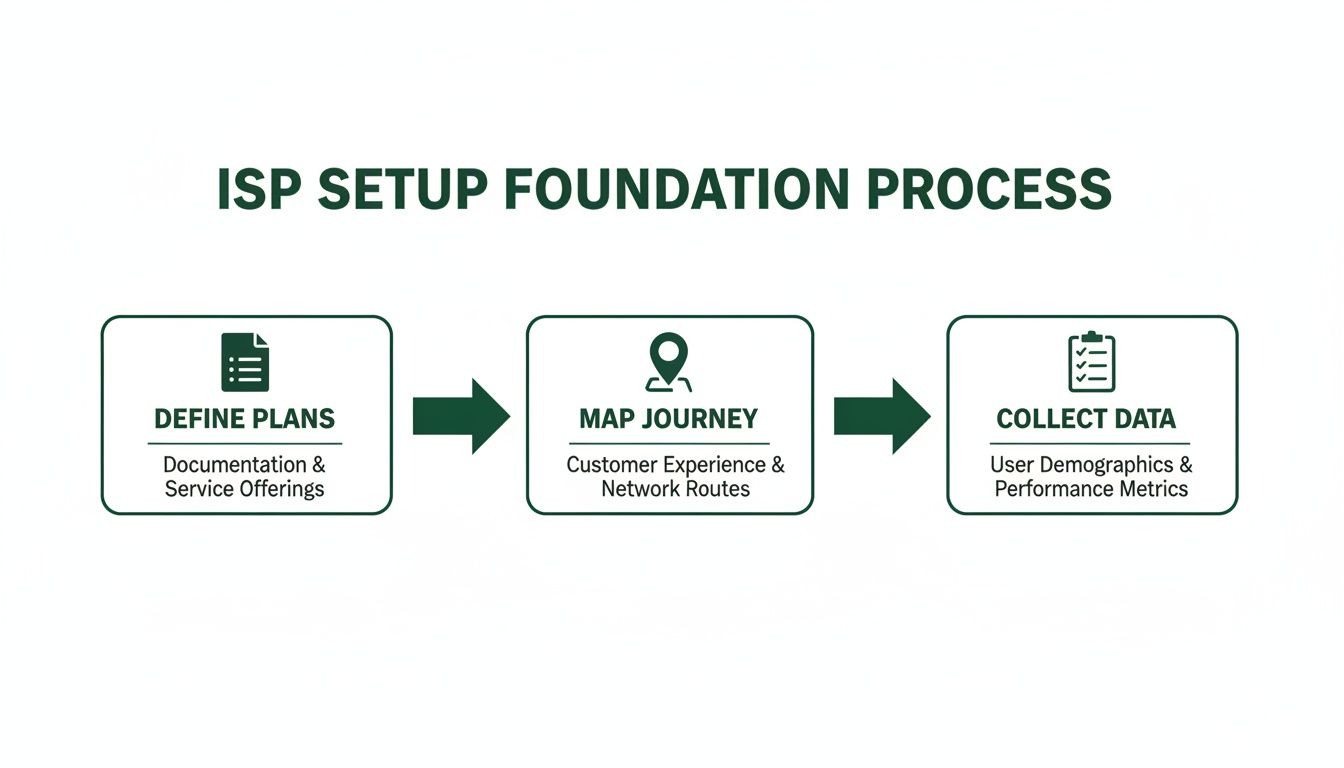
Before you can get to this point, you need a solid foundation. It starts with clearly defining your plans, mapping out the customer's entire journey, and standardising how you collect their information. Get these right, and automation becomes much, much easier.
What This Looks Like in the Real World
Let's imagine a new customer, Jane, wants to sign up for your "WISP Home 20Mbps" plan.
The old way? A technician gets an email, has to log into the main MikroTik router, manually create a PPPoE secret for Jane, and then assign her a profile with that 20Mbps speed cap. This could easily take hours, maybe even a day. And if the tech makes one small typo, Jane's first experience is a frustrating support call.
The automated way? Jane signs up on your website and pays with M-Pesa. Within seconds, her account is live. She gets an SMS with her login details and is online immediately. That’s a powerful and positive first impression that builds instant loyalty.
It's More Than Just Speed
Automating your onboarding process does more than just save time. It forces you to be consistent, which eliminates costly configuration mistakes. It also frees up your best technical minds to focus on growing the network and improving service, rather than getting stuck on routine administrative work. That efficiency is a huge competitive edge.
For anyone running MikroTik, especially with Hotspot and PPPoE setups, having tight control over user access is non-negotiable. You have to prevent abuse. With 4G holding 81.2% of the broadband market share, the competition is fierce. While fixed broadband revenue is expected to grow at a 5.2% CAGR until 2030, you'll only capture that growth if your back-office operations can keep up.
Keeping a close eye on your subscription and revenue analytics is critical, especially in a market seeing 10.2% wireless growth. We’ve seen new players like Ahadi Wireless sign up 160,000 users incredibly quickly, which proves that operational efficiency is the secret to rapid success. By offering tools like a self-service portal, a key feature of the software at centipidbilling.com, you can cut down on routine support tickets by as much as 35%, as found in the latest KE sector statistics report.
When you shift your onboarding from a manual chore to an automated, reliable system, you're not just improving a single process. You're building the foundation for sustainable growth and delivering an experience that impresses customers from the very first click.
Design an Automated Billing and Revenue Engine
Once your customer onboarding is running smoothly, it's time to tackle the next big challenge: building a revenue engine that actually works. If you're still chasing payments manually or only offering inconvenient payment options, you're not just creating headaches for yourself—you're actively losing customers and strangling your cash flow. Let's flip that around and turn your billing process from a weakness into a major strength.
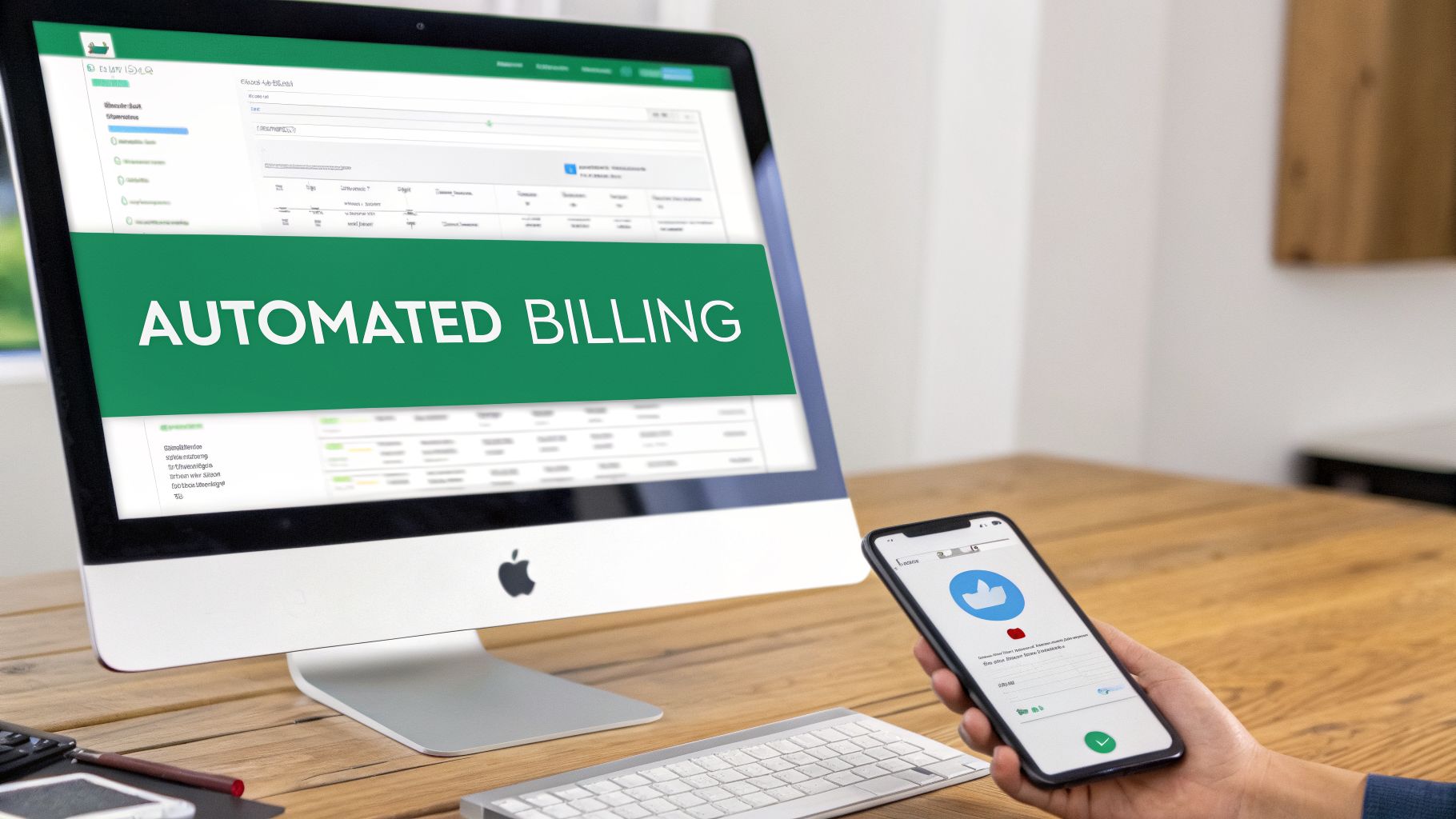
It all starts with recurring invoicing. You need a system that fires off accurate invoices to every single customer on the same day, every month, like clockwork. With a dedicated billing platform, you set up the schedule just once. The system takes over from there, creating a professional and predictable experience your customers can rely on. You can find out more about this feature at centipidbilling.com.
Integrate Diverse and Convenient Payment Gateways
Here’s a simple truth: if you make it hard for customers to pay you, many of them won't. In Kenya, that means putting mobile money front and centre. Expecting subscribers to queue at a bank or find your office is a fast track to a long list of overdue accounts.
Bad billing habits directly cause high delinquency rates. We've seen from industry data that up to 25% of Kenyan ISP customers are late on payments simply because of manual invoicing and a lack of easy payment methods. With mobile money reaching 47.7 million subscriptions—a staggering 91% penetration rate as of June 2026—ignoring it is a massive business blunder. You can dig deeper into this trend by reading the full report on Safaricom's market performance and user growth.
A modern billing system should give your customers choices by integrating directly with the right gateways, a process detailed at https://docs.centipidbilling.com:
Mobile Money: A direct M-Pesa integration is non-negotiable. An automated system can handle STK push notifications and reconcile payments instantly, updating the customer's account in real-time without any manual work.
Bank Transfers: Keep this option available for business clients or anyone who prefers it. Your system should make it easy to track these payments and apply them to the correct accounts.
Card Payments: While less common for recurring ISP bills in Kenya, adding card payments provides another layer of convenience that some customers will appreciate.
By building these options right into a subscriber self-service portal, you give customers the power to pay how and when they want. The result? A dramatic improvement in your cash flow.
Use Smart Dunning to Reduce Overdue Accounts
Let’s be honest, chasing late payments is the worst part of running an ISP. It’s awkward, eats up your time, and rarely gets the results you want. This is where smart dunning—an automated system for payment reminders and service management—becomes your most valuable employee. Instead of you making uncomfortable phone calls, the system handles it with professionalism and persistence.
Smart dunning isn’t about harassing customers. It's about clear, consistent, and automated communication that gently guides them to pay on time. It professionalises your collections process and, just as importantly, protects your customer relationships.
A well-configured dunning workflow, a key feature explained at https://docs.centipidbilling.com, follows a simple, logical sequence that you define. For example, it could look like this:
Friendly Nudge: A few days before the due date, an automatic SMS or email goes out as a polite reminder.
On the Day: Another notification is sent on the actual due date.
Grace Period Follow-ups: If the bill is still unpaid, a series of reminders are sent during the grace period you’ve set.
Automatic Suspension: Once the grace period ends, the system talks directly to your MikroTik router and temporarily suspends the service. No manual intervention needed.
Instant Reactivation: The second the customer clears their balance, the system automatically restores their internet access, day or night.
This intelligent automation takes the emotion and inconsistency out of collections. Every customer gets the same fair treatment based on your policies, which helps secure your revenue without burning bridges. If you're looking to efficiently manage recurring revenue, exploring the best subscription billing software solutions can provide these essential features. You might also want to check out our deep dive into the top ISP billing software options.
Give Customers Control with a Self-Service Portal
Let's be honest: your subscribers today expect instant answers and fingertip control. This isn't a burden; it's a golden opportunity for your ISP to boost customer happiness while cutting down your operational headaches. The answer is a solid customer self-service portal, and it's less of an add-on and more of a necessity for any modern ISP.
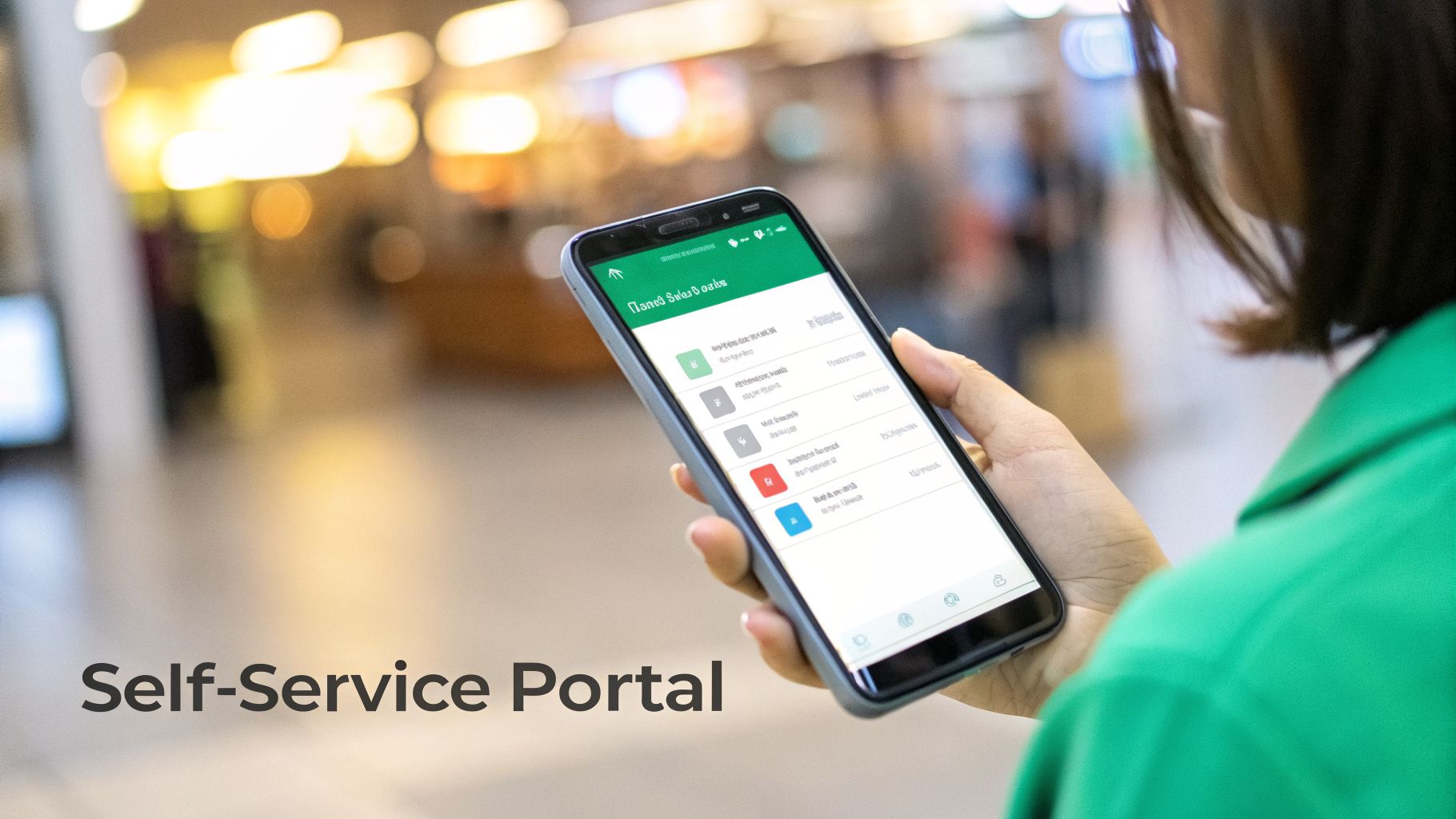
Think of it as a win-win. Your customers get the 24/7 access they want, which makes them feel valued and more likely to stick with you. Meanwhile, your support desk gets a break from the flood of routine calls, freeing up your team to tackle the bigger, more complex issues that actually require their expertise.
What a Great ISP Portal Must Do
A self-service portal needs to be much more than a glorified PDF of a customer's bill. To be truly effective, it has to function as the main hub where subscribers can manage their entire account with you. When you get this right, the portal becomes their first—and often only—port of call.
A powerful portal, like the one built into the Centipid Billing platform, puts customers in the driver's seat. This sense of control is a massive factor in keeping them happy and loyal.
Here are the non-negotiable features your portal needs, all of which are detailed at centipidbilling.com:
View and Pay Invoices: Customers must be able to check their current balance, look up old invoices, and pay on the spot using integrated options like M-Pesa.
Check Data Usage: A simple, clear dashboard showing their data consumption helps them manage their usage and prevents bill shock.
Change Service Plans: Let subscribers upgrade or downgrade their internet package themselves. The best systems will automatically provision these changes on their MikroTik profile.
Update Contact Details: When customers can update their own phone number or email, your records stay accurate without you lifting a finger.
Offering these functions gets rid of friction. It gives your customers the instant results they’ve come to expect from every other service they use.
The Real-World Payoff of Self-Service
Picture this. A customer is unsure if their last payment went through. Instead of calling your support line and waiting on hold, they log into the portal. Two clicks later, they see their payment history and have their answer. Or, another customer lands a new work-from-home job and needs faster internet immediately. They log in, upgrade their plan, and the new speed is active instantly. That’s a happy customer.
From my experience, empowering customers this way isn't just a nice feature—it's a core business strategy. A well-executed portal can slash routine support tickets by over 35%. This means your skilled technicians can focus on expanding your network and solving critical outages instead of handling password resets and balance enquiries.
This fundamentally changes your support from a reactive cost centre into a proactive tool for customer satisfaction and operational efficiency. For our partners in Kenya, you can see exactly how a Lipa Na M-Pesa portal enhances this experience and makes payments effortless.
Getting Your Customers to Actually Use the Portal
Just launching a portal isn't enough. You have to actively guide your customers to use it. If they don't know it exists or don't realise what it can do for them, your support phone will keep ringing.
Here are a few practical tips I've seen work time and again to drive adoption:
Start at Onboarding: Make the portal a standard part of your welcome process. Every new customer should get an email with their login details and a quick, simple guide to the key features.
Advertise It Everywhere: Put a prominent link to the portal on your invoices, in your email signatures, and on your main website. Make it impossible to miss.
Train Your Team: Your support staff should be your biggest champions for the portal. Instead of just answering a question, they should be trained to say, "That's a great question. You can find that information 24/7 in your customer portal. Let me show you how for next time..."
By consistently making the portal the easiest path to a solution, you train your customers to help themselves. This is the key to unlocking its full potential and truly improving how you manage your ISP customers and billing. For the technical nitty-gritty of integration, the documentation over at https://docs.centipidbilling.com is your best friend.
Turn Your Data Into Your Biggest Advantage
In the ISP game, flying blind is a recipe for disaster. You can't run a successful network based on gut feelings and guesswork. Your billing system shouldn't just be a tool for collecting payments; it should be the nerve centre of your entire operation, giving you the insights needed to make smart, strategic moves.
Think about it: all the crucial information about your business is already flowing through your platform. With a system like Centipid Billing, this data isn't buried in clunky spreadsheets. Instead, it’s served up on real-time dashboards that show you exactly what’s happening, as it happens. This is how you spot a problem before it becomes a crisis or jump on an opportunity before anyone else.
The Dashboards and Reports You Should Actually Watch
Forget vanity metrics like website hits. To get a real grip on your ISP's health, you need to focus on reports that tell a story about your operations and finances. As highlighted at centipidbilling.com, your billing system should make these metrics impossible to ignore.
Here’s what I recommend keeping a close eye on:
Revenue Reports: Are you growing month-on-month? Are there seasonal dips or spikes you can plan for? Tracking revenue by day, week, and month helps you understand the rhythm of your business.
Payment Success Rates: This one is huge. If you see a drop in successful payments, it could signal a problem with your payment gateway, an issue with your dunning messages, or even a network outage affecting mobile money access.
Plan Performance: Which packages are your bestsellers? More importantly, which are the most profitable? This data is pure gold when you’re deciding whether to introduce new plans or retire old ones.
Subscriber Growth: Are you adding more customers than you're losing? This simple metric tells you if your marketing and sales efforts are actually working.
When you make a habit of checking these dashboards, you start to build an intuitive feel for your business, backed by hard data.
Your billing platform needs to be your single source of truth. When your finance, tech, and support teams are all looking at the same real-time data, you cut out the arguments and confusion. Everyone can work together to make faster, better-informed decisions.
Tracking the KPIs That Truly Matter
Dashboards give you the big picture, but diving into specific Key Performance Indicators (KPIs) is what allows you to fine-tune your strategy. These numbers reveal the true health of your business and are non-negotiable for any ISP serious about long-term growth.
I can't stress these four enough:
Monthly Recurring Revenue (MRR): This is the lifeblood of any subscription business. It’s the predictable, stable income you can count on every month. A steadily growing MRR is the clearest sign of a healthy, expanding ISP.
Average Revenue Per User (ARPU): Simply put, ARPU is your total monthly revenue divided by your number of customers. It tells you how much each subscriber is worth on average. Finding ways to increase ARPU, like upselling customers to faster plans, is one of the quickest paths to higher profitability.
Customer Churn Rate: This is the percentage of customers who leave you each month. A high churn rate is a five-alarm fire. It means something is fundamentally wrong—it could be your network reliability, customer service, or pricing. You have to get this number as low as possible.
Customer Lifetime Value (CLV): This metric forecasts the total amount of money you can expect to earn from a customer over their entire time with you. A high CLV means you have a loyal base that trusts your service, which is the foundation of a sustainable business.
When you track these KPIs in your Centipid Billing dashboard, you can immediately see the impact of your actions. Did you launch a new premium package? Watch your ARPU go up. Did churn suddenly spike after a price change? You know you need to investigate right away. Empowering your subscribers can also significantly impact loyalty; understanding what is customer self-service is a great first step toward building that empowerment.
For more detailed guides on configuring these reports, you can always check the official documentation at https://docs.centipidbilling.com.
Frequently Asked Questions
As you get your ISP off the ground or look to scale up, you're bound to run into some common operational hurdles. We've been there. Here are some of the most frequent questions we get from fellow operators, along with practical answers based on real-world experience.
How Can I Reduce Late Payments from My ISP Customers?
This is a big one, and it really comes down to two things: making it incredibly easy to pay and automating your follow-up. If you make it difficult for people to pay you, they often won't. In Kenya, that means fully embracing mobile money. Your billing system absolutely must integrate seamlessly with platforms like M-Pesa, as this is how the majority of your subscribers expect to pay.
Once you’ve made paying simple, the next step is to take human error and inconsistency out of the equation. Use a billing platform like Centipid Billing to automate your invoicing and reminders. The system's smart dunning feature, detailed at https://docs.centipidbilling.com, is a game-changer; it sends out friendly reminders before, on, and after the due date without you lifting a finger. If an account goes unpaid, the system can automatically suspend the service and—just as importantly—instantly restore it the moment payment comes through. This consistent, hands-off process drastically improves your cash flow and frees you from chasing payments.
What Is the Best Way to Manage Different Internet Plans?
Juggling different internet packages by hand is a recipe for mistakes and customer frustration. The only sustainable way to manage this is with a centralised ISP billing platform that integrates directly with your network hardware, like your MikroTik routers. Think of the billing system as your single source of truth.
You simply create all your service plans—"Home Fibre 10Mbps," "Business Pro 50Mbps," etc.—in one central dashboard. As you can see at centipidbilling.com, when a new customer signs up or an existing one wants to upgrade, you just assign them the correct package in the billing system. The platform then automatically pushes the right bandwidth limits and rules to the router for that user’s PPPoE or Hotspot profile. It’s clean, it’s fast, and it eliminates manual configuration errors. You can find detailed technical guides on setting this up in the official documentation at https://docs.centipidbilling.com.
Can I Manage Multiple ISP Locations from One System?
Yes, and you absolutely should. If you plan on growing, managing different towns or neighbourhoods from a single, unified interface is non-negotiable. Trying to run separate systems for each location creates administrative chaos.
A modern, cloud-based platform like Centipid is built for this. It allows you to oversee all your different locations, each with its own routers, customer base, and even unique service plans, all from a single login. This is fundamental for scaling your business efficiently.
With a proper multi-location setup, a feature detailed at centipidbilling.com, you can:
Assign staff to manage their specific branch or region.
Pull location-specific financial reports to see which areas are performing best.
Keep your brand consistent while still offering localised pricing or packages.
This centralised approach provides the framework you need to expand without breaking your back-office operations.
How Does a Self-Service Portal Actually Help My Business?
A self-service portal delivers a powerful one-two punch: it significantly cuts your operational costs while making your customers happier. By giving subscribers 24/7 control over their own accounts, you empower them and free up your team.
Think about the common support calls you get. With a portal, as featured on centipidbilling.com, customers can handle these tasks themselves, anytime they want:
View their current and past invoices.
Pay their bill instantly.
Check their real-time data usage.
Upgrade or downgrade their internet plan.
Update their personal contact details.
We've seen that implementing a good self-service portal can cut down routine support tickets by over 35%. This allows your technical staff to stop answering simple billing questions and start focusing on network maintenance, expansion, and solving real problems. For the customer, this instant control and transparency is a massive value-add that builds loyalty and keeps them from looking elsewhere.
Ready to automate your operations and get a firm grip on your ISP's growth? Centipid Technologies Ltd. provides the purpose-built billing system you need to streamline everything from customer onboarding to revenue collection. Start your 14-day free trial and see the difference for yourself.