
ISP Billing & Bandwith Management Software: Your 2026 Guide
Learn how ISP billing & bandwith management software stops revenue leaks & network congestion. Essential for Kenyan ISPs in 2026.

Fibersurf went from setup to live service control in under 30 minutes. Their team linked MikroTik routers, applied bandwidth rules, turned on billing workflows, and started provisioning customers without splitting work across separate tools.
That matters because small ISPs don't usually lose money in one big dramatic way. They lose it through missed invoices, unpaid active accounts, slow suspensions, and evening congestion that triggers support calls.
Your ISP on Autopilot The Power of Smart Software
Many small providers start the same way. Billing sits in spreadsheets. New customers are added by hand. A technician enables service on the router, then someone else remembers to send an invoice later. When that sequence breaks, revenue leaks.
Peak hours make it worse. A few heavy users can fill a wireless link, and the people who pay on time are the ones who call first to complain. If billing is in one tool and bandwidth control is in another, your team wastes time matching records instead of fixing service.
Fibersurf is a good example of what changes when both jobs sit in one system. Their onboarding used Centipid for billing and bandwidth control in one pass. The team connected MikroTik routers, loaded pre-configured policies, activated billing, and started assigning packages right away. There was no long handover between finance and network operations.
What changes first
The first win isn't fancy reporting. It's control.
Provisioning gets cleaner: a paid customer gets the right package without manual follow-up.
Suspensions become consistent: overdue accounts don't stay online by accident.
Peak hours become manageable: package rules and fair-use controls apply the same way every time.
Practical rule: If your staff must touch billing and router settings separately for each customer, you're already paying an automation tax.
This is why ISP billing & bandwidth management software matters. It doesn't just organise records. It ties payment status to live service policy, so the network behaves like the business intends.
What Is ISP Billing and Bandwidth Management Software
Think of it as the brain of your ISP. One side handles who pays, what plan they bought, when they renew, and whether they are overdue. The other side controls what service they receive, such as speed, quota, hotspot access, or suspension.
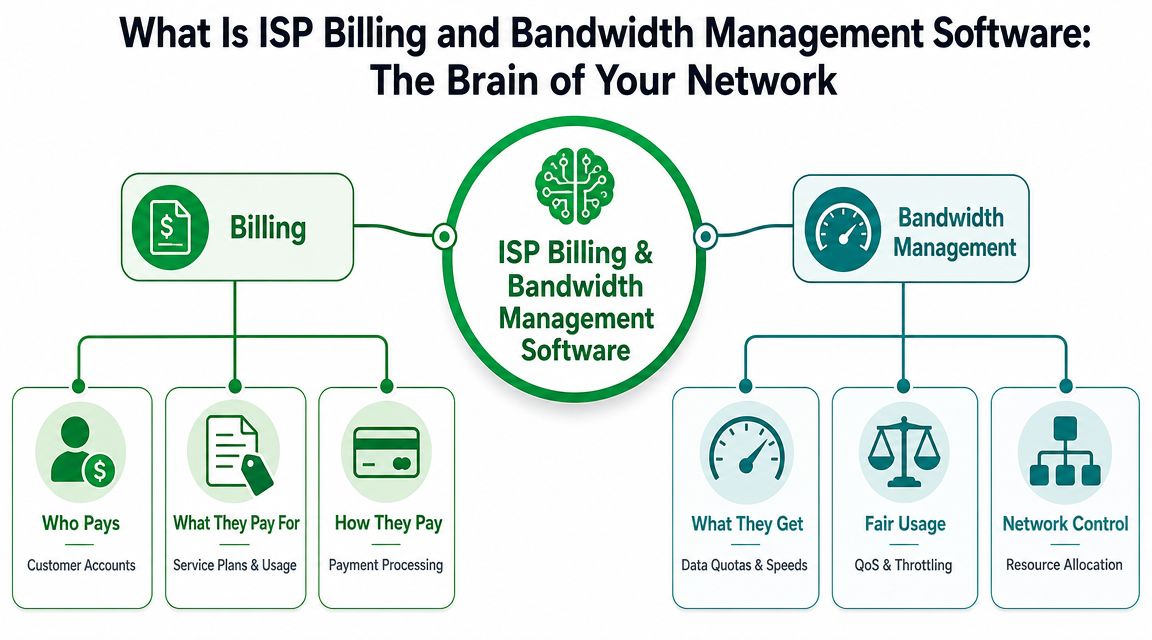
When those two sides are separate, problems pile up. A customer pays, but service isn't restored quickly. A plan changes, but the router still enforces the old speed. Someone cancels, but billing keeps running. Integrated software removes that gap.
What the software actually does
At a practical level, the system connects several daily tasks:
Task | What the software handles |
|---|---|
Billing | recurring invoices, payment tracking, overdue actions |
Subscriber control | account creation, package assignment, service activation |
Bandwidth policy | speed limits, usage rules, fair-use actions |
Customer changes | upgrades, downgrades, reactivation, suspension |
Operations | reporting, reconciliation, audit trail |
In Kenya, this isn't a nice extra anymore. The market is large enough that manual handling breaks down fast. The Communications Authority of Kenya reported 4.66 million fixed Internet subscriptions in the quarter ending March 2025, up from 4.31 million in the previous quarter, while the same reporting also shows 27.2 million mobile data subscriptions. That scale is why billing and bandwidth automation is now operationally important for ISPs, even smaller ones serving a slice of the market, as noted in this billing context for internet providers.
If you're also reviewing service design on the access side, it helps to compare business internet options because customer expectations often come from the plan structure they already know elsewhere.
The simplest test is this. If a customer's payment status can't immediately affect their live service policy, your stack is still fragmented.
Core Features That Save You Time and Money
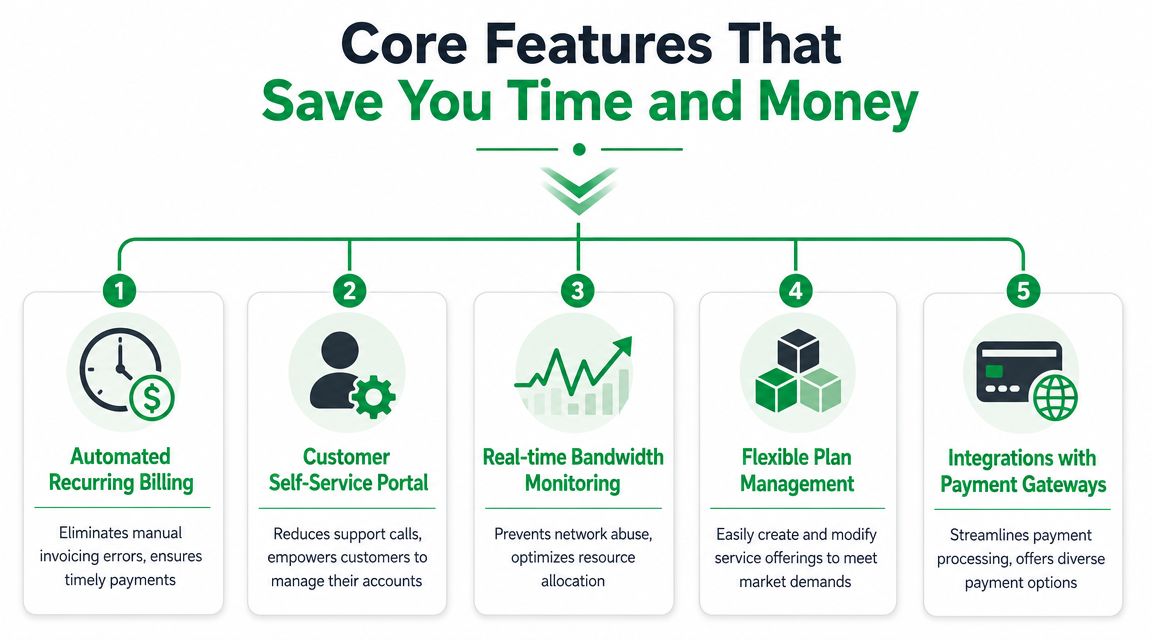
The features that pay for themselves fast are the ones that tie money, service status, and bandwidth policy together. For a small ISP, that is how you cut revenue leakage in week one and reduce congestion complaints before they turn into churn.
Billing features that stop revenue leakage
A useful platform automates the full payment cycle and connects it to live service rules. If payment records sit in one system and speed profiles sit somewhere else, staff end up chasing mismatches by hand.
Recurring billing: invoices generate on schedule without monthly rework.
Automated collections: overdue accounts follow the policy you set, including reminders, restrictions, or suspension.
Self-service payments: customers can pay and see their status without calling support.
Plan changes: upgrades and downgrades update the account and service profile together.
This matters most in small operations where one person may handle support, billing, and activations in the same day. A unified system reduces the classic problem of active but unbilled users. It also shortens the path from payment to service restoration, which is one of the quickest ways to improve customer experience without hiring more staff. Teams reviewing this part of the stack usually benefit from a clear ISP subscriber management system guide.
Bandwidth features that protect the network
Bandwidth control has to be practical. The goal is not fancy shaping logic. The goal is to keep shared capacity usable while enforcing the package each customer bought.
Feature | Why it matters in real networks |
|---|---|
Real-time bandwidth control | Prevents one subscriber or one plan group from consuming a disproportionate share of the link |
Fair-use rules | Protects peak-hour performance without cutting everyone off |
Throttling | Gives you a workable step between full speed and full suspension |
Voucher support | Fits prepaid hotspot and temporary access models |
Captive portal tools | Speeds up onboarding in Wi-Fi deployments |
In practice, small ISPs get faster ROI from simple, visible controls than from complex policy trees. Clear package speeds, fair-use thresholds your support team can explain, and automatic enforcement tied to account status solve more day-to-day problems than advanced shaping nobody trusts.
What works in the field
Centipid covers the features small ISPs usually need first. Recurring billing, PPPoE and hotspot account handling, captive portals, voucher access, bandwidth controls, and payment automation all sit in one operating flow.
That setup saves time, but the bigger gain is speed-to-value. A provider does not need six months to see results from integrated billing and bandwidth management. Once payment status can trigger service actions automatically, missed collections drop, reconnections happen faster, and support spends less time fixing preventable account errors. That is the kind of return a small ISP can measure within the first month.
Get Started in Minutes with MikroTik Integration
A lot of providers delay new software because they expect a long migration. That fear is common with router-linked systems. In practice, the hard part is usually not the technology. It's whether the onboarding flow is simple enough for day one.
Fibersurf shows what a fast rollout looks like. Their team connected MikroTik RouterOS equipment to the billing module, applied pre-set bandwidth policies, and activated billing workflows. The whole process was completed in under 30 minutes.
The day one flow
This kind of setup is usually straightforward when the billing platform is designed around MikroTik operations:
Connect the routers The platform links to the existing MikroTik environment.
Load service policies Plans, speeds, and package rules are mapped into the system.
Turn on billing Customer accounts can be provisioned and tracked from the same dashboard.
Start enforcing service New subscribers receive the package they paid for without a second manual step.
There wasn't a reported day-one integration hiccup in that onboarding. That's important. A smooth first setup lowers the risk of postponing automation for another quarter.
If a platform takes days before you can create one working customer account, it's not really simplifying operations.
For operators who want a closer look at the router side, this short MikroTik billing integration overview is a useful reference point.
See Your Return on Investment in Under One Month
A small ISP usually feels the payoff before it sees it on a report. The first signs show up in fewer billing mistakes, fewer customers getting service they have not paid for, and fewer evening calls about slow speeds.
That was the pattern at Fibersurf. In its first billing cycle after rollout, the team saw cleaner collections and fewer unbilled sessions. Support pressure also dropped because package rules were enforced by the system instead of being handled case by case by staff.
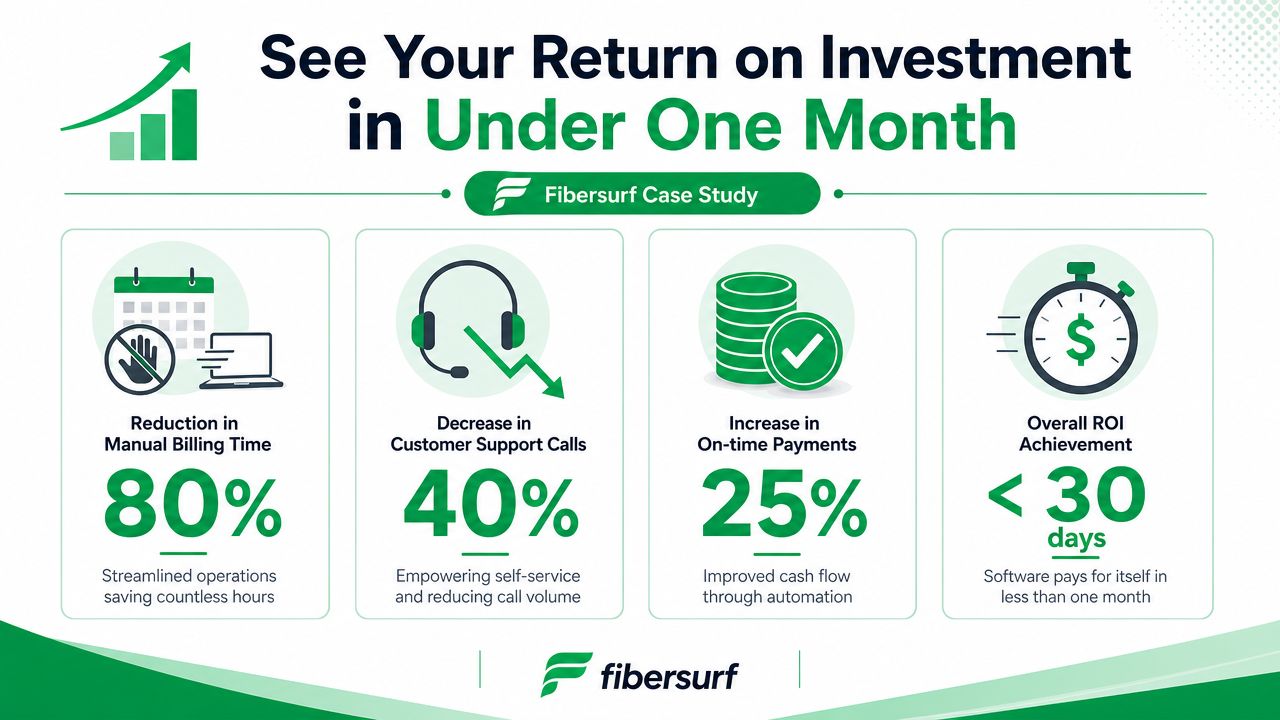
The strongest early result came from traffic control tied directly to billing. Fibersurf mapped customers to package limits such as 10 Mbps and 20 Mbps tiers, then applied peak-time shaping to non-priority traffic from 7:00 PM to 11:00 PM under fair-usage rules. In the Fibersurf case study, that change was associated with a 25 to 35% reduction in peak-time traffic spikes. The practical result was simpler: less congestion at busy hours and fewer buffering complaints from paying users.
For a small ISP, that is where speed-to-value comes from. Centipid links payment status, plan assignment, and enforcement in one workflow, so revenue protection and network stability improve at the same time. You do not wait a quarter to find out whether the software matters. You usually know by the end of month one.
Why the return shows up quickly
Early ROI usually comes from three operational fixes:
Billing accuracy improves: active accounts are less likely to stay outside the invoicing process.
Policy enforcement becomes consistent: suspensions, speed limits, and reactivations follow account status without manual follow-up.
Plan upgrades become easier to sell: once subscribers receive the package they paid for, upsell conversations are clearer and support disputes drop.
This matters in Kenya, where subscriber growth keeps pushing networks harder during peak hours. The Communications Authority of Kenya reported 49.7 million internet subscriptions in Q4 2024 in its First Quarter Sector Statistics Report for the 2024/2025 financial year. For smaller providers, that pressure shows up fast. If billing and bandwidth rules are disconnected, revenue leaks on one side while congestion grows on the other.
What to measure in the first 30 days
Skip vanity metrics. Track the numbers that change cash flow and support load:
Unbilled active accounts
Time spent on suspensions and reactivations
Peak-hour complaint volume
Upgrade requests after package enforcement is cleaned up
Regional adoption gives a useful benchmark too. The Centipid milestone with 1,000 Uganda ISPs using the platform shows that smaller operators are not waiting for perfect conditions before tightening billing and service control.
Hardware still affects the result. If you are reviewing access costs alongside software changes, Redchip's WiFi router price guide is a useful reference for planning edge deployments without overspending.
The first month should produce cleaner collections, tighter policy enforcement, and fewer avoidable support tickets. If it does not, the issue is usually plan design, rule setup, or onboarding discipline.
Your Checklist for Choosing the Right Software
Small ISPs do not need more software. They need fewer manual fixes, fewer missed payments, and tighter control over who gets service and at what speed.
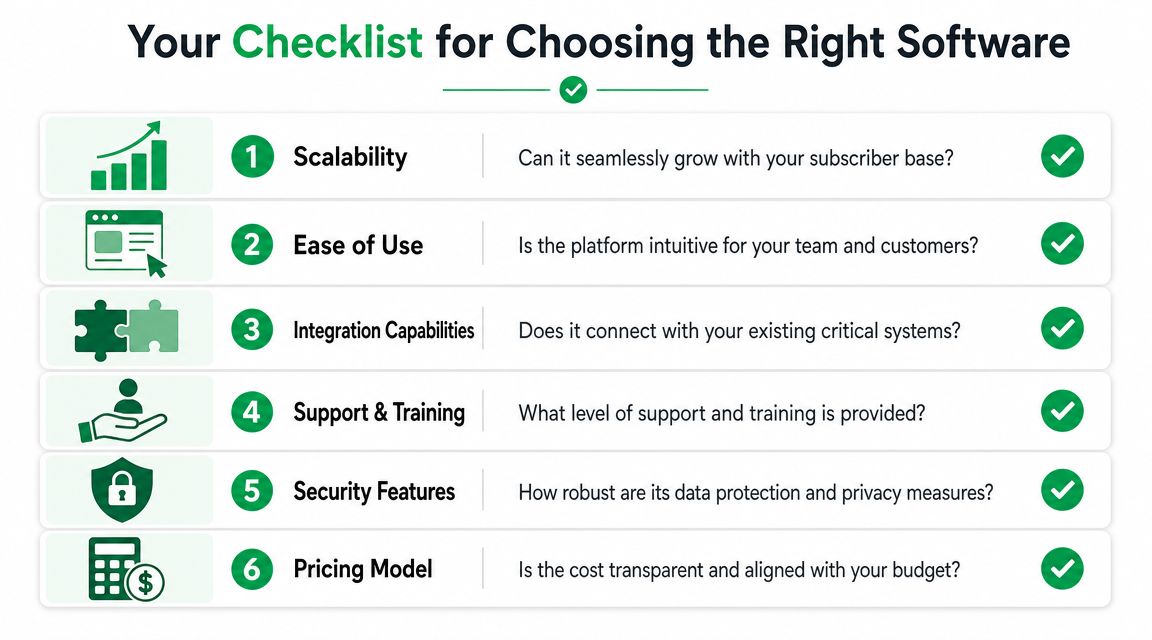
The right choice usually comes down to one question. Will this system pay for itself fast, without forcing your team into workarounds?
The shortlist that matters
MikroTik fit: suspensions, activations, speed profiles, and package rules should apply cleanly from the billing side. If staff still log in to routers to finish routine jobs, the software is only solving half the problem.
Mobile money support: for Kenyan ISPs, payment collection has to match how customers pay. Billing software should handle M-Pesa-style settlement, tax handling, and reconciliation without extra spreadsheets.
Multi-currency readiness: if you operate across borders or sell services priced in different currencies, reporting should stay clean enough for finance review and month-end close.
Transparent pricing: know whether costs rise by subscriber count, transactions, or another usage model. Hidden pricing usually shows up later as margin pressure.
Support quality: setup is where weak vendors get exposed. You need fast answers when package mapping, tax settings, or payment callbacks need adjustment.
One practical check gets missed in many software evaluations. Ask whether one platform should handle billing, CRM, and network monitoring, or whether splitting those roles will keep operations cleaner as you grow. This article on when billing, CRM, and NMS should stay separate is a useful filter before you commit.
Hardware still matters. A billing and bandwidth platform can enforce policy well, but weak edge equipment will still create support tickets and unstable service. If you are costing out smaller hotspot or wireless rollouts, Redchip's WiFi router price guide is the kind of hardware budget reference worth checking alongside software selection.
Centipid Technologies Ltd. is one example of a platform built around this operational model. It brings billing, payments, MikroTik control, and customer account handling into one workflow, which is often the fastest route to visible ROI for a small ISP.