For any Indonesian Internet Service Provider, the ISP billing system is the operational heart of your business. It's the software that handles everything from customer sign-ups and invoicing to collecting payments and controlling network access. In short, it replaces scattered spreadsheets and manual tracking with a single, organised platform that acts as the command centre for your entire operation.
The Core Engine for Your Indonesian ISP Business
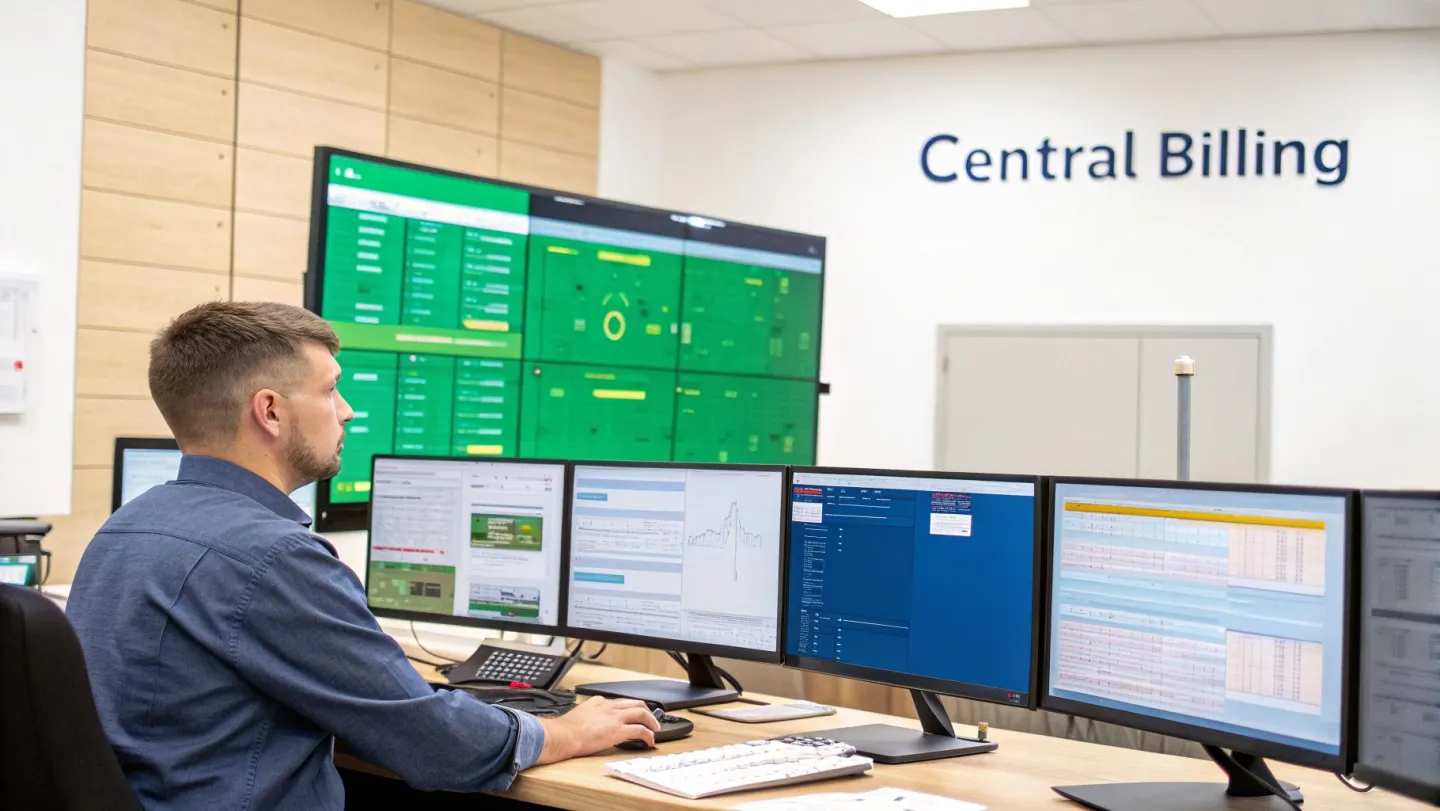
As your ISP grows from a handful of local clients to hundreds or thousands of subscribers, the daily work can become chaotic. If you're managing an expanding network, whether in a dense Jakarta neighbourhood or across remote islands, you've likely felt the pain. Tracking payments, activating services, and solving customer problems manually just doesn't scale.
This is where a dedicated billing system becomes absolutely essential, not just for convenience, but for survival.
Think about the difference between running a small warung with a cash box and notebook versus managing a modern supermarket with a full point-of-sale (POS) system. Spreadsheets and WhatsApp reminders might work when you're starting out, but they quickly lead to bottlenecks, mistakes, and lost revenue as you grow.
From Manual Chaos to Automated Control
The daily grind of running an ISP without a proper system is exhausting. Time is wasted on repetitive tasks that are prone to human error, pulling your focus away from growing the business. An integrated billing platform completely transforms this dynamic.
The table below paints a clear picture of the before-and-after. It contrasts the common struggles of manual management with the efficiency gained through automation.
Manual vs Automated ISP Management
| Operational Task | Manual Method (The Problem) | Automated System (The Solution) |
|---|---|---|
| New Customer Sign-up | Manually entering data into a spreadsheet, then separately configuring their router access. It's slow and prone to typos. | Customer signs up via an online portal, and the system automatically creates their account and provisions their service. |
| Monthly Invoicing | Your team spends days creating and sending individual invoices or payment reminders via email or WhatsApp. | The system generates and dispatches professional invoices to all customers automatically on their correct billing date. |
| Payment Collection | Chasing late payments, manually checking bank transfers, and reconciling who has paid. This is a huge time sink. | Integrates with local payment gateways (Virtual Accounts, e-wallets), automatically marking invoices as paid and reconciling accounts. |
| Service Suspension | Someone has to manually log into the MikroTik router to disable the account of a non-paying customer. | The system automatically suspends network access for overdue accounts and sends a notification. |
| Service Reactivation | After a customer pays, a team member must be notified to manually re-enable their service, causing delays. | Once payment is confirmed through the gateway, the system instantly restores the customer's internet connection. |
As you can see, the right system doesn't just make things easier; it fundamentally changes your operational capacity and reduces revenue leakage.
A modern isp billing system in Indonesia should deliver a core set of automated functions:
- Automated Invoicing: Generates and sends invoices on any schedule (monthly, quarterly) without you lifting a finger.
- Integrated Payment Collection: Connects with the Indonesian payment gateways your customers actually use, making it easy for them to pay you.
- Network Access Control: Automatically talks to your network hardware to manage subscriber access based on payment status.
- Centralised Subscriber Management: A single source of truth for all customer information, service plans, payment history, and support tickets.
Think of an effective billing system as the central nervous system for your ISP. It links your finance, network, and support teams together, allowing you to grow without the chaos. You get to focus on what matters: building a better network and keeping customers happy.
For example, a system like Centipid is built from the ground up to work seamlessly with MikroTik RouterOS. When a new subscriber pays, the system instantly creates their PPPoE or Hotspot profile. If they're late on a payment, their service is cut off. The moment they pay their outstanding bill, service is restored automatically.
Trying to replicate this level of automation manually is simply impossible at scale. To see how these software features come together in a complete package, you can explore our detailed guide on ISP billing software. By adopting a system like this, you aren't just buying a tool; you're building a solid foundation for your ISP's future.
Why Automated Billing Is So Important for Indonesian ISPs
Does running your growing ISP feel like you’re trying to fill a leaky bucket? You pour in new customers, but revenue keeps trickling out through small administrative gaps and late payments. For many network operators in Indonesia, this isn't just a metaphor, it's the daily grind.
Manually chasing payments, matching up bank transfers, and cutting off non-paying users is a massive time sink. It’s time you could be spending making your network faster or helping your customers. This isn’t just an annoyance; it’s a bottleneck that’s holding your business back.
Stop the Leaks with Smart Automation
Think about your end-of-month process. You're hunched over a spreadsheet, trying to match names on a bank statement to your list of subscribers. One customer paid two days ago, but you didn't see it, so their internet is still off and they’re calling you, frustrated. Another customer completely forgot to pay, and their connection has been running for free for three weeks.
Each of these little incidents is a leak in your revenue. An automated billing system is designed to plug these holes. It doesn't get tired, it doesn't make mistakes, and it works around the clock to manage your finances.
- Automatic Invoicing: Every single customer gets a professional, branded invoice on the right day, every time. No exceptions. This alone creates a predictable and professional payment rhythm.
- Recurring Billing: The system handles all your different packages and billing cycles, whether it’s monthly, quarterly, or yearly. It ensures the right person is billed the right amount, on the right date.
- Smart Reminders (Dunning): When a payment is late, the system can send a series of polite but firm reminders. This process, known as dunning, dramatically improves your cash flow without forcing your staff to become debt collectors.
Getting this right means your billing process shifts from a reactive chore to a smooth, efficient operation. It frees up your team to focus on what really matters: growing the business.
Get Ready for Indonesia's Broadband Boom
The need for this kind of efficiency is only getting more critical. Indonesia's fixed broadband market is growing fast, and projections show the number of subscribers will continue to climb. As you expand your service across an archipelago of over 17,000 islands, managing all those customers and enforcing service rules becomes a huge headache. You can find more data on this growth and learn more about Indonesia's broadband market trends.
A proper billing platform is built for this kind of scale. For instance, a system like Centipid gives you a clear, structured way to handle everything from signing up new customers to setting up different service plans.
The real power here is how automation connects your billing directly to your network. When a customer signs up and pays, their service is activated instantly. If they miss a payment after several reminders, their service is automatically suspended. Everything is tied together.
An automated billing system turns your subscribers into a predictable, recurring revenue engine. It gets rid of the guesswork and human error that eat away at your profits, making sure you collect what you’ve earned, on time, every time.
By automating your billing, you’re not just saving time; you’re building a business that can actually scale. Instead of hiring more people just to chase invoices, you can invest that money in better equipment and expanding your coverage. That’s how you’ll compete and win in Indonesia’s booming internet market.
Integrating with Indonesian Payment Gateways
If you want your ISP to thrive in Indonesia, you have to let your customers pay you in the ways they actually use every day. Just offering a standard bank transfer won't cut it anymore. The payment scene here is incredibly diverse, and getting your billing system connected to it is fundamental to keeping your cash flow healthy.
Think about it from your customer's perspective. If paying their monthly internet bill is a pain, they’ll put it off. Maybe they'll forget entirely. By offering the familiar payment apps and methods they already have on their phones, you make it effortless for them to pay on time. This single change can massively improve your collection rates and bring some much-needed stability to your revenue.
The Payment Methods Your Subscribers Expect
Any serious ISP billing system in Indonesia needs to support the payment channels that people genuinely use. These aren't just nice extras; they are non-negotiable for running a modern ISP.
Your customers will be looking for these options:
- Virtual Accounts (VA): This is a cornerstone of Indonesian digital payments. A VA is a unique payment number assigned to a customer's invoice, linked to major banks like BCA, Mandiri, and BNI. It means payments are identified instantly, so you don't have to manually check bank statements.
- E-wallets (Dompet Digital): The growth of e-wallets has been explosive. Your subscribers fully expect to pay with services like GoPay, OVO, and DANA. These are woven into the daily lives of millions of Indonesians and offer incredible convenience.
- Retail Outlets (Over-the-Counter): For many people, especially in areas with less access to digital banking, paying in cash at a local convenience store is still the go-to method. Your system must be able to generate payment codes for networks like Indomaret and Alfamart.
Supporting this mix ensures you’re catering to everyone, from your tech-savvy city subscribers to customers in rural areas who rely more on cash and local agent networks.
Automating a Complex Payment Ecosystem
The real difficulty isn’t just offering these methods; it's managing the chaos that comes with them. Can you imagine trying to manually check bank statements for VA payments, match transaction IDs from OVO, and reconcile settlement reports from Alfamart? It’s a logistical nightmare that quickly leads to mistakes, payment delays, and very unhappy customers.
This is where a purpose-built billing platform truly proves its worth. A system like Centipid handles this entire workflow by integrating directly with Indonesia’s payment gateways. You can see more on how Centipid organises payment collection by reading our guide on creating a self-service payment portal.
An integrated system becomes your financial command centre. It automatically generates the right payment details for every invoice and then listens for the confirmation from every single channel. The moment a payment is made, the system knows.
This automated reconciliation gets rid of the most soul-destroying task for any ISP operator: manually verifying payments. No more guesswork. When a customer pays their bill with GoPay, the invoice is marked as paid instantly, their account is updated, and if their service was cut off, it’s automatically switched back on.
Tapping into Indonesia’s Digital Payment Growth
By adopting these modern payment channels through an automated ISP billing system, you are essentially future-proofing your business. You slash administrative overhead, massively improve your cash flow, and give your customers the seamless experience they've come to expect. It frees up your team from chasing payments so they can focus on what really matters: growing your network and providing excellent service.
Seamless MikroTik Integration for PPPoE and Hotspots
For any ISP operator in Indonesia running on MikroTik, the real magic happens when your billing system and your network hardware talk to each other seamlessly. Think of your MikroTik router as the gatekeeper of your network, it controls who gets online and how fast their connection is. An integrated ISP billing system, like Centipid, is the brain behind the operation, telling that gatekeeper exactly what to do without you lifting a finger.
This connection is what truly automates your day-to-day grind. It means no more logging into RouterOS to manually create a new account, suspend someone who hasn't paid, or change a customer’s internet plan. The billing system handles all of it, sending automated commands to your MikroTik router based on what's happening with payments in real time.
Automating PPPoE for Home and Business Users
Most fixed broadband ISPs across Indonesia rely on PPPoE (Point-to-Point Protocol over Ethernet) to manage their subscribers. It’s a solid, reliable way to authenticate users and apply their specific service plans. The problem is, managing hundreds of PPPoE accounts by hand is a surefire path to mistakes and frustrating delays.
A proper ISP billing system in Indonesia automates this entire cycle from start to finish:
- Automatic Account Creation: When a new customer signs up and pays for a home internet package, the system instantly creates their PPPoE credentials in your MikroTik router. They get their username and password right away and can connect immediately.
- Dynamic Service Management: If a customer decides to upgrade to a faster plan, the system automatically updates their bandwidth profile in RouterOS. You don’t have to go in and manually change their speed limits.
- Suspension and Re-activation: This is where the automation really protects your cash flow. If an invoice becomes overdue, the system automatically disables the subscriber's PPPoE account. The moment they pay their bill, even at 2 AM via a virtual account, their service is instantly re-enabled.
This level of automation completely changes how you operate. It removes the human bottleneck and ensures your network rules are enforced fairly and consistently, 24/7. Your team is freed up from tedious admin work to focus on what really matters: keeping the network healthy and supporting your customers.
The flow is simple but powerful, as you can see below. It all comes down to connecting payments directly to service access.
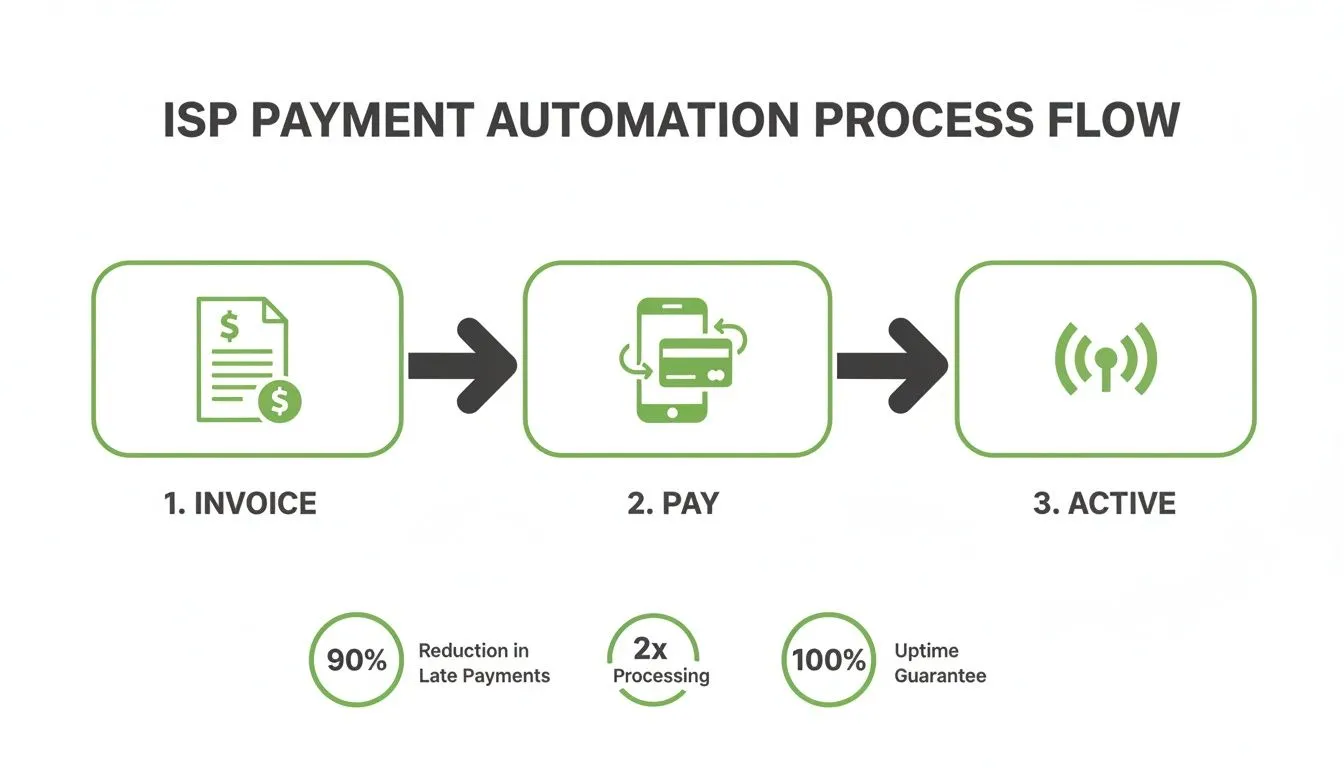
This simple, three-step process, Invoice, Pay, Active, is the heartbeat of an efficient ISP. It guarantees that service is only delivered once payment is confirmed, directly tying your revenue to network access.
Centralising Hotspot and Voucher Management
For those of you running public Wi-Fi in cafes, hotels, co-working spaces, or local community centres (RT/RW Net), MikroTik’s Hotspot feature is indispensable. But managing access with printed vouchers or timed sessions can get messy, fast.
An integrated billing platform brings order to that chaos.
By linking your billing software directly to your MikroTik Hotspot services, you turn public Wi-Fi from a management headache into a revenue stream that can scale. The system takes care of generating vouchers, enforcing session times, and authenticating users all on its own.
Imagine you need to generate a thousand unique Wi-Fi vouchers for different packages, like 1-day, 7-day, or 30-day access. The system can create them in seconds. Your resellers or staff can sell them, and the platform tracks every voucher's status in real-time. When a customer logs in with a voucher, the system tells the MikroTik router to grant access for exactly the duration or data limit they purchased. You can read more about how to manage your MikroTik network efficiently with a centralised system to get a deeper understanding.
A Single Dashboard for Your Entire Network
Perhaps the most significant advantage for an ISP in an archipelago nation like Indonesia is managing a distributed network from one place. Whether you have routers in Jakarta, Surabaya, and Bali, a centralised billing system gives you a single pane of glass to oversee your entire operation.
This is a complete game-changer for scaling your business. You no longer need a technical person on-site at every location just to manage user accounts. From one central dashboard, you can monitor all your connected MikroTik routers, see active sessions, and manage subscribers across different islands. This powerful capability lets you expand your footprint with confidence, knowing your billing and network management will grow right alongside you.
Core Features That Drive Sustainable ISP Growth
Sure, any good billing system can handle automated invoices and collect payments. But the features that really separate a basic tool from a true growth partner are the ones that go beyond these simple transactions. A top-tier isp billing system in Indonesia should feel less like a cash register and more like the operational heart of your business.
These are the tools that cut down your daily workload, give you clear insights into your business, and put your subscribers in control. They let you stop fighting fires and start making smart, strategic decisions that build a healthy, growing ISP for the long haul.
Empower Subscribers with a Self-Service Portal
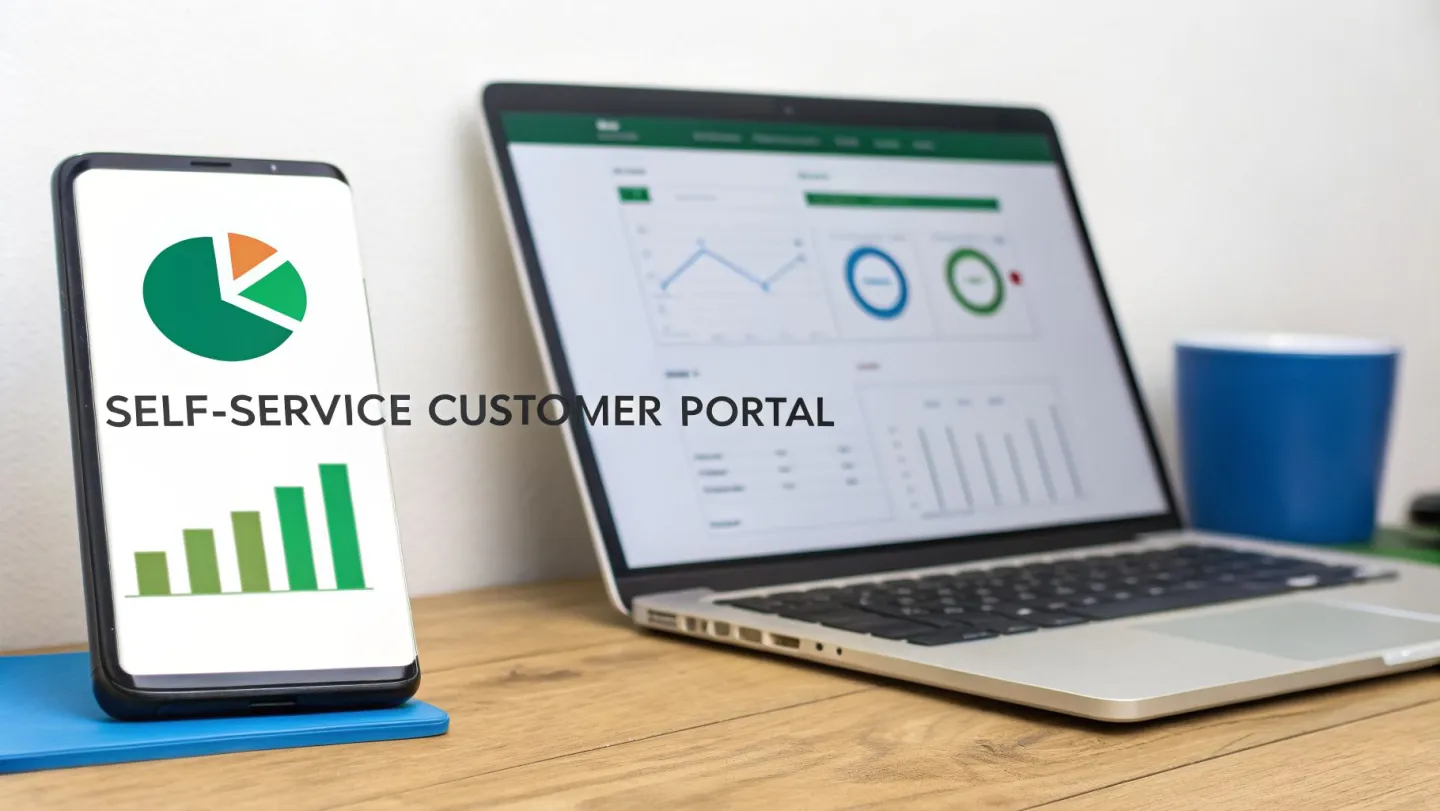
Imagine cutting your customer support calls in half. That’s the real-world impact of a good self-service customer portal. By giving subscribers a branded, online space to manage their own accounts, you free them from having to call your team for every little thing.
It’s a genuine win-win. Your customers get the instant gratification and control they expect, while your team gets to focus on more complex issues instead of answering the same questions all day. This portal becomes their go-to spot to:
- View and Pay Invoices: Customers can check their billing history, download past invoices, and settle their bills using their favourite local payment methods.
- Upgrade or Change Plans: Let subscribers browse your internet packages and upgrade their service on their own time. It's a direct path to increasing your revenue without any sales effort.
- Check Data Usage: Give users a clear view of their data consumption or session history, which builds trust through transparency.
- Update Personal Information: Customers can easily keep their contact details and other personal info current, ensuring your records are always accurate.
A system like Centipid, for instance, lets you offer a professional, white-label portal that carries your own branding. This reinforces customer trust and provides a modern experience that makes your business look great.
Make Data-Driven Decisions with Analytics
Running an ISP without good data is like trying to navigate Jakarta during rush hour with your eyes closed. You might be moving, but you have no idea if you're heading in the right direction, which routes are blocked, or where the opportunities are. A strong analytics dashboard swaps that guesswork for hard facts.
A quality billing platform delivers immediate insights into the health of your business. It takes all your subscriber and payment data and turns it into simple reports and charts you can actually use. You get a real-time view of the metrics that truly matter.
Think of your analytics dashboard as a live X-ray of your business. It reveals the hidden patterns in your revenue, subscriber behaviour, and network performance, allowing you to diagnose problems early and seize opportunities quickly.
With Centipid, you can track your key performance indicators right from the dashboard. This means keeping a close eye on subscriber churn, seeing which of your service plans are the most popular, and watching your monthly recurring revenue (MRR) grow. This is the information you need to fine-tune your prices and services.
Scale Across Indonesia with Centralised Management
As your ISP grows, trying to manage operations in different cities or across islands becomes a huge headache. A system built for expansion has to handle this complexity without breaking a sweat, especially in a diverse country like Indonesia.
Multi-location management lets you oversee all your network branches from one central dashboard. This is absolutely essential for any operator planning to grow beyond a single neighbourhood. You can add new MikroTik routers, manage subscribers in different regions, and compare performance branch by branch. You can also generate prepaid access codes for your network, a fantastic way to offer flexible internet. To learn more, check out our guide on how to sell internet access with vouchers in Indonesia.
Finally, full support for the Indonesian Rupiah (IDR) is completely non-negotiable. Your billing system must process every transaction, invoice, and report in your local currency. This isn't just for convenience, it's for financial clarity, simpler accounting, and compliance with local regulations. It removes all the headaches of currency conversion and gives you a perfectly clear picture of your ISP's financial standing.
How to Implement Your New ISP Billing System
Switching to a new ISP billing system is a big move. It’s more than just a technical task; it's a project that can genuinely upgrade your business. If you approach it with a clear, step-by-step plan, the whole process becomes far less intimidating and a lot more manageable.
Think of it as a roadmap. Breaking the journey down into smaller, logical steps ensures nothing gets missed, minimises service disruption, and sets you up for a smooth transition.
Auditing Your Subscribers and Services
Before you touch a single line of code or install any software, you need to get your house in order. This starts with a thorough audit of your entire subscriber base and the services you provide. You absolutely must know who your customers are, what internet plans they're on, and how they’re currently paying you.
It's like creating a detailed map of your current network before you start laying down new fibre. Your audit should involve:
- Compiling a complete customer list with up-to-date, accurate contact details.
- Documenting every single internet plan you offer, including speeds, prices, and their billing cycles (e.g., monthly, quarterly).
- Reviewing your payment records to see which methods your customers actually use most often.
This initial work is the foundation for everything that follows. A solid audit ensures your data migration is clean and that the new system perfectly mirrors your real-world business from day one.
Preparing Your MikroTik Routers
Your MikroTik routers are the heart of your network operations, acting as the gatekeepers for customer access. They need to be configured to talk to your new billing system. This communication happens via an API, which lets the billing software send automated commands to manage your users.
You’ll need to make sure the API service is enabled on every MikroTik router you want to connect. More importantly, you must create a dedicated API user with specific, limited permissions just for the billing system.
Crucial Tip: Never, ever use your main administrator account for API integration. Creating a separate, restricted user for the billing system is a basic security measure that every experienced operator follows. It protects your entire network.
This setup allows a system like Centipid to securely add, modify, and remove PPPoE secrets or Hotspot users without ever needing full access to your core router configurations. You can find detailed guides for this in the Centipid documentation.
Migrating and Testing Your Setup
With your audit complete and your routers ready, it's time to bring your customer data into the new system. Thankfully, this isn't as daunting as it sounds. Most modern platforms allow you to import your subscriber list from a simple CSV or spreadsheet file, making the process quick.
Once the data is in, the most critical phase begins: testing. You need to walk through the entire customer journey yourself to make sure every automated function works flawlessly. This end-to-end testing must include:
- New User Registration: Go through your new customer portal and sign up for a test account.
- Payment and Activation: Make a real test payment using an Indonesian gateway (like a Virtual Account) and check that the internet service activates automatically.
- Suspension and Re-activation: Let a test invoice go overdue to confirm the system correctly suspends the account. Then, pay the invoice and verify the service is restored instantly.
Thorough testing like this is what guarantees a seamless, professional experience for your customers when you officially go live. Don't hesitate to use the resources available to you, like Centipid’s free technical support, to help you resolve any hitches you find during this stage.
Tackling Your Top Questions About ISP Billing in Indonesia
When you're running an ISP in Indonesia, you have a unique set of challenges. It's only natural to have questions about how a dedicated billing system can handle the day-to-day realities of your operation. Let's walk through some of the most common ones we hear from operators just like you.
Can It Really Handle My Network of MikroTik Routers?
Yes, and this is where a proper system truly shines. Think of it as a central command centre for your entire network. Whether you have routers spread across different floors in a single building or scattered across several islands, a modern ISP billing system in Indonesia brings them all under one roof.
You can add, monitor, and manage every MikroTik router from a single dashboard. This means no more late-night drives or sending technicians to remote sites just to make a small change. Systems like Centipid are built for this kind of distributed network management.
What if I Only Use Hotspots, Not PPPoE?
That's perfectly fine. A flexible billing platform doesn't force you into one model. It should support both with equal strength.
You can easily manage your residential broadband customers on PPPoE while simultaneously running a thriving public Wi-Fi business using MikroTik's Hotspot service. This is ideal for generating prepaid vouchers or access codes for cafes, hotels, or local RT/RW Nets, giving you multiple streams of revenue from the same platform.
How Does It Deal with Indonesian Taxes?
Getting taxes right is non-negotiable, and a good billing system makes this straightforward. Instead of manual calculations, you can configure your required tax rates (like PPN) directly in the system.
From that point on, the tax is automatically calculated and added to every invoice. This keeps your billing accurate and ensures your financial records are clean and ready for your accounting team, saving you a massive headache down the line.
Is My Customer Data Actually Secure?
This is a critical concern, and the answer is a firm yes. Reputable billing systems are cloud-based and built with robust security measures from the ground up to protect your sensitive customer and financial information.
All communication between the billing platform and your MikroTik routers happens through a secure API. This ensures that your commands are encrypted and your network's integrity is never compromised.
Ready to see how a dedicated billing system can transform your Indonesian ISP? Explore Centipid Technologies Ltd. to discover features built specifically for MikroTik operators like you. Get started today at https://centipidbilling.com.