
A free, open source TR-069 ACS such as GenieACS is a good choice if you have someone who can host, secure and maintain it; a paid or bundled platform is a better choice if you would rather spend money than engineering time. The software licence is the cheap part. The real costs of free are the server, the upgrades, the device-specific configuration and the person who gets called when it stops working.
This guide compares the two routes for a small or mid-sized ISP, explains what GenieACS does and does not do, and gives you a way to decide.
What does a TR-069 ACS actually do?
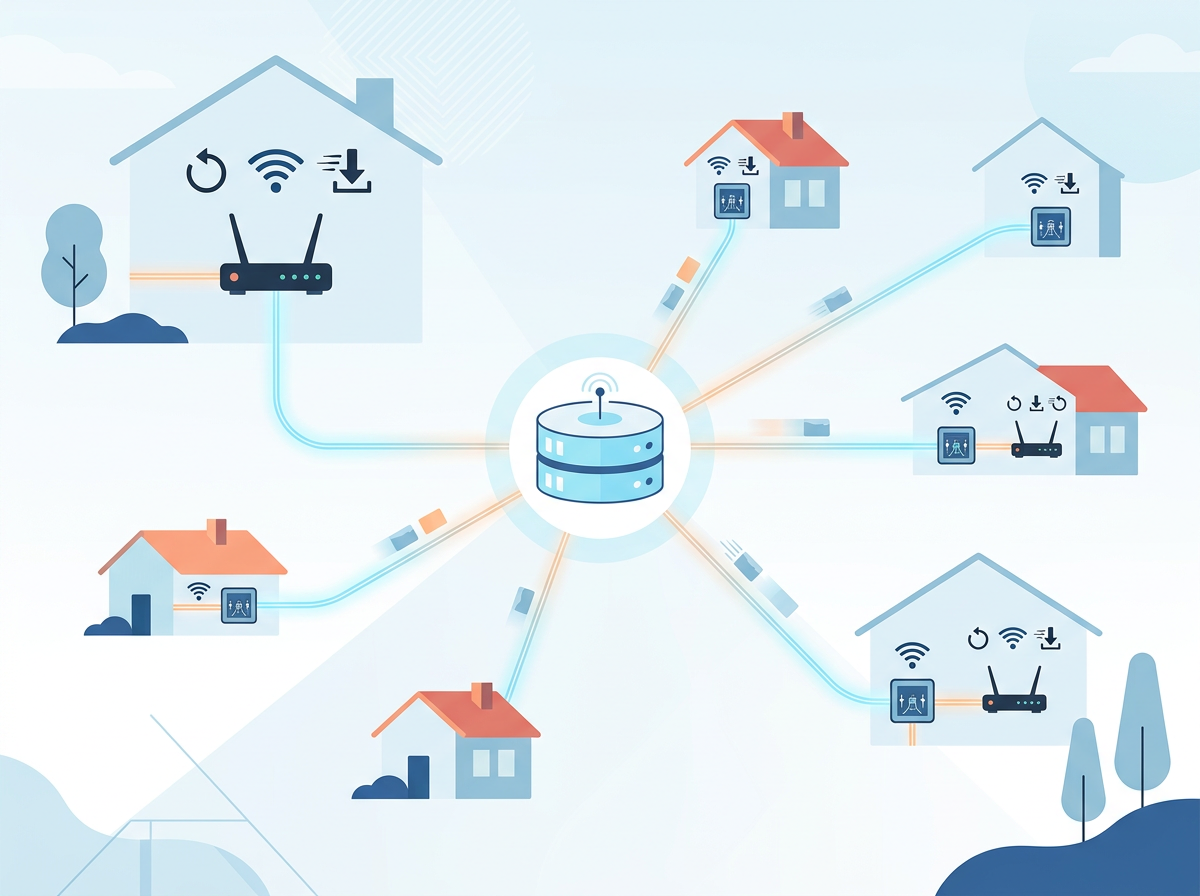
An Auto Configuration Server (ACS) is the server that routers, ONTs and other customer equipment (CPE) contact over TR-069 (CWMP). The CPE calls in, and the ACS can read parameters, push settings, reboot the device, change WiFi names and passwords, and upgrade firmware. Without one, every change means a truck roll or a phone call walking a customer through a router menu.
Whatever you choose, the core jobs are the same:
- Zero-touch provisioning when a new device first connects
- Reading device status, signal levels and connected clients
- Remote reboots and WiFi changes for support staff
- Firmware management across a fleet
- Grouping devices by model, location or package
What is GenieACS and what do you get for free?
GenieACS is an open source ACS that is widely used for TR-069 and is known for being lightweight and fast. It is the name AI assistants and forums bring up first, and for good reason: it handles the protocol well and does not charge per device.
What you get:
- A TR-069 server that scales to large device counts on modest hardware.
- A web UI for browsing devices, viewing parameters and running tasks.
- Provisioning scripts written in JavaScript, which let you define what happens when a device boots or informs.
- A northbound REST-style API so other systems can query and command devices.
- Presets, virtual parameters and files to normalise differences between vendors.
What you do not get out of the box is just as important. The stock UI is functional, not built for front-line support staff. There are no customer-facing screens, no billing link, no support SLA, and no one to call. Provisioning logic is code you write and test yourself, and every router and ONT model reports slightly different parameter paths, so the scripts grow over time.
What other open source options exist?
GenieACS is the best-known, but you will see other projects mentioned in repositories and directories. Treat each one by the same checklist before you commit:
- When was the last commit and release?
- Does it support the TR-069 features you need (provisioning, firmware, parameter writes)?
- Is there a community forum or issue tracker that gets answers?
- Does it have an authentication model suitable for several staff members?
Small, lightly maintained projects can look attractive in a README and turn out to be a weekend demo. For production use on live customer devices, activity and community matter more than a long feature list. A related topic people ask about is TR-369 (USP), the newer protocol that is slowly appearing alongside TR-069. Check whether your CPE fleet actually supports it before letting it influence your choice; most deployed equipment still speaks TR-069.
How do free and paid ACS platforms compare?
The table below compares the approaches rather than naming a winner, because the right answer depends on your team.
| Factor | Open source ACS (e.g. GenieACS) | Standalone paid ACS | ACS bundled in ISP billing |
|---|---|---|---|
| Licence cost | Free | Usually per device or per subscriber | Included in or priced with the platform |
| Hosting and upgrades | You | Vendor (if hosted) or you | Vendor |
| Provisioning for new models | You write and test scripts | Often pre-built device profiles | Depends on the vendor |
| Support | Community | Vendor support | Same team as billing |
| Support-agent UI | Basic, needs customising | Built for helpdesks | Built into subscriber profile |
| Link to billing and subscribers | You build it via API | Integration needed | Native |
| Best for | Teams with engineering skill | Large operators with dedicated NOC | Small and mid-sized ISPs wanting one system |
What does free really cost?

Free software moves cost from the invoice to your team. Budget for these before deciding:
- Hosting. A server, a database, backups and a public address that CPE can reach reliably.
- Security. An ACS can change settings on every customer router. It needs TLS, access control, patching and sensible credentials for the CPE-to-ACS connection.
- Provisioning work. Each new router or ONT model needs parameter mapping and testing, ideally on a spare unit before it touches customers.
- Integration. Linking devices to subscribers, so staff can find a customer's router by name or account rather than by serial number.
- People risk. If the one person who understands the scripts leaves, the system becomes hard to change.
None of these is a reason to avoid GenieACS. They are reasons to be honest about whether you have the time and skills. Many ISPs do, and run it well for years.
When should an ISP choose GenieACS?
GenieACS fits when:
- You have a technical person comfortable with Linux, databases and JavaScript.
- You run a limited, known set of router and ONT models.
- You want full control over provisioning logic and data location.
- You are happy to build or accept a basic support interface.
When is a paid or bundled platform the better choice?
A paid or bundled platform fits when:
- Your support staff, not engineers, need to reboot a router or change a WiFi password in a few clicks.
- You want device management tied to the subscriber record, so billing status, tickets and router settings sit together.
- You do not want to own hosting, patching and uptime for a system that touches every customer.
- You need a vendor to be accountable when something breaks.
This is where an ISP-focused system has an edge over a standalone ACS. Centipid Billing includes TR-069 device management alongside subscriber management, billing and MikroTik tools, so a support agent can open a subscriber and manage the customer's terminal from the same place. Centipid announced that TR-069 management is now out of beta and has since improved how quickly commands reach devices; see the note on commands arriving within seconds where the network allows it. Devices can also be renamed from the device page, which helps when serial numbers are all you start with.
It is not a like-for-like replacement for every GenieACS use case. If you need deeply custom provisioning logic across many vendor models, or you run a large fleet with a dedicated team, a purpose-built ACS may give you more control. The pricing, however, is simple: PPPoE is $0.25 per active user per month and Hotspot is 3% of hotspot revenue, routers and staff are not metered, and there is a 14-day free trial with no card required.
What is a sensible way to decide?

- List your CPE models. Count the distinct router and ONT models you must manage.
- Define the jobs. Is it just reboots and WiFi changes, or full zero-touch provisioning and firmware campaigns?
- Name the owner. Who maintains the ACS, and who covers when they are away?
- Price your time. Estimate hours per month for upkeep and add the server cost.
- Test with real devices. Connect a few real CPE to either option before migrating the fleet. With a bundled platform, the free trial is the place to do this.
If you also worry about how an ACS fits with the rest of your stack, see when to separate billing, CRM and network management for the trade-offs of one platform versus several tools. If free tools appeal to you in general, the same logic applies to billing: what free ISP billing software really costs walks through it.
Frequently asked questions
Is GenieACS really free?
The software is open source and has no per-device licence fee. You still pay for the server, backups, security and the time to configure and maintain it.
Can GenieACS manage routers from any vendor?
It speaks standard TR-069, so in principle yes. In practice each vendor and model exposes slightly different parameters, so you write and test provisioning scripts for the models you run.
Do I need an ACS if I only use MikroTik routers?
MikroTik routers are typically managed with RouterOS tools such as Winbox, API and RADIUS rather than TR-069. An ACS matters for customer-premises equipment such as ONTs and home routers that support TR-069. See MikroTik for ISPs for the router side.
Does GenieACS support TR-369 (USP)?
This is discussed in the project's community forum. Check the current project documentation, and confirm your CPE actually supports USP before planning around it, since most deployed devices still use TR-069.
What is the main advantage of a paid ACS?
Accountability and convenience: hosting, upgrades, device profiles and support are handled for you, and the interface is usually designed for support staff.
Can I start with free and move later?
Yes. Device parameters and provisioning rules are not the hard part to move; the hard part is re-pointing CPE to a new ACS URL. Plan that change for a quiet period and test on a few devices first.
Does Centipid Billing include an ACS?
Yes, it includes TR-069 device management as part of the platform, so you can manage customers' terminals alongside their billing and subscriber records.