

Your team is probably living this already. A customer pays, then sends a WhatsApp message asking for reconnection. Someone checks a spreadsheet, someone else opens the router, another person updates an invoice manually, and by evening nobody is fully sure which list is current. Support says the line is active. Billing says the account is overdue. The customer says they already paid.
That setup works for a very small ISP, until it doesn't.
Manual operations create quiet damage. Renewals get missed. Mid-cycle plan changes are handled differently by different staff. Installations and suspensions depend on who is on shift. Finance, support, and network operations each keep their own version of the truth. The result isn't just admin fatigue. It's slower collections, avoidable disputes, and service delays that customers feel immediately.
For growing providers, ISP management software is the point where the business stops reacting and starts operating with control. Done properly, it connects subscriber records, payments, service plans, and network access in one system. That changes the day-to-day reality of the business. Staff stop chasing updates across spreadsheets. Activations happen when payment is confirmed. Expiry reminders go out on time. Reporting stops being guesswork.
In emerging markets such as Kenya, this matters even more. Many operators deal with mobile-money-heavy collections, mixed access models, and rapid expansion across sites. Generic guides often assume card-first billing, simple tax handling, and stable infrastructure. That's not the situation on the ground for many local ISPs, hotspot businesses, hotels, campuses, and community networks.
The practical question isn't whether to automate. It's which tasks to automate first, which workflows must stay tightly connected, and which software can handle local operational realities without creating new manual work.
Beyond Spreadsheets Your ISP's Next Step
A familiar pattern shows up in small and mid-sized ISPs. The business grows faster than the back office. At first, a spreadsheet tracks customers. Then another spreadsheet tracks due dates. Invoices are created in one tool, payments are checked in another, and service activation depends on an engineer logging into network equipment by hand.
That patchwork feels manageable when the subscriber base is still small. Then the cracks widen. A plan upgrade happens mid-month and the invoice doesn't match. A customer renews late at night and waits until morning for reconnection. Support spends too much time checking payment status instead of solving service issues. Finance spends month-end cleaning records that should have been accurate from the start.
What manual chaos usually looks like
Most operators don't call it chaos because each task has an owner. The problem is that the workflow between tasks is broken.
- Customer payments sit in one queue: Staff confirm payments manually, then update account status later.
- Network access sits elsewhere: A subscriber may be paid up, but still disconnected because nobody pushed the change to the network.
- Billing logic lives in people's heads: Proration, grace periods, renewal timing, and package rules are handled inconsistently.
- Support lacks one clean record: Agents can't quickly see payment history, active plan, device status, and recent changes in one place.
Practical rule: If your billing team and your network team each maintain their own customer status list, you already have an automation problem.
The operational cost isn't only time. It's also lost confidence inside the business. Managers stop trusting reports. Staff create side processes to “double-check” the system. Customers learn they must follow up after paying because service restoration isn't dependable.
The real next step
The next step isn't buying software just to send invoices. It's replacing disconnected tasks with one controlled workflow. Subscriber creation, package assignment, payment tracking, suspension, renewal, and service activation need to operate as one chain.
That's where modern ISP management software earns its place. It gives the business a single operating layer across customer records, billing, and network control. Once those pieces are connected, the most painful tasks stop depending on memory, manual checking, and repeated re-entry.
For a growing ISP, that shift is strategic. It frees staff to focus on installs, support quality, network performance, and expansion instead of repetitive admin.
What Is ISP Management Software
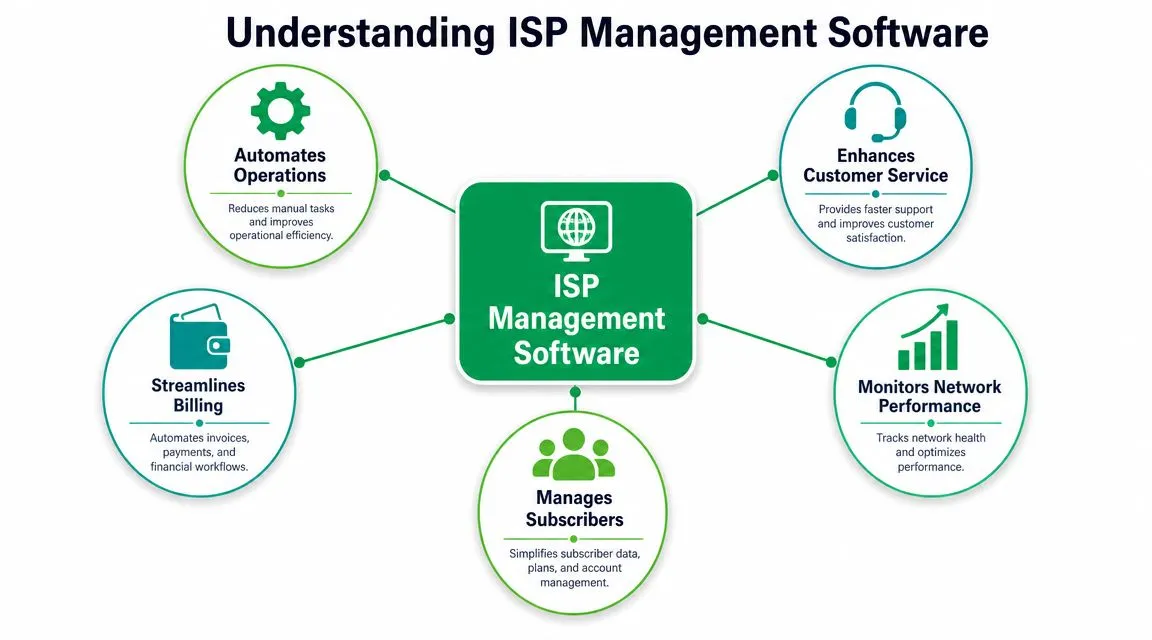
ISP management software is the operating system of an internet provider. It sits between your customers, your finance workflow, and your network. Instead of treating billing, subscriber records, and service control as separate tools, it ties them together so one action triggers the next.
Think of it as the central nervous system of the business. A customer signs up, chooses a package, makes a payment, gets provisioned, uses the service, renews, upgrades, or gets suspended if needed. In a manual setup, each step lives in a different place. In a proper software stack, those steps are linked.
The five functions that matter most
An ISP platform usually brings together five core jobs:
- Subscriber management: It stores account details, service plans, balances, status, and history in one place.
- Billing and payments: It handles recurring invoices, renewals, payment matching, and account status changes.
- Provisioning: It connects account status to actual network access so activations and suspensions are not manual.
- Monitoring and support visibility: It helps teams see service state, account history, and operational issues faster.
- Reporting: It gives managers one view of collections, active services, plan performance, and exceptions.
In Kenya, the scale of the market makes this operational discipline hard to ignore. The Communications Authority of Kenya reported 23.5 million fixed broadband subscriptions and 51.1 million total internet subscriptions by the end of Q3 2024, which makes small process errors expensive when multiplied across a large subscriber environment, as noted in this market overview.
Why the definition matters in practice
A lot of buyers still think of ISP software as “billing plus maybe CRM”. That's too narrow. If the platform doesn't influence what happens on the network, staff will still do manual work after every payment, renewal, and expiry event.
The stronger view is this: the platform should be the system your team trusts first. If support wants to know whether a customer should be online, the answer should be there. If finance wants to know whether a payment changed service status, the answer should be there too. If you need a deeper look at that subscriber-side control layer, this guide on an ISP subscriber management system is a useful reference point.
The right platform doesn't just record your business. It runs the routine parts of it reliably.
That distinction matters because software that only documents activity still leaves staff doing the actual operational work by hand. Software that coordinates the full subscriber lifecycle removes those handoffs.
Core Modules That Power Your Operations
The most useful way to evaluate ISP management software is module by module. Not every feature matters equally. Some functions look impressive in a demo but do little for daily operations. Others eliminate the manual steps that keep draining time and cash.
Billing that actually controls outcomes
Billing isn't just invoice generation. In an ISP, billing only works properly when it connects directly to service state. Usage data has to be captured from network infrastructure, rated by pricing rules, and pushed into invoicing without manual re-entry. That's what reduces billing errors, proration mistakes during mid-cycle plan changes, and revenue leakage tied to missed renewals or inconsistent records, as described in this ISP billing operations analysis.
If your team still exports usage, edits charges, and re-enters totals into another system, you haven't automated the hard part.
A good billing module should handle:
- Recurring invoicing: Monthly, periodic, prepaid, or fixed-cycle charging without manual creation.
- Plan changes: Upgrades, downgrades, and package changes without billing confusion.
- Renewal logic: Due dates, reminders, grace periods, and suspension rules aligned to your business policy.
- Payment reconciliation: Matching incoming payments to the right account and invoice quickly.
Subscriber records and CRM visibility
Support quality improves when staff stop switching tabs to answer basic questions. A proper customer record should show package, account status, payment history, service history, and recent actions in one screen.
This matters more than many teams expect. It cuts repeat checking and removes the “ask billing, then ask network” routine that slows support queues. For hotspot operators and multi-site providers, this visibility becomes essential because the same subscriber may interact with the business through vouchers, portal logins, agent-assisted renewals, or recurring package changes.
MikroTik and network access control
Many operators using MikroTik run into the same issue. Billing may be centralised, but actual network changes still depend on logging into routers one by one. That's a bottleneck.
The better approach is linking RADIUS, PPPoE, hotspot controls, and policy enforcement to the subscriber account itself. That way, a payment can trigger activation and an unpaid renewal can trigger the correct restriction without staff manually touching every device.
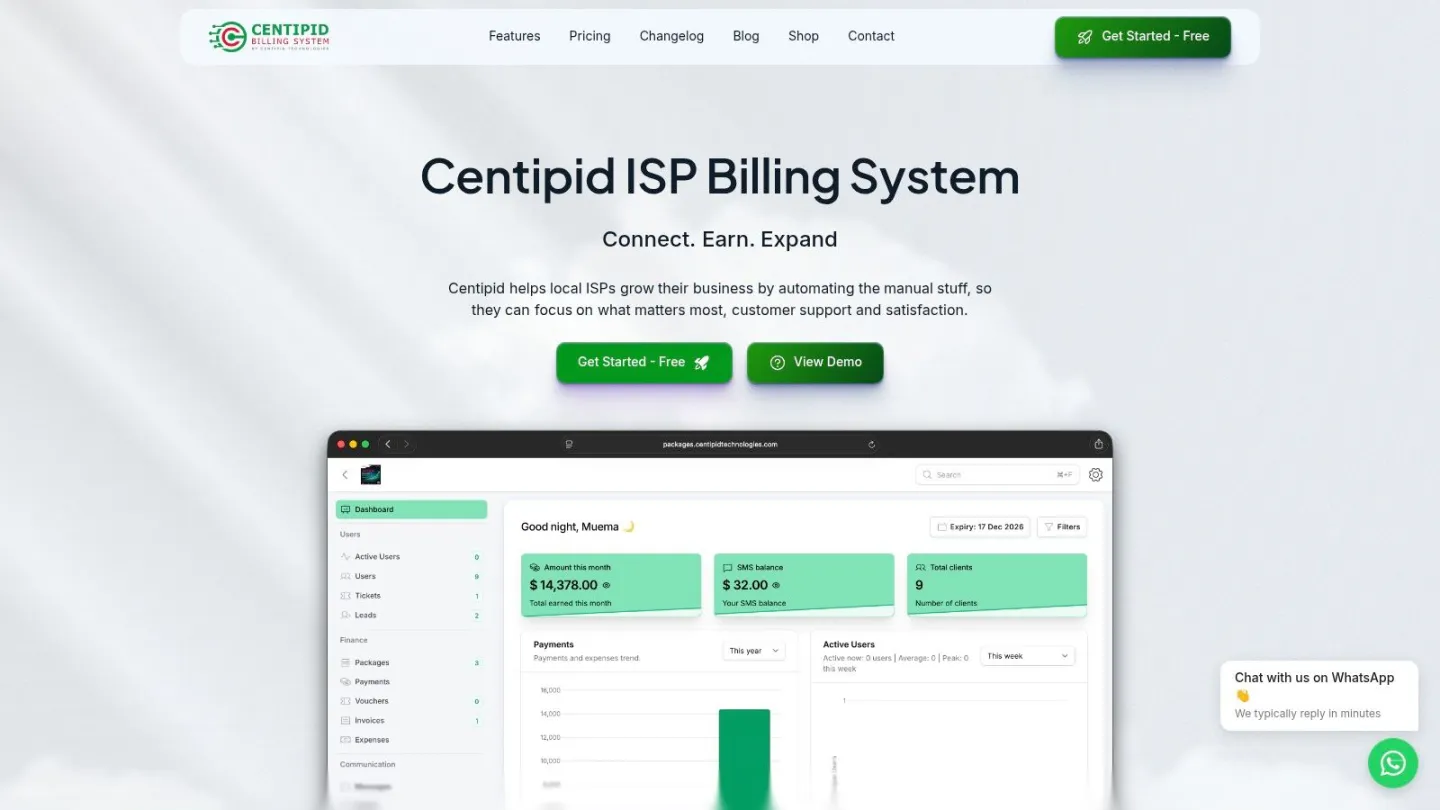
One practical example from the market is Centipid ISP Billing System, which supports MikroTik RouterOS workflows for PPPoE and hotspot environments, including recurring billing, self-service payments, package management, and central control across locations through features documented on Centipid's documentation portal.
If your engineers are still acting as the bridge between finance and the router, the software stack is incomplete.
Hotspot tools and local collections
Hotspot businesses have their own pressures. They often need vouchers, captive portals, shorter service windows, and fast payment confirmation. Generic billing software often handles none of that well.
The useful module set here includes:
- Captive portal control: Branded login and payment journeys that fit your customer environment.
- Voucher management: Creation, validity control, and usage tracking for prepaid access.
- Flexible package design: Time-based, quota-based, and location-based offers.
- Local gateway support: Payment flows that match how customers pay.
If you're reviewing vendor operations more broadly, some of the workflow discipline discussed in Products for Automation's insights is also relevant. ISPs often focus only on technical features and forget that service vendors, payment providers, and integration partners need managed processes too.
Analytics that support action
Analytics are only valuable if they help someone decide what to do next. In ISP operations, useful dashboards usually answer questions such as:
- Which accounts are approaching expiry without renewal?
- Which packages trigger the most support contacts?
- Which sites or devices generate recurring complaints?
- Where do payment delays line up with disconnections?
The strongest analytics don't stop at revenue charts. They connect collections, subscriber behaviour, and service performance so you can act before a customer churns or a site falls into recurring support trouble.
Real-World ROI and ISP Success Stories
Most software pitches sound the same. The better test is operational change. What manual task disappeared, what friction reduced, and what became easier to control day after day.
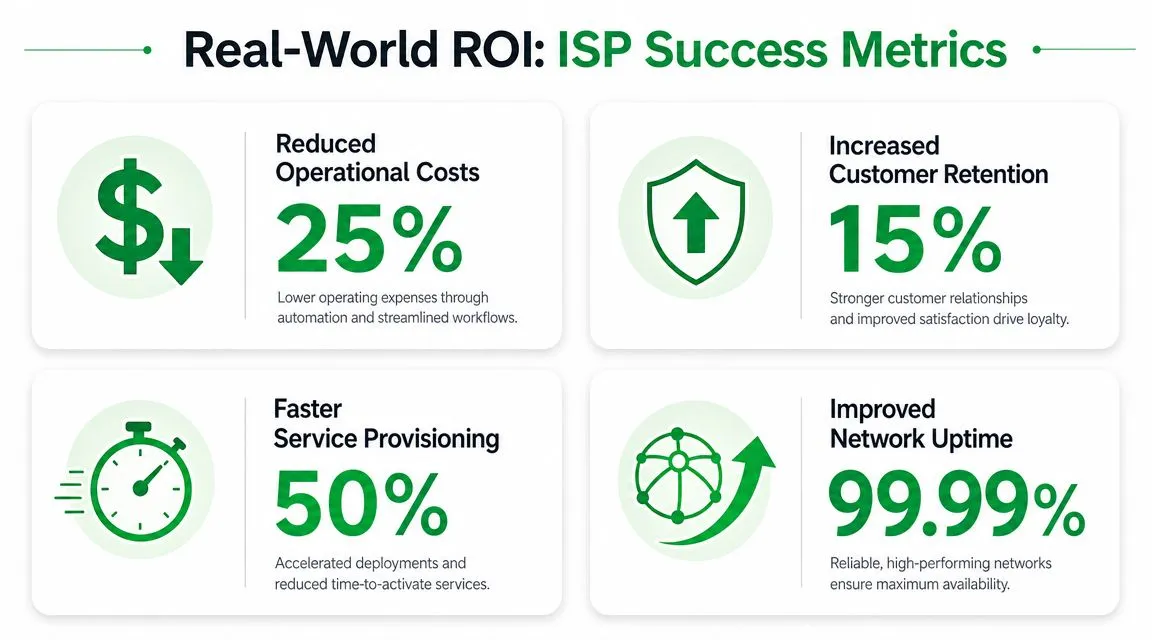
One recurring result from automation projects is that ISPs stop spending staff time on repetitive payment follow-up. When customer payments, service activations, and renewals are automated, teams spend less time checking statuses manually, billing errors drop, and paid customers can be restored faster. The business impact shows up in cleaner collections, less admin pressure, and fewer avoidable support complaints.
A packaging example that affects churn
Custom billing rules often matter more than flashy dashboards. One example is FiberSurf, which configured package and renewal rules around its customer base. It used automated renewal reminders and flexible renewal options to reduce avoidable expiry-related churn. It also introduced targeted package upgrades that encouraged movement to higher-value plans while keeping the customer experience straightforward.
That kind of result is practical because it comes from workflow design, not marketing theory. If renewal reminders are badly timed or package changes are awkward, customers leave for reasons that have little to do with network quality.
Centralised MikroTik management in the real world
Another common pain point is distributed router management. Administrators often end up logging into many MikroTik devices separately to make routine changes, troubleshoot, or verify service state across locations. That doesn't scale well.
WaveCore addressed this with centralised management for multiple MikroTik routers from one interface. The direct operational win was faster routine management and quicker issue resolution across distributed networks. For multi-site ISPs, that's often more valuable than adding another standalone monitoring tool, because the team needs one workflow that covers both action and visibility.
The Kenyan operational lens
For Kenyan ISPs and hotspot operators, the most useful specification is often real-time network monitoring plus payment gateway and CRM-style integration. That combination helps operators catch performance issues early while still handling local collection flows and subscriber changes at scale. Guidance on ISP software consistently points to real-time monitoring, traffic analysis, remote diagnostics, and KPIs such as bandwidth utilisation and revenue trends in this ISP software selection guide.
Good ROI in an ISP rarely comes from one dramatic feature. It comes from removing dozens of small delays that used to happen every day.
When operators review results, the biggest wins usually aren't glamorous. Fewer accidental disconnections. Cleaner reminder timing. Faster reactivation after payment. Less engineer involvement in admin work. Better visibility into which customer issue is financial, technical, or both.
How to Choose the Right ISP Software
The wrong way to choose ISP management software is by comparing feature checklists in isolation. Almost every vendor can claim billing, CRM, reporting, and automation. The harder question is whether the platform fits the way your business collects money, handles compliance, and controls service.
For Kenyan operators, that choice is often less about generic automation and more about whether the platform supports local billing formats, tax handling, and payment-provider fit without forcing manual reconciliation. That gap is pointed out clearly in this guide to choosing ISP software for local revenue operations.
Start with the cash cycle
If your customers mainly pay through mobile money, don't let a vendor steer the conversation toward card-first workflows. The software must fit the payment reality of your market.
That means asking direct questions:
- Can it match incoming payments reliably?
- Can it trigger renewals and service changes without staff intervention?
- Can it support multi-currency and tax handling where needed?
- Can finance close the period without exporting and cleaning transaction data by hand?
If you need a non-ISP primer on gateway setup and merchant-side payment flow considerations, this piece on merchant account payment gateway setup helps frame the payment side of the decision.
Don't assume all-in-one is always better
An all-in-one platform can simplify operations. It can also become a poor fit if one critical area is weak, especially payments or network integration. Some ISPs are better served by a tightly integrated stack where billing, CRM, and monitoring are separate but well connected. This perspective is explored well in this discussion of when billing, CRM, and NMS should be separate.
Buyer's filter: If a platform automates provisioning but leaves payment matching and tax posting manual, it may create more work than it removes.
Use a real evaluation checklist
Here's a practical shortlist to use in demos and vendor calls.
| Criterion | Question to Ask | Why It Matters |
|---|---|---|
| Payment fit | Does it support the local collection methods our customers actually use? | A billing system that ignores your payment reality pushes reconciliation back onto staff. |
| Tax and billing format | Can it handle local invoicing and tax requirements cleanly? | Compliance problems often show up after go-live, not in demos. |
| MikroTik integration | How deeply does it connect to RouterOS, PPPoE, hotspot, and policy control? | Weak integration leaves activations and suspensions partly manual. |
| Subscriber lifecycle | Can one workflow cover sign-up, activation, renewal, upgrade, suspension, and reactivation? | Fragmented lifecycle control creates support delays and inconsistent records. |
| Multi-site control | Can our team manage several locations without separate admin routines? | Growth usually adds operational complexity faster than headcount. |
| Reporting quality | Can managers see revenue, renewals, exceptions, and account status without manual report building? | Poor visibility leads to reactive management. |
| Self-service | Does the customer portal reduce support load for common actions? | Customers expect to pay, renew, and review status without always contacting staff. |
| Deployment model | Is cloud or on-premise the better fit for our team capacity and control needs? | The wrong deployment model can create support overhead or infrastructure burden. |
What works in vendor demos
Good demos focus on your actual workflows, not polished screens. Ask the vendor to show a late renewal, a mid-cycle plan change, a failed payment, a reconnect, and a suspension. Those moments reveal whether the software is operationally mature or just visually tidy.
A useful buying process also includes finance, support, and network staff. Each team sees a different failure mode. Finance notices reconciliation gaps. Support sees subscriber confusion. Engineers see whether automation really touches the network.
Your Implementation and Migration Roadmap
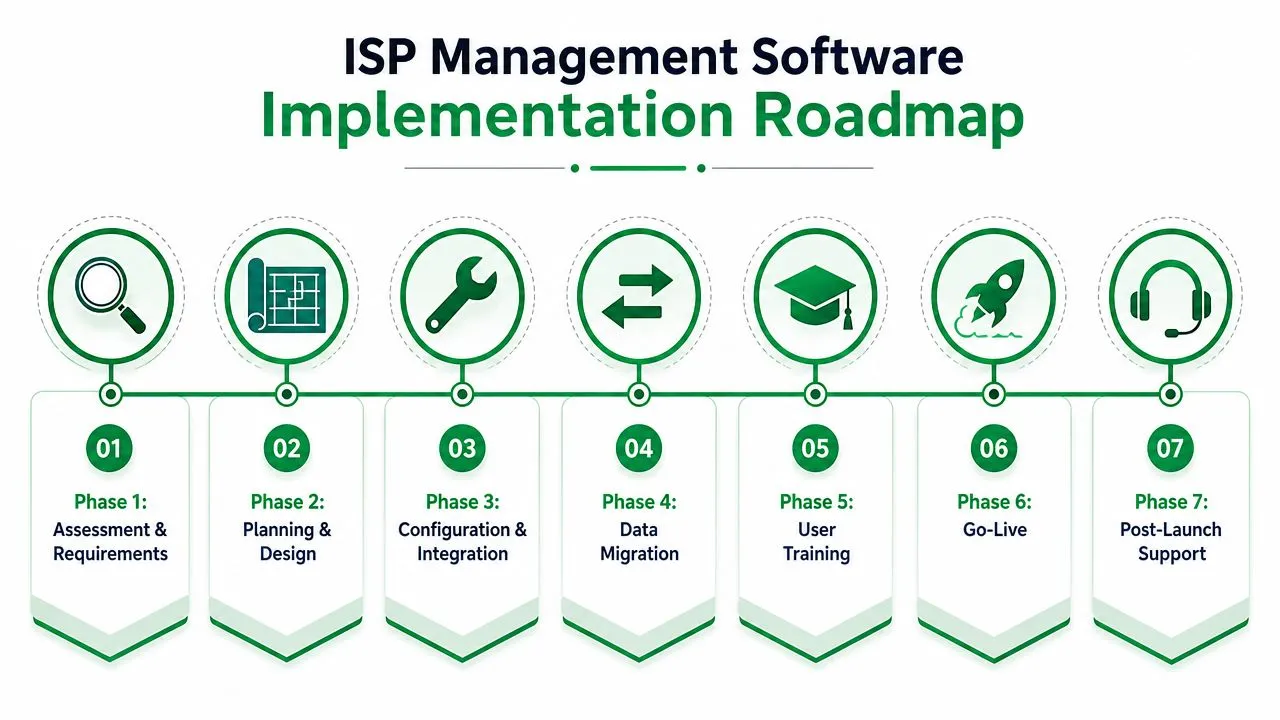
A software migration fails when the team treats it as a technical install instead of an operational change. The smoother approach is phased, boring, and disciplined. That's a good thing.
For small and mid-sized Kenyan providers, this matters because the software has to absorb growth in subscribers, locations, and support workload without forcing more admin hiring. That pressure becomes sharper as the market expands and operators move from a handful of sites toward broader coverage, as discussed in this growth-focused ISP tools article.
Phase the rollout properly
A practical migration usually follows this sequence:
- Clean the customer data Remove duplicate records, verify active plans, confirm due dates, and decide which legacy fields matter.
- Define service and billing rules Standardise packages, renewal timing, grace periods, suspension rules, and exceptions before importing anything.
- Configure network integration Connect billing logic to network access. If you run MikroTik, this is where a guide to a MikroTik RADIUS server setup approach becomes relevant to the control side of implementation.
- Set up payments and notifications Test collection flows, payment confirmations, reminder messages, and failure handling.
Pilot before full cutover
Don't migrate everyone at once. Use a controlled pilot group first. Pick friendly customers, one site, or one package family. That pilot should test renewals, suspensions, reconnects, support visibility, and reporting.
A short pilot reveals hidden process issues quickly. Maybe the finance team needs different invoice references. Maybe support needs a clearer account timeline. Maybe engineers want tighter naming rules for packages and profiles.
Run the pilot on real workflows, not just test accounts. Fake data won't expose real operational friction.
Train the team by role
Generic training wastes time. Each group needs a different workflow view:
- Finance staff need invoice handling, payment matching, exceptions, and reporting.
- Support staff need account lookup, service status, payment verification, and customer timeline visibility.
- Network staff need provisioning logic, service policy behaviour, and troubleshooting paths.
The goal isn't just go-live. It's a stable operating rhythm after go-live, with fewer manual workarounds than before.
Driving Growth with Smart Automation
Growth usually breaks an ISP before it rewards it. New sign-ups come in faster than the team can provision them, payment confirmations pile up in WhatsApp, support keeps asking finance to verify balances, and engineers spend too much time reconnecting customers who already paid. Good ISP management software fixes that operating problem by putting billing, collections, customer records, and access control into one working system.
That matters even more for ISPs in Kenya and similar markets, where mobile money is part of daily operations, subscriber growth can spike quickly, and local compliance needs are not optional admin work. A platform has to fit how customers pay, how field teams work, and how network access is controlled. If it does not, staff return to spreadsheets, screenshots, and manual overrides.
The customer impact is immediate. Payment reminders go out on time. Renewals are easier to complete. Support can confirm account status without chasing another department. When billing rules and network actions stay in sync, customers who have paid are less likely to sit offline waiting for a manual reconnection.
If mobile money sits at the centre of your collections process, this guide to ISP billing with M-PESA mobile money integration shows what that setup should look like in practice.
For operators reviewing software options, Centipid Technologies Ltd. provides ISP billing, subscriber management, payments, and MikroTik-based service automation built around the day-to-day requirements of local and regional providers.